How the (closure of the) Suez Canal changed the world

The segment of my January/February container-ship journey I am most anticipating is passing through the Suez Canal.  Here is what Horatio Clare writes about his passage through Suez:

Unfinished wars lie under all our horizons.  The chart on which Chris plotted our approach to the canal shows Egypt, the Sinai, the southern end of Israel an Gaza.  The refinery we saw last night was bombed by the British during the Suez crisis.  During Suez, Port Fouad was the scene of one of the more dubious victories of the French Foreign Legion, which fought its way through the little town, taking no casualties while inflicting many.  The lake we float on now was home to the ‘Yellow Fleet’: a convoy of merchant ships trapped by the closing of the canal in 1967 during the Six Day War.  They remained at anchor, blown over with desert sand, until the canal reopened in 1975, when only two of them were able to leave under their own power.  One of Yellow Fleet, African Glen, was sunk during the battles of the Yom Kippur War in 1973.  The crews trapped on the Great Bitter Lake had a terrifyingly good view of this war: the canal was one of the front lines and the counter-attack which eventually ended the conflict began with Israeli tanks crossing into Egypt at Deversoir, at the northern end of the lake (pp. 82-83).

The Suez Canal was closed twice.  Once when Israel/UK/France attacked Egypt in 1956, and a second time when Israel attacked Egypt and the rest of its neighbours in 1967.

Although the 1956/57 closure (between November 1956 and just before May 1957) was much shorter, its effect was somehow more dramatic.   The British still held much colonial real estate in the region, and controlled the flow of oil from Iran (post-1953 coup), Iraq (pre-1958 revolt), Aden, and of course the Trucial states.  Their regional base had only recently (1954) shifted from the banks of Suez to Cyprus, and their domestic economy was only just recovering from the effects of the Second World War (there was still rationing of food, petrol and various other necessities).  The French had recently had to deal with the independence of Morocco and Tunisia, were embroiled in their pacification of Algerian revolt (which they blamed on Nassser), and had been actively allied with Israel, providing it with the nuclear expertise and materiel that were to form the core of Israel’s nuclear weapons capability.

A great deal very good work has been written about the 1956 war – and its connection to Hungary; the deeper embedding of the Cold War; the entrenchment of Israeli internal apartheid and regional power [despite its brief humiliation by the US]; the transformation of Gaza; the massive transformation of the Middle East; the overthrow of pro-British regimes in Iraq and the rest of the Arab world; the start of the anticolonial movement in Aden; and so on.  I have found a lot less material about the actual echoes of the closing of the canal on the region and in the world.

The closure of the canal was a massive shock to the system to the British and the Europeans.   Everyday consumption patters in Europe began to change.  The New York Times headline of 1 January 1957 says it all: “British Tea Habit Is a Costlier One: Shipping Rates Due to Suez Closure Cited–Sugar and Milk Also Are Going Up; Route Around Africa Costly; Vast Quantity Is Consumed.”  Petrol had to be rationed in the UK.  There was even a spike in emigration from the UK to New Zealand, Australia and Canada, as there were layoffs and factory closures because off shortage in oil (New York Times 7 December 1956).

The oil that had flown from the Persian Gulf via the canal to Europe suddenly had to be rerouted around the Cape of Good Hope.   So did other supplies.  Suddenly Cape Town in South Africa was bustling with meat supplies being routed to the Cape from Rhodesia, in order to feed the masses of sailors now arriving in the port.

The effect of the closure is certainly electrifying.  The US -despite the massive slap on the wrist it gives the UK, France and Israel- nevertheless brings ships out of mothballs to transport coal to the UK.  Suddenly, questions of economies of scale means ship-building investment pours into supertankers -those VLCCs and ULCCs- which are to become the sine qua non of the oil industry.  Discussions about pipelines flare up.  The European states look to extracting West African and North African oil.  Although Levinson’s wonderful book about the birth and life of containers says nothing about the Suez closure of 1956 and focuses primarily on the labour contention around the unloading of ships (which acted as a spur for inventing a mechanism that decreased the need for militant dockside labour), I am sure the efficacy of transport and economies of scale  -that was suddenly made so urgent because of Canal closure- also played a role in the invention of the container ship.

Fast forward a decade.

Israel began the 1967 war on 5 June with aerial assaults on Egyptian airfields. On 6 June, Gamal Abdal-Nasser closed the Suez Canal.  As the New York Times wrote the next day,

For a ship traveling from the Persian Gulf, where many of the Arabian oil ports are, to Britain and Western Europe, the voyage around the southern tip of Africa will take 16 days longer, add 4,800 miles of travel and increase the overall cost of the voyage by as much as $20,000 [approximately equivalent to $142,000 in 2014].

The Times estimated that of the 50 ships passing through the Canal in 1966, half were oil tankers.  Italy and France were most directly affected (as 60 and 39 percent of their oil respectively came through the Canal), while “Britain, which depended on Canal shipping for 60 percent of her oil 10 years ago, now has cut that total to 25 percent, primarily because of new African sources of petroleum.” By the end of July, the cost of purchasing tankers had already increased, and the shipping rates had doubled for some tankers carrying oil, with the “Persian Gulf-to-Britain run… most severely affected”;  further increases were being forecast for the autumn (NY Times 23 July 1967).  There are also indications that Iranian oil began to find itself East Asian customers, particularly in Japan, whose economy was massively taking off.  Incidentally, the opening of container-shipping routes to the US during the Vietnam war (as recounted in the wonderful Levinson book) and this shift of preferential sales of oil to Japan in the late 1960s and 1970s must have had a major impact in the meteoric rise of that country’s economy.

By October, 300,000 Egyptians had been evacuated from the villages and towns near the Canal, with New York Times reporting that “Ismailia, a city of 100,000, where the Suez Canal authorities maintain headquarters, was reported by visitors there this week to be virtually deserted” (22 October 1967).

The closure of the Suez Canal had massive influence on the Indian economy (if the profusion of articles in Economic and Political Weekly is an indication) and was a boon for South Africa.  Innovative modes of oil-swapping became an order of the day: for example, USSR would provide oil to Kuwait and Abu Dhabi’s customers in Western Europe, while the two Arab emirates supplied equivalent amounts of oil to USSR’s customers in East Asia, in lieu of Soviet oil transport via the Canal.

And then there is one Bernard Lewis, writing in Foreign Affairs:

In May 1967, the prospects for a southward expansion of Soviet influence seemed excellent. In Somalia, the Soviets were already strongly entrenched and were encouraging Somali irredentist claims against both Ethiopia and Kenya. In southern Arabia, British rule was coming to an end, and there was no reason to doubt that it would be followed by a regime closely linked with Cairo and thus also with Moscow. With the coast from Hodeida to Aden under their control, the Egyptians would not have needed to trouble themselves with the Yemeni interior. With the Suez Canal and Aden at its disposal, the Soviet Navy would soon have established supremacy in the Red Sea, and the regimes on both shores would have been due for realignment or replacement. The way was open to further penetration in southern and eastern Arabia, and especially in the Gulf, where Iraq was already in the revolutionary camp and Iran could be isolated and threatened at its weakest point.

All this was stopped by the June war.

Read that again: “All this was stopped by the June war.” He goes on to explain:

With the closure of the Canal, Soviet naval activity east of Suez was severely limited; the Egyptians withdrew from the Yemen, and the ripe plum of Aden fell to the ground and was not picked. The Somalis, deeply discouraged by the Soviet failure to help the Arabs, decided that irredentism with Soviet support was unsafe, and, since war was not practicable, they proceeded with unusual logic to make peace. In the Gulf, in Arabia and in North Africa, the conservative forces rallied, and the Arab monarchy were even able to impose a halt in subversion on an Egyptian Government that was now financially dependent on them.

If 1967 was significant it wasn’t because of the usual canard peddled by the likes of Fouad Ajami about the growing revulsion of Arabs towards Arab nationalism – it was because the closure of the Canal and 1967 more broadly marked the pivotal moment during which the counterrevolutionary and reactionary forces that so often served (and were protected by) the imperial powers got the upper hand.

It took some 8 years, the War of Attrition, and the 1973 War, plus an intensive dredging operation before Suez was opened on 5 June 1975.  If you go to page 67 of this issue of Popular Mechanics, the story of the dredging and clearing of the Canal is beautifully presented with loads of useful photographs and illustrations (also see The National Geographic on the same subject).

There is also a rather sweet side story which is just begging a documentary film (there is a good radio documentary on the subject which is sadly not available online).  Some 15 ships were crossing through Suez when the 1967 War started and the Canal was closed.  One of the ships, MS Observer, was trapped in Lake Timsah (love the name of the lake), while another 14 ships were trapped in the Great Bitter Lake (also love the name of this lake).  The sailors trapped on the 14 ships formed the “Great Bitter Lake Association” for mutual aid and support.  The GBLA even issued its own stamps (which it seems some kind-hearted souls in the Egyptian post office had even acknowledged as proper postage, allowing postcards and letters marked with the DIY stamp to go through to their destinations).  The sailors remained onboard their ships for a couple of years, but by 1970, most countries decided to abandon the ships, and the fleet, blown over by the Sinai sand became known as the Yellow Fleet.  When the work of clearing the Canal began in 1974, and once the Canal was made safe from scuttled ships and mines, only two of the Yellow Fleet could sail the Canal under their own steam, both of them German ships which arrived in Hamburg to great fanfare.

The opening of the Canal, coming as it did on the heels of the 1973 cartelisation of oil production by OPEC- was a kind of foreshadowing of Camp David and really the death knell of the era of decolonisation – at least in the Arab world.

Suez now allows both supertankers and very large container ships, and at the time of the Arab uprisings of 2011, around 1.8 million barrels per day of crude was transported through Suez.  Fears of closure of the Canal was part of the reason given by the Mubarak security forces for extra harsh crackdowns in the city of Suez, and the popular anger there -resulting in the burning down of most police stations there- was itself a response to regime brutality.  Much of the business news of the uprisings around that time voiced anxieties about the closing of Suez, and its effect as a chokehold on oil transport.

But in throes of a delusion of grandeur and fantasies of Nasseresque myth-making, Egypt’s Abdal Fattah Sisi has his own Suez plans, a kind of $4 billion works project of digging a new canal that will provide employment, while giving the Egyptian military (likely to be in charge in some way of construction) yet further capacity to consolidate.  As to whether this military-infrastructural Keynesian project will come off is still open to speculation,  but what will a second Canal mean for the complex palimpsest of relations -oil extraction, trade, infrastructure construction, insurance, and finance- and networks of geopolitics it will inevitably entail?

Update: The Guardian reports that 1500 Egyptian houses have been demolished without payment for the new Suez project.

Posted in infrastructure, Middle East, militaries, political economy, ports, shipping conditions, ships, transport, war | 4 Comments

The Uses of Shipping Containers

There is a deep fascination with shipping containers… The best reading on all of this is of course the classic The Box  by Marc Levinson – but recently there are a lot more links.  Here are a few more:

This piece on the 60th birthday of the container – including great conversations with a longshoreman, a beachcomber, the owner of a restaurant made out of a shipping container, and with Alex Colas and Saskia Sassen- is by Tristan Stewart-Robinson.

This news item from the BBC is about the uses of shipping containers as instruments of policing.  And this one is about the shipping container as a vehicle of migration.

And architectural gems made from shipping containers seem to capture people’s imaginations.  And this one.  And this one too.  And the other uses for containers.  And this one too.


Posted in infrastructure, political economy, shipping conditions, transport | 1 Comment

Become a Sea Against Imperialism

Given the centrality of the sea to the work of colonisation and empire, I love this Turkish graffito my friend Pascal photographed in Istanbul:

The sea is against imperialism


Update: Pascal’s friend says this Deniz is Deniz Gezmiz… Good pun, in that case!

Posted in empire, imperialism & colonialism, the sea | 1 Comment

By the Sea

A truly beautiful book, Abdulrazak Gurnah’s By the Sea is full of quiet insight about leaving home, about families, about illegal immigration, and about malice.  It has a brilliant humour.  Here is a bit about  a madrasa, a chuoni on the island of Zanzibar:

Chuoni, that was where we went to learn the aliph-be-te so we could read the Koran and listen to the miraculous events which befell the Prophet throughout his lifetime, salallahu-wa-ale.  And whenever there was time to spare, or the heat was too great to concentrate on the nimbly curling letters on the page, we listened to stories of the hair-raising tortures that awaited us after death.  Nobody bothered with age in chuoni.  You started more or less as soon as you were toilet-trained and stayed there until you could read the Koran from the beginning to end, or until you found the nerve to escape, or until the teachers could no longer bear to have you around, or your parents refused to pay the miserable pittance which was the teacher’s fee.  Most people had made their escape by the age of thirteen or so (p. 36).  

It is a truthful book unlike most other books about exile.  And the malice can escalate from the petty to the operatic in a few devastating and beautifully described steps.    There is so little nostalgia here about “home”:

I’d forgotten so much… Willfully, I suspect.  I mean that I willfully forgot so much.  I was listening to you and thinking, Lord, that’s what it was like. That is precisely how it was.  All that bickering and pettiness.  All that insulting.  Old people with their unending grudges and their malice.  That was what it felt like as a child, whispers and accusation, and complicated indignations that stretched further and further back all the time (p. 193).

And later the same narrator says,

When I escaped from GDR, I  never wrote to them, and I guessed that they would not know where I was so they would never be able to write to me. I wanted nothing to do with them, and their hatreds and their demands. Their hatreds of each other, the hatreds that made him rant and mumble and fall into that corrosive silence  of his. I know you’re not supposed to be able to say that about your parents, but it was a bit of luck, being able to escape from the GDR into a kind of anonymity, even to be able to change my name, to escape from them. To be able to start again. You know that fantasy? (p. 239).

And you think wow. This is on the one hand about the myth of starting over and on the other hand it doubles back on itself and gently chides itself.  The chiding is done by the other narrator (there are two – and there are millions of stories within stories):

I marvelled at [his] sternness about his parents, not because it was inconceivable from so far away, where the insistent demands of intimacy can be deflected with silence, but because I wondered about the price he would have to pay for his perverse triumph, and how much those looks of pain owed to the inevitable distress and guilt he would feel (p. 239)

Oh my god, the gentle but lacerating insight that stays with you.  Much critical theory has questioned the (im)possibility of love’s “insistent demands of intimacy” – I was only today reading Marcuse’s Eros and Civilization, where he brutally makes love the compromise we make when we give up the free play of sex:

Love, and the enduring and responsible relations which it demands, are founded on a union of sexuality with ‘affection,’ and this union is the historical result of a long and cruel process of domestication, in which the instinct’s legitimate manifestation is made supreme and its component parts are arrested in their development.  Thus cultural refinement of sexuality, its sublimation to love, took place within a civilization which established possessive private relations apart from, and in decisive aspects conflicting with, the possessive societal relations….  The full force of civilized morality was mobilized against the use of the body as mere object, means, instrument of pleasure; such reification was tabooed and remained the ill-reputed privilege of whores, degenerates and perverts (pp. 200-201).

And of course in a funny and provocative exchange with Michael Hardt, Lauren Berlant suggests that there are “other modes of relating,”

the ones involving proximity, solidarity, collegiality, friendship, the light touch and intermittent ones, and then the hatreds, aversions, and not caring (the pleasure of the city: to be proximate without a plan) (p.687).

But back to Gurnah’s By the Sea.  This is a book that accumulates inside your capillaries, under your skin.   You remember images from it when you are doing something entirely unrelated.  Phrases come back insistently.  That fragment I have bolded above is just so beautiful, so heart-breaking, so true.

And he has extraordinary passages about detention camps on islands and in Tanzania, where without much sentimentality or using the vocabulary of trauma he recounts the indignity, the horror of such postcolonial brutality and political malice.  Many of the island detainees are people designated as Omanis:

The government had been using the island as a detention centre since independence. They rounded up whole families of people of Omani descent, especially those who lived in the country or wore beards and turbans or were related to the ousted Sultan, and transported them to the small island some distance off shore.  There they were detained under guard, until eventually, several months later, ships chartered by the Omani government took them away in their thousands.  There were so many of them that it was weeks before the ships stopped coming.  It was known that there were still some people detained there.  The whole island was out of bounds to visitors, so what was known about what happened there relied on rumour and a photograph snapped by someone unknown and printed in a newspaper in Kenya.  It showed a scene which was not unfamiliar from press photographs of other disasters – a crowd of people squatting on the ground, some of them with heads bent, some looking towards the camera with tired melting eyes,some with cautious interest, bearded men capless and worn out, women with heads shawled and eyes cast down, children staring (p. 222).

And the bits about both of the main characters’ illegal immigration into the UK (both as refugees, one during the Cold War, one long after) are gently, beautifully rich and point to the diminished possibilities and futures of such migration as decades have gone by.  Here, there is no sentimentality either, no inevitable goodness in victimhood, nor any extravagant virtue in halfhearted hospitalities.

But the book also has lovely sketches of how the sea was woven into the lives of the Zanzibaris:

A nahodha (a ship’s captain) cut a figure in the streets, a man of the sea striding about, attending to merchandise and technicalities, calling and urging porters and crew before the tide turned or the wind dropped.  When he walked past, going about his affairs, people greeted him and called out to him, sometimes by name and sometimes by his calling (p. 177)

It definitely reminded me of the Villiers memoir of sailing on a dhow from the Arabian Peninsula to the east coast of Africa.  And “the traders and the sailors who came during the musim were an uncouth and rough-hewn riff-raff, although this is not to say they did not have a decorous integrity of their own” (p. 21).  He has more to say about them

For centuries, intrepid traders and sailors, most of them barbarous and poor no doubt, made the annual journey to that stretch of coast on the eastern side of the continent., which had cusped so long ago to receive the musim winds.  They brought with them their goods and their God and their way of looking at the world, their stories and their songs and their prayers, and just a glimpse of the learning which was the jewel of their endeavours.  And they brought their hungers and greeds, their fantasies and lies and hatreds, leaving some among their numbers behind for whole life-times and taking what they could buy, trade, or snatch away with them, including people they bought or kidnapped or sold into labour and degradation in their own lands.  After all that time, the people who lived on that coast hardly knew who they were, but knew enough to cling to what made them different from those they despised, among themselves as well as among the outlying progeny of the human race in the interior of the continent (p. 15).

And there is this  geopolitical story that starts with the Customs Police:

You know, the people who stand at the harbour gate and search all the vehicles, and keep unauthorised people out, and require a bribe for everything.  You didn’t need to be able to read and write for that kind of a job, a lowly job in most people’s eyes, which I suppose is how Nuhu got it.  I didn’t know he was attracted to that kind of work, unforms and those heavy boots. … Anyway, after a few years Nuhu found a way of leaving, of escaping to God knows where.  He was in a good position to do that,you might think, but in those early years [of mass arrests] the Harbour Police were very vigilant, the ones with guns and powerful motor-boats not the slouching bawabs of whom Nuhu was one. The penalties for attempting to escape were severe then. He must have stowed away in one of the Cargo ships, and to judge by the destination of the ships that used to call on us then, he is now living somewhere in Russia or China or the former GDR. If he survived undetected, or if the crew did not throw him overboard, or if he did not find a way to jumping ship earlier in Aden or Mogadisho, or Port Said (pp.207-208).

And the one unquestionably villainous character in the story is

a Persian trader from Bahrain who had come to our part of the world with the musim, the winds of the monsoons, he and thousands of other traders from Arabia, the Gulf, India and Sind, and the Horn of Africa.  They had been doing this every year for at least a thousand years.  In the last months of the year, the winds blow steadily across the Indian Ocean towards the coast of Africa, where the currents obligingly provide a channel to harbour.  Then in the early months of the new year, the winds turn around and blow in the opposite directions, ready to speed the traders home.  It was all as if intended to be exactly thus, that the winds and currents would only reach the stretch of coast from southern Somalia to Sofala, at the northern end of what has become known as the Mozambique Channel.  South of his stretch, the currents turned evil and cold, and ships that strayed beyond there were never heard of again. South of Sofala was an impenetrable sea of strange mists, and whirlpools a mile wide, and giant luminescent stingrays rising to the surface in the dead of night and monstrous squids obscuring the horizon (pp. 14-15).

But even the villainous trader has a family story that is entirely embedded in and interwoven with the history of empire, of British betrayals and devastations their law and avarice and order caused.  And in this story, the “natives” are not innocent, nor victims, and they are not even strictly “natives” – a Bahraini of Persian origin starting his business in Malaya under the rule of the British has a kind of colonial cosmopolitanism that much history erases (though of course Conrad touches on it in his Lord Jim and so much else).

And then the empire also arrives in the east coast of Africa, along with maps and their magical properties:

Then the Portuguese, rounding the continent, burst so unexpectedly and so disastrously from that unknown and impenetrable  sea, and put paid to medieval geography with their sea-borne cannons. They wreaked their religion-crazed havoc  on islands, harbours and cities, exulting over their cruelty to the inhabitants they plundered.  Then the Omanis came to remove them and take charge in the name of the true God, and brought with them Indian money, with the British close behind, and close behind them the Germans and the French and whoever else had the wherewithal.

New maps were made, complete maps, so that every inch was accounted for, and everyone now knew who they were, or at least who they belonged to. Those maps, how they transformed everything.  And so it came to pass that in time those scattered little towns by the sea along the African coast found themselves part of huge territories stretching for hundreds of miles into the interior, teeming with people they had thought beneath them, and who when the time came promptly returned the favour.  Among the many deprivations inflicted on those towns by the sea was the prohibition of the musim trade.  The last months of the year would no longer see crowds of sailing ships lying plank to plank in the harbour, the sea between them glistening with slicks of their waste, or the streets thronged with Somalis or Suri Arabs or Sindhis, buying and selling and breaking into incomprehensible fights, and at night camping in the open spaces, singing cheerful songs and brewing tea, or stretched out on the ground in their grimy rags, shouting raucous ribaldries at each other (pp. 15-16).

The rhythm of the sentences and their force that carries them forward and forward and forward until we arrive at independence – and then the darkness of betrayals and cruelty after independence.  I now have to read his Paradise.

Posted in empire, imperialism & colonialism, ports, readings, seafaring, the sea | Leave a comment

Hitching a lift on a US aircraft carrier

The Super Hornet bombers that dropped 8 500-pound JDAM bombs on Islamic State forces in Iraq had flown from the aircraft carrier USS George H W Bush, afloat in the Persian Gulf.  It is one among at least 5 Navy ships and 3 ships belonging to the US Marines in the Gulf right now.

The news struck me because I had just finished Geoff Dyer’s Another Great Day at Sea, his account of a writer’s residency aboard the same ship.  Rose George and Horatio Clare inter alia have recently written about their adventures aboard freighters (though George also embedded in a EU-NAVFOR ship policing the waters off Somalia).  There is a kind of not-so-subtle upmanship in Dyer’s two-week stint aboard a United States Navy aircraft carrier somewhere in the Persian/Arabian Gulf.  He specifically avoids a Royal Navy ship, because he fears “the accents, the audible symptoms of the top-to-bottom, toff-to-prole hierarchy that is so clearly manifest in the British military.”  There is such a HUGE amount of love for the US and its citizens (especially the martial ones) in this book it sometimes feels uncomfortable.

This definitely is a love song to the American military and it reminds me of the way another of Dyer’s compatriots also feels this pure unadulterated love for Americans in uniform.  At the height of the US war in Iraq, British counterinsurgency humanitarian, Emma Sky, a civilian advisor to General Odierno in Iraq was quoted by Tom Ricks as saying “the military is better than the country it protects. “That’s the way I feel about it – America doesn’t deserve its military.”” Dyer must feel the same;  his Americans can do no wrong.  They are better-mannered, more attractive, more egalitarian, friendlier, more ambitious; they even walk more attractively.  He says somewhere something about the loose-limbed confident way Americans walk (and which he attributes to the performative of African-American men’s walk having been absorbed into the general culture).  As I was reading that particular section incredulously, I thought of Chimamnda Ngozi Adichie’s Americanah, in which the African immigrant woman in the US actually reflects in an amused if affectionate sort of way on the strangeness of the American walk.

Maybe it is the unapologetic love for the US and for the sailors he encounters here that makes Dyer’s book remarkably devoid of a political context or a critical examination.  Dyer flies to the aircraft carrier from Bahrain and at some points  in the story, the ship is only 30 miles from the Iranian coastline, and there are fighter jets flying reconnaissance flights to Iraq or points further afield, and yet we get no sense that the warship is in the Persian Gulf.  Maybe he is trying to authentically convey the feel of being aboard what is essentially a floating small-town America, but I think it goes beyond that.  There is also no politics in the book.  He mentions the killing work of the US Navy only in passing and when the Iranians are mentioned he is flippantly making a wish for Ahmadinejad to magically appear on board so some woman sailor can kick his ass.  This utter and complete absence of politics is all the more galling given that Dyer is aboard a ship in a part of the world in which the US has wreaked such death, destruction and violence that we still feel the seismic effects of it so many years later.

Essentially, this is a book about Geoff Dyer, and if you are a Geoff Dyer fan (as there seem to be legions out there) then you will enjoy the painful self-deprecation and the forced humour.  But other than the fiery evangelical faith of his shipboard interlocutors nothing ruffles Dyer; he is an atheist and except for a fervent profession of faith, he finds nothing worthy of criticism. The ship portrayed in Dyer’s book is a kind of utopia in which there is no racism, no sexism (he does dutifully footnote sexist incidents in the Navy), and other than differential access to good food, no inequality.

Some of the passages in the book are of some interest: how crowded the carrier is (p. 21); how much food it carries to feed the crew (pp. 26-30); the processes of landing and takeoff that seem a terrifying test of technical knowhow and minutely planned organisation; the proliferation of acronyms (p. 22); and… that’s it really.  There are a lot of personal vignettes about the characters onboard, but if you want to learn about what it means to be on a warship, the 3/4 of a chapter by Rose George in her Deep Sea and Foreign Going contains far more technical and political information and opinion than the whole of Dyer’s 188 pages.

Don’t bother reading it if what you want is more than human interest stories about the members of the US military.  Certainly not if you want to know about the Persian Gulf.  In Dyer’s book, USS George H W Bush might as well be sailing on Mars.

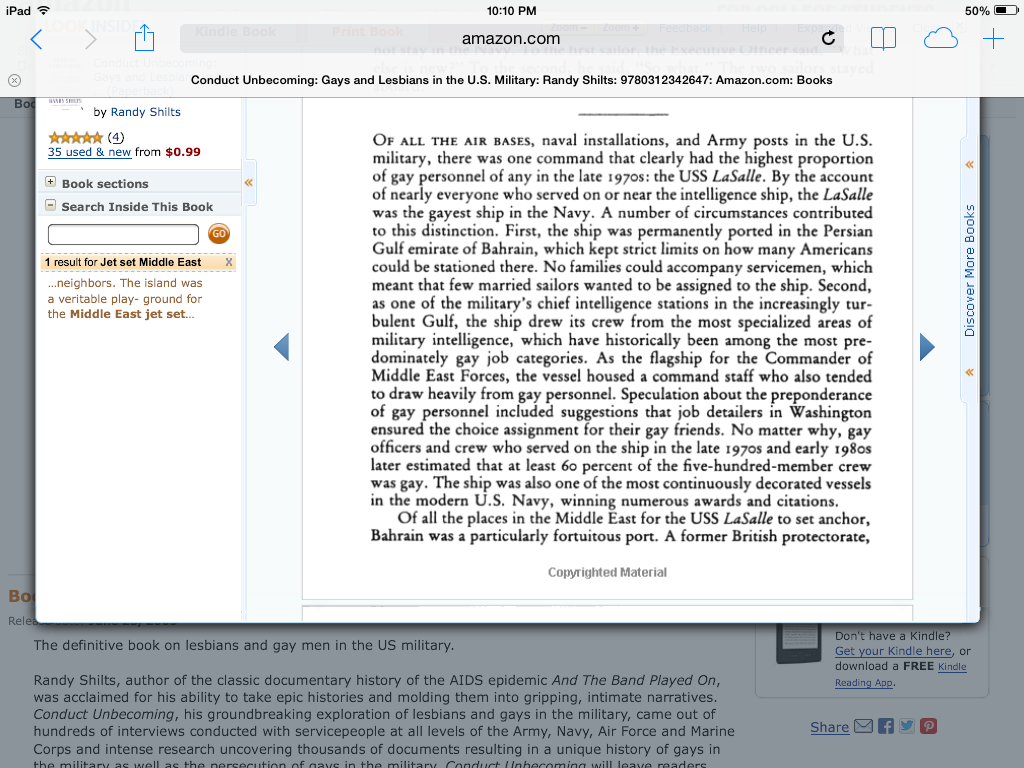
Update: I forgot to add that the book also says very little of homosexuality onboard.  Meanwhile, my friend Waleed sent me this screenshot about another ship in the Persian Gulf:

USS La Salle


Posted in Middle East, militaries, readings, ships, war | Leave a comment

The docks as a non-place

Francisco Goldman and Jean-Claude Izzo speak to each other through their respective novels, The Ordinary Seaman and The Lost Sailors.  Both are stories about waiting in the docks, literally, in a floating metal tub full of holes.  Both tell stories within stories within stories – which is what you do when you are waiting.  And waiting.  When you are on the sea “only leaving has any meaning. Leaving and coming back.”  That is what Izzo writes.  Goldman’s sailors don’t so much wait as endlessly labour for no pay at all. Izzo’s boat, Aldebaran, owned by Greek crook, is crewed by a broad mixture of people when it is impounded at the port of Marseille.  Only three people remain onboard, the Lebanese captain, Abdul Aziz, the Greek first mate, Diamantis, and a young Turkish sailor, Nedim. Goldman’s boat, Urus, is owned by a mysterious owner, with a crooked captain and first mate, and crewed by many a first time sailor from Nicaragua and other Latin American countries, with Esteban (a former Sandinista soldier) and Bernardo (a one-time ship’s waiter who has returned to sea with romantic memories and unreasonably high opinion of British captains) the most memorable among them. Both books portray the ports at which their boats are beached affectionately, generously, expansively, and with a great deal of inside knowledge.  The Marseille of Izzo is often -no, always- the prime protagonist of his books.  The Brooklyn of Goldman is the borough most people don’t often see: of proyectos, working class neighbourhoods, and wind-blown and debris-strewn abandoned docks:

Here and there masts, derricks, and the bristling tops of monumental ships’ superstructures protruded over the roofs of numbered terminal buildings.  Motionless cargo cranes against the sky.  Parked truck cabs. Sheds and warehouses with aluminum siding.  A man driving an empty forklift out from behind a long row of containers.  It was Sunday evening; perhaps that was why there didn’t seem to be much going on.  But El Pelos kept on driving for a surprisingly long time, deep into what seemed to be a deserted and apparently defunct  end of the port, where the buildings were much older, abandoned looking, made of crumbling brick and concrete.  Sandy wastes of weeds and built-up earthworks suddenly opening on a patch of beachfront fronting a long, broken pier. A smashed, hollowed-out car chassis in a rubble-filled lot.  They passed a small, listing old freighter apparently resting in eternal dry-dock inside a fenced-in, overgrown, scraggly-treed yard, leafy squirrel nests in the conning tower and a squat black dog barking at them from the bridge, an inner tube hung with rope from a bridge wing.  An elephantine warehouse built of tattered gray wood, an emptiness of darkening sky and water glowing like a movie screen through huge, gaping doorways (pp 18-19).

The stunningly evocative passage comes from Goldman’s novel, and he manages to convey a sense of the place so incredibly well.  There were bits of this which reminded me of the older break-bulk and ro-ro part of the Beirut port.  Anthropologist Mark Augé has a little essay called Non-places which Goldman’s description (and my memory of Beirut) recalls.  Augé’s essay is as much about the object of anthropology as about the non-place places upon which he reflects, but he describes non-places as “formed in relation to certain ends (transport, transit, commerce, leisure)” (94),  and though they are the generic spaces of the transnational, they are directly in relation to the ever concrete imaginations of a heimat, “of the land and roots” (35).  {I should mention at this point, that Augé has a second designation for non-place in mind which is just as relevant to Goldman’s Brooklyn docks: non-place also designates not just the spaces defined as above, but also “the relations that individual have with these spaces.”} If Goldman and Izzo sketch a Brooklyn and a Marseille that are alive; heaving, violent, capitalist, bloody, smelling, dirty, but alive; the desolate docks Goldman beautifully draws are non-places.  Augé’s primary non-places are in fact spaces associated with transport:

The installations needed for the accelerated circulation of passengers and goods (high-speed roads and railways, interchanges, airports) are just as much non-places as the means of transport themselves, or the great commercial centres, or the extended transit camps where the planet’s refugees are parked.  For the time we live in is paradoxical in this aspect, too: at the very same moment when it becomes possible to think in terms of the unity of terrestrial space, and the big multinational networks grow strong, the clamour of particularisms rises; clamour from those who want to stay at home in peace, clamour from those who want to find a mother country (34-35).

And both Izzo and Goldman convey this tug and pull of particularism of a place (of homes in Greece and Turkey and Lebanon and Central America) and of the non-place this is the ship, or the interstitial no-man’s-land of being literally between borders in a non-place. The books work very differently.  Izzo’s story is a bit like his police procedurals, full of mysteries whose resolution is bloody and devastating.  Goldman’s novel proceeds slowly, and is as much a story of home as it is a story of homelessness on the sea (or at the docks).   They are both political novels though, with the leftist inclinations of both authors clear in the way they account of political cataclysms of their time.  And the villains in both are crooked shipowners perpetrating frauds on insurance companies but even more horrifically on their crew and officers. Rather strikingly, both Izzo and Goldman don’t have distant villains. We learn enough about the villains either directly or through the swirl of stories that they are not two-dimensional baddies, but quite complex CAPITALISTS.  Because that is also what both authors manage to convey: the enmeshment of ordinary bodies in the machine and the machine’s overwhelming ability to wipe out friendship, and loyalty, and virtue, and honour. The books are also about other things however.  Inevitably, stories whose main protagonists are male sailors are also going to be about masculinity.  And there is a lot of thinking through and describing of a broad range of masculinities here.  There are ways in which both Izzo and Goldman are alive to the way manhood is understood and performed, and its nuances and variations that feels both pleasurable and ethnographic (and I mean that in a very complimentary sort of way).  Here, in both stories, are men who have been soldiers and mechanics and cooks and waiters.  Men who are lovers and fathers and fighters.  Men who have been jilted, who are desperate for love, who are comfortable in a fight – or humiliated in the throes of a beating.  There are so many ways to be manly in these stories – and the authors are gentle, probing,and leaving enough to imagination and sympathy as to allow ways of thinking about how class, race, and geopolitics shape the contours of masculine sentiment and practice. But the books are also ultimately about loneliness.  There is a sense of solitude pervading both stories, a kind of melancholic reflection on the world of work in a non-place, of abandonment and precarity by a ravenous and rapacious economic system of exploitation.  And here again, Augé:

A person entering the space of non-place is relieved of his usual determinants. He becomes no more than what he does or experiences in the role of passenger, customer, or driver. . . . The space of non-place creates neither singular identity nor relations; only solitude, and similitude. There is no room for history unless it has been transformed into an element of spectacle, usually in allusive texts (103).

Although, I suppose, it is ultimately the wonder of both Izzo and Goldman that they rescue their wonderful characters from the ignominy of facelessness that Augé writes about, assigns them stories and histories, and allow them to breathe the sea air, however polluted it may be.

Posted in capital accumulation, labour, logistics, ports, readings, seafaring, shipping conditions | Leave a comment

Rime of mariners ancient or modern

I think I read the Rime of the Ancient Mariner some years ago when i was young, but like a great many great works of literature, it is a poem that is wasted on the youth.  Its sense of regret, loss, of cussedness, of deadened lives and of an anxiety so overwhelming that cannot be overcome are well transmitted through the rhythm and imagery and colour of the poem.

There is the moment of arrival in a windless sea which reminds one of the cursed ship in Conrad’s The Shadow Line

We were the first that ever burst
Into that silent sea.
Down dropt the breeze, the sails dropt down,
’Twas sad as sad could be;
And we did speak only to break
The silence of the sea!
All in a hot and copper sky,
The bloody Sun, at noon,
Right up above the mast did stand,
No bigger than the Moon.
Day after day, day after day,
We stuck, nor breath nor motion;
As idle as a painted ship
Upon a painted ocean.
Water, water, every where,
And all the boards did shrink;
Water, water, every where,
Nor any drop to drink.

Even the sense of loneliness is the mariner is replicated in the helplessness of a captain all whose crew is ill:

Alone, alone, all, all alone,
Alone on a wide wide sea!
And never a saint took pity on
My soul in agony.

And the leaden sky and sea, and the sense smell sound of pestilence upon the sea and on the ship which Coleridge so beautifully describes are replicated in that scene of a leaden windless cursed sky in The Shadow Line.

But there is now a Rime of the Globalised Mariner, which I first heard about on Laurie Taylor’s show.  This one is slightly different: it is less about the psychic life of seafaring and more about its sociology.  There is a chorus of MBAs, and instead of a wedding guest listening to the story, the audience is a “Consumer” on his way to B&Q.  Michael Bloor’s poem is a tongue-in-cheek rendering of the curse of the ship, but entirely in a contemporary context.  In this rime, there is a ship’s inspector as well – alongside the Filippino sailor- who tells us and the Greek Chorus about the complexities of a life of labour on the sea.

And we get to hear about flags of convenience, and Minimum Manning laws, about outsourcing and underpaid crew – all terrain of struggle between the maritime workers and the ship-owners.

Michael Bloor, who is a research professor at Seafarers International Research Centre at Cardiff University, has spent a lifetime researching the conditions of work for seafarers, and the note that accompanies the poem (at the above) has a very useful and lucid explanation of how the industry has divided the various elements of shipping into every more specific businesses -ship-owners, and ship-operators, agents, recruiters, charterers and so on – thus diffusing responsibility, destroying any idea of transparency, and resulting in a total absence of any accountability.  Bloor gives an example:

As an illustration, when the tanker ‘Erika’ foundered in 1999 and polluted 400 km of the French coast, it was being re- let by an Italian ship management company (‘Panship’) to another operator (‘Amarship’), the main charterer (Totalfina) had re-let on a time charter to the Bahamas-based ‘Selmont International’, and the registered owner was a single-ship Maltese Company (‘Tevere Shipping’) although it ultimately emerged that the ‘beneficial owner’ was the London-based ship-owner Giuseppe Savarese, who had bought the 24-year-old tanker with a loan from the Bank of Scotland (OECD, 2001b: 30-33).

Ports are just as complex a set of operating spaces.  Not to mention the processes of their construction, financing and insurance.  Should be a lot of fun researching this!

Posted in capital accumulation, infrastructure, labour, logistics, political economy, readings, seafaring, shipping conditions, transport | Leave a comment

A love story far from the sea

This beautiful little love story has some extraordinary bits about the Syrian revolution, the subsequent civil war(s), love, families, sectarian sentiments, and the sea:

On the second day of Ramadan, I come home from work to find Jesus, Maalik, and Qais sitting on the back steps, vaguely matching in short-sleeved plaid shirts, whiling away the last of their 17-hour fast by enumerating the current staggering prices of refrigerators, meat, and bread in Syria. Turkish versus Syrian price comparisons is another sideshow.

But always their talk returns to the sea. What size house you could buy after working for two months as a captain. How much money a tricky crew can embezzle by playing with the fueling log. How maritime insurance companies calculate compensation for a shipwreck (by the weight of the sunk iron). How many ships total there are in the world. How many in Syria, in the possession of Syrians: they start listing family names.

Jesus is the expert, reeling off wages: that of an uneducated seaman and of an educated one, of a captain, a first mate, and the local pilot who must, under maritime law, be the one to steer an arriving ship into port: that guy makes a killing. But on the long stretches of ocean between berths, newer ships are steered automatically, by CD.

“Soon we will all be replaced by CDs,” Jesus adds wryly.

For Qais, Jesus is a visitor from a world to which he longs for admittance. Qais’s dream is to follow another of his older brothers out to sea. Though this brother made a shrewd detour in 2011, deserting ship sans passport, and is now an asylee in a small, orderly EU member state.

Like him, Qais studied maritime engineering–this is how the two-year vocational course translates into English—and dreams of traversing the globe in a vessel he can keep running with his own know-how. But the Syrian shipping business shrank as the revolution picked up steam, and after receiving his laminated course certificates, he could find no ship to take him.

In Istanbul, he rouses himself from speechlessness only to enumerate kinds of sea-faring knowledge. At a café overlooking the Bosphorus, he displays “SOS” for us unbidden, using a Morse code phone app he’s installed on his phone, the distress signal flashing out across lit bridges. He skips most of the Turkish classes Maalik enrolls him in: the language of the sea is of course English. Which he has gleaned from Eminem videos.

The beautiful and strange name of the essay is explained thus:

An inveterate student of history, Maalik is constantly amazed by my ignorance. Among his brothers, he’s the odd son out in his quest for academic knowledge. As the only male interested in such, he was allowed to leave home to pursue it, but his desire is nevertheless inexplicable to his family, who could not understand his stubborn insistence on turning his back on that great provider, the sea.

“It’s the same in my city!” exclaims my friend Suhail when I mention Lattakia’s collective seaward bias. His city is Tartous, the next city of any size to the south and the site of Russia’s only Mediterranean submarine base. “No one goes to school there; people only want to work at sea.”

Indeed, he recalls, when he told his grandmother–”a very special person,” he adds, smiling at the recollection–that he wanted to go off to university to study accounting, she couldn’t place the term.

“Sea accounting?” she asked doubtfully. “You want to be a sea accountant?” To any marine profession she would give her blessing.

“No, grandma, not sea accounting. Just regular accounting,” Suhail said. And this, for several years, she scowled upon–until he had proven that a living could also be made from landlubber figuring.

Sea accounting: more than just a nonexistent profession, it is the mechanism that dictates that the unfamiliar must be bent out of its own shape to be encompassed by the known, contorted in order to be fitted into an identifiable model; it therefore remains unrecognizable and unassimilable on its own terms. Sea accounting maintains the status quo by labeling innovation as anathema.

Posted in Middle East, ports, readings, seafaring, the sea, war | 4 Comments

The Cargo Cults of USA – Part II

In an extraordinary essay titled “The Smell of Infrastructure,” Bruce Robbins argues that the scaffolding of our lives, the infrastructure that carries shit and coal and lobsters and water and electricity is often made invisible. He has a rousing call to arms:

Infrastructure needs to be made visible, of course, in order to see how our present landscape is the product of past projects, past struggles, past corruption—for example, how public transport lost out to the private automobile only because tax dollars were diverted to roads, effectively lowering the price of cars. But we also need to make infrastructure visible as a guide to the struggles of the present (p 32).

That is what John McPhee does in his divine Uncommon Carriers, which is his beautiful ethnography of coal trains and hazmat trucks, river and lake barges, and extraordinarily, of UPS.  I think most of the chapters in this volume have been New Yorker essays, but it’s their adjacency that makes them so powerful.  This is a kind of ballad of transport, a decidedly humanist take on the technological sublime, and although its politics are nowhere as radical as Alan Sekula’s extraordinary work, it carries something of the poetry, something of the humility and curiosity and intelligence that make Sekula’s work so much the best thing there is out there on transportation.

My own favourites in the volume are the chapters on the coal trains – miles long and incredibly powerful- and on the riverine transport.  We learn a lot about how coal trains have become the norm in the central plains of the US. And I was surprised to read that with the mines in Wyoming’s Powder River Basin becoming  “the largest coal mines in the history of the world” (p 194), the decline of rail in the US was arrested; or that “the coal thing would revolutionize American railroads, slow the spread of creeping desuetude, reverse -to a large extent- their antiquation.  Before the end of the twentieth century, it would all but jam solid the busiest trackage”; or that this “was the direct economic result of the Clean Air Act of 1970” (p 193).

The chapter on riverine trade is a beautiful complement to the chapter on rails, not least because McPhee’s direct comparison with the rails reminds me so much of China Mieville’s Railsea (a kind of landbased Moby Dick taking place on a tangled skein of rails):

All day long as I look out from the pilothouse I can’t help thinking, and thinking again, that this river is as natural as a railroad track.  Its corridors are framed in artifice.  The pool above the damn at LaGrange is eighty miles long.  The State of Illinois and the US Army Corps of Engineers have accomplished such extensive alterations that restoration is beyond reason.  [..Within the river’s] straightened sides it is really a canal, and it has been a route of freight transportation since Colonial times. […] Navigational dredging began in the eighteen-fifties, but the rearrangement of nature did not really become earnest until the eighteen-nineties and the early twentieth century, when many hundreds of miles of levees were constructed not only along the river but also around segments of its floodplains -those bottomland lakes, ponds, marshes, and  sloughs- which were drained by a system of ditches and pumps, “reclaiming” acreage for agriculture (p 94).

McPhee writes about the military usage of these rivers, and of course all transportation infrastructure in the US are considered strategic assets [pdf]:

But what really strikes me in the book is the chapter on the logistics firm, UPS:

UPS once leased old gas stations, furnished them with sawhorses under four-by-eight plywood sheets, and used the old gas stations as centers for sorting packages.  How they have the Worldport, as they call it -a sorting facility that requires four million square feet of floor space and is under one roof.  Its location is more than near the Louisville International Airportl it is between the airport’s parallel runways on five hundred and fifty acres that are owned not by the country, state, or city but by the UPS.  The hub is half a mile south of the passenger terminal, which it dwarfs.  If you were to walk all the way around the hub’s exterior, along the white walls, you would hike five miles.  You would walk under the noses of 727s, 747s, 757s, 767s, DC-8s, MD-115s, A-300s – the fleet of heavies that UPS refers to as “browntails.” Basically, the hub is a large rectangle with three long concourses slanting out from one side to dock airplanes.  The walls are white because there is no practical way to air-condition so much cavernous space (p 163).

What is striking about this is the extent to which the infrastructure we consider public is no longer such a thing.  That the ownership of the “public” spaces and access to such ostensibly public goods as airport runways has passed to mega-corporations such as UPS is completely normalised.

McPhee also beautifully conveys the way the space is used inside the UPS hangar has become a kind of a parody of a dystopian vision of industrlialisations, something like Charlie Chaplin’s Modern Times:

moderntimes2

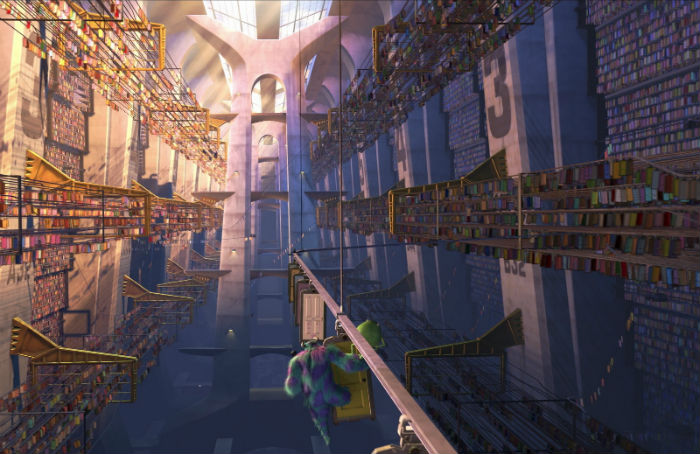
or Monsters Inc.:

MonstersIncVault

Here is McPhee:

A  hundred and twenty-two miles of belts and monorails… You see packages in every direction moving on a dozen levels and two principal floors, which are perforated by spaces that allow the belts to climb to all levels and descend ultimately to the level of the airplanes. Over all, this labyrinth, which outthinks the people who employ it, is something like the interior of the computers that run it.  Like printed circuitry, seven great loops, each a thousand feet around, are superposed at right angles above other loops… Unending sequences of letters and small packages zip around these loops, while the larger packages follow one another on the belts, each package tailgating the one in front of it but electronically forbidden to touch it…. Somewhere around each primary loop is one of three hundred and sixty-four positions where a given parcel will suddenly depart for another loop, where there are three hundred and sixty-four additional positions, at one of which the package will continue its quest to school up with like-minded packages (pp 166-167).

But what is fascinating is something I had no idea about.  That UPS is now expanding into provision of services that have other companies’ names on them (sometimes even, UPS provides these services under nondisclosure agreements): “Over recent years, FedEx, of Memphis, has been chasing UPS in ground transportation of packages with about the same intensity that UPS has displayed in competing with FedEx in overnight deliveries…  The root criterion impelling UPS and FedEx appears to that a healthy business grows, expands, and must go on indefinitely expanding, or it dies” (p 169).  And this expansion entails taking over for repair of Toshiba laptops in UPS hangars, it stores and ships Bentley parts and specialist pet food.  It warehouses and dispatches Jocket underwear.  “UPS calls this relatively new part of its business UPS Supply Chain Solutions” (pp. 171-172).

What is most despiriting in the story McPhee tells is the story of the workers who work for UPS:

Some five thousand workers come nightly to the sort, but few of them ever touch a package, which is largely what the hub is about, as it carries automation off the scale of comprehension.  After a package comes out of a can [a standard aluminum container] and is about to zing around in belts and chutes and into on-ramps and down straightaways as fast as an athlete can run, the first of the two handlers -package under eyeball- applies the live human factor, making a couple of crucial but not irreversible decisions: the package is to be placed on the correct choice among three adjacent belts, and the package is to go off on its ride label-side up. Sortation used to require a more complex application of human thought, but in the development of the UPS air hub the intellectual role of the workers “out in the sort” underwent a process of “de-skilling.”  “When they made the hub, they de-skilled a lot of positions,” a UPS manager explained to me. “Label-side up. That’s pretty much the extent of the training for these folks” (p 164).

In the context of capitalism, automated or semi-automated work is soulless, repetitive, exhausting. It requires no thinking, makes the labourers expendable. And interestingly, the meteoric expansion of automation has meant that with the declining need for labour, a great deal of capital can be “re-shored” in industrial countries, precisely because labour costs are not an issue [of course there is controversy about automation – and many a Marxist argues that such automation can be emancipatory, though of course in a socialist context.  But where “work is scarce,” Peter Frase argues in The Jacobin“political horizons tend to narrow, as critiques of the quality of work give way to the desperate search for work of any kind.”]

But the workers who only have to place the packages label-side up are not the only people working for UPS. There is also a skilled workforce that tries to correct ordinary human error in labeling of packages:

A package going through Louisville is scanned as many as six times in the hub alone… The label is read, the weight and dimensions registered. The label is digitally photographed. If something is wrong, as is not infrequently the case, the system calls the package an “exception.” […] In the Telecode Office, a large room at the edge of the core, row of telecoders bend toward computer monitors and study bad labels in digital imagery.  Telecoders have twenty to thrity seconds to rectify the labels in an electronic way, which, usually they are able to do, tapping at their keyboards. […]

A large percentage of the people at the computers appear to be college students, and that is what they are.  While automation has de-skilled the sort from the human point of view, shrinking the population around the belts, it is at the same time burning the midnight oil of college students in order to overcome its blemishes.  Automation alone will not do everything for eight million packages a week, and UPS is so needful of reliable part-time employees that it has embraced the field of education as if it were a private university.  It recruits students. It pays tuitions. It gives medical benefits and assistance with housing.[…] UPS is both the founder and the endowment of Metropolitan College, which has classrooms at the hub and also outsources its students to the University of Louisville, Jefferson Community College, and Jefferson Technical College.  One semester at a time,the college signs contracts with the students, committing them to attend classes by day and work in the small hours for the UPS Next Day Air operation.Whether this is an academic bonanza or indentured servitude is in the eye of the scholar (pp 176-177).

In the context of the US, where education is everything and everything costs money, money spent for education binds the workers to the firm: “The [student] loan is the only thing that relates to staying time [i.e.working at UPS] – four years for eight thousand dollars” (p. 179).  Many of these workers “are single parents, seventy per cent are female, and the median age is thirty-four” (p. 180).

And there are the on-call hyper-skilled workers as well:

Every night around the network, UPS has something thirteen airplanes and thirty-two crew members ready but unassigned. They sit and wait for trouble to arise… The UPS term for this is “hot spares.” In Louisville or elsewhere, the light lights up, a siren goes off, and a loud-speaker says, “Activate the hot spare!” Hot-spare crews report to work each evening and go out to the ramp to pre-trip their plane. They they wait.  They arrive at seven and go home at three in the morning. If they are triggered by a call to “replace a mechanical” or “rescue that volume!,” they have thirty minutes to get their planes off the ground (p 183).

Many of these pilots have been trained by the military – paid for publicly, and the training and skills are taken to the UPS.

There is something about this whole package: unskilled, semi-skilled, and hyper-skilled workers embedded in a vast network which includes the military and universities (both as providers of training to the work-force) whose elucidation is to me the signal achievement of McPhee’s UPS chapter.

Posted in bureacuracy, capital accumulation, infrastructure, labour, logistics, political economy, readings, transport | Leave a comment

Jayaben Desai

In this moving obituary of an extraordinary woman, Jayaben Desai, this passage stood out:

Desperate for work, the newly arrived accepted long hours and low wages, though the need to do so, Desai said, “nagged away like a sore on their necks”. When she decided she had had enough, the 4ft10in employee told her 6ft manager, Malcom Alden, “What you are running is not a factory, it is a zoo. But in a zoo there are many types of animals. Some are monkeys who dance on your fingertips. Others are lions who can bite your head off. We are those lions, Mr Manager.” As a result of her passion and magical turn of phrase, 100 of her fellow workers joined her on strike. Yet they were not even in a trade union. The local Citizens Advice Bureau gave her son Sunil two phone numbers – that of the Trades Union Congress and mine, as secretary of the Brent Trades Council. The TUC advised them to join the white-collar union Apex, now part of the GMB. Then, on Monday 13 June 1977, the police arrested 84 pickets out of 100 who had come to demonstrate their solidarity on what was called Women’s Support Day. The campaigners were angry that the involvement of Acas, the Advisory, Conciliation and Arbitration Service, had not enabled them to obtain union recognition. Jayaben’s nationwide tour encouraged workers from all over Britain, outraged that the strikers had been sacked, to join the picket line outside the factory. There were 1,300 by the following Friday, and 12,000 by 11 July, the day that 20,000 went on a TUC-organised march to the factory. Once again, the Cricklewood postmen took action, blacking the mail to Grunwick. Colin Maloney, their chairman, observed: “You don’t say ‘no’ to Mrs Desai.” The postmen – all white apart from one West Indian – were suspended for three weeks and threatened with dismissal. Defiant to the end, Jayaben told the final meeting of the strikers that they could be proud. “We have shown,” she said, “that workers like us, new to these shores, will never accept being treated without dignity or respect. We have shown that white workers will support us.” Only 10 years previously, dockers had marched in support of the Conservative politician Enoch Powell, and workforces had polarised along racial lines at Mansfield Hosiery Mills in Nottinghamshire and Imperial Typewriters in Leicester.

My first impression was: ah, so no “identity politics” for them white workers then…

Posted in labour, political economy, ports | Leave a comment