Shipping Containers as Shelters

Shipping containers, as I wrote before, are fascinating things.  Deb Cowen’s superb new book has on its cover an amazing photograph of shipping containers tumbling atop two destroyed cranes in the aftermath of the devastating 2011 earthquake in Japan.

Shipping container act as symbols.  When they are empty or abandoned, they speak of declining or depressed economies, as they do in this photograph of “forlorn” shipping containers in Hong Kong.  And of course shipping containers are now regularly used in protests, both by protesters who use them as barricades and by the state who also uses them to barricade in the protesters.  Examples are these from Pakistan, Korea, and Misrata in Libya.

And of course there are the horrendous stories of death by containers in Afghanistan.

The brief story I want to tell though is told to me by that an amazing oldtimer who also told me the story of Karantina port-workers and the massacre at the port of Beirut during the civil war.

The story about shipping containers is this:

Merzario shipping Firm  was the first logistics firm to send container ships to Beirut.  Until then goods were unloaded from regular freighters by stevedores and dockers.  Merzario’s ships were then quite small, carrying something like 70 containers (not 14,000 or 18,000 like some of today’s mega-ships), and they were unloaded by stevedores that went on board and emptied the containers.

The story goes that Merzario lost something like 5000 shipping containers then (I haven’t been able to verify the number; but let’s say they lost HUNDREDS of containers).  What happened to the containers?  They were removed from the port area to neighbourhoods controlled Lebanese Forces.  The containers were stacked two high and end to end and they were used as a shelter from snipers.

In his amazing Hollow LandEyal Weizman writes about the Israeli technique of “walking through walls,” punching holes through Palestinian walls into adjoining houses, so that the tunnel thus created through the debris of people’s homes can be used for Israeli soldiers as a kind of sheltered passageway.

Well, the Lebanese Forces used the containers in the same way.  The only verification of this story I have found in my very cursory research thus far, is this Associated Press story reprinted in the Daily Telegraph dated 10 January 1987 which speaks about barricades built from “mounds of earth, fortified by rusting rail cars, blasted city buses and shipping containers” on “Maroun Maroun [sic. Is this possibly Mar Maroun] street in the Christian neighbourhood of Ein Rummaneh.”

I wonder if containers were also used by the other side to protect themselves from the LF snipers…

Posted in construction, infrastructure, logistics, ports, war | Leave a comment

East India Company Routes

Excellent video animating East India Company 1798-1834…

http://vimeo.com/43884291

Posted in capital accumulation, empire, imperialism & colonialism, political economy, ports, shipping conditions | Leave a comment

The Bloody Business of War

I discovered something interesting that somehow I had managed to miss all those years ago about the massacre at Karantina… Years ago, I wrote in my first book (which was based on my PhD research) which also included stories about the Phalange massacres of Palestinians (and others) living in the Karantina area of Beirut.  As I wrote in the book,

Between 1975 and 1976, the Lebanese Forces (LF) planned and executed sieges, mass expulsions, and massacres of the residents of the mixed-nationality slum of Maslakh-Karantina and Palestinian camps of Dbaya, Tal al-Za‘tar and Jisr al-Basha, and the subsequent razing of the living quarters in those camps and neighbourhoods. 

Maslakh-Karantina began its life as a quarantine camp for survivors of the Armenian genocide in 1915, later becoming a slaughterhouse and tannery, and yet later a shantytown housing Palestinian refugees, and Lebanese, Kurdish, and Syrian poor families.  On 18 January 1976, LF militiamen, who considered the shantytown strategically important, razed it, killing hundreds of its inhabitants and expelling the remaining thousands to west Beirut (Sayigh 1997: 376). The razed site was then used as the headquarters for the LF throughout the civil war.  After the war, the site lay unused and rubble-strewn, surrounded by dense urban neighbourhoods until 1998, when [architect Bernard] Khoury was asked to design a nightclub on that tract.  Khoury himself says that the site was one “which I did not choose, but had to confront” (Khoury 2002).  The nightclub, BO18, is situated three and a half metres underground “to make it invisible, paralleling how the shantytown was made invisible” to the rest of the city by a high wall, and the building itself is shaped like a bunker or coffin (Khoury 2002). Inside, the entry vestibule is divided from the rest of the club by a wall punctuated with small “sniper windows” that allow a one-sided voyeurism by the club clientele.  The tables in the seating area are tombstone-shaped, with pictures of jazz singers on them as if commemorating the dead, and all have a small vase with wilted flowers in front of the photograph.  The seats around the tables are arranged to evoke seating at a wake.  The BO18 design is intended as a conversation with the public, as a controversial argument about memory and war, because “there are no public institutions for materialising this debate in architecture, and so one has to resort to ‘vulgar’ buildings such as bars or restaurants to speak about things that are being silenced” (Beirut, 13 May 2002).

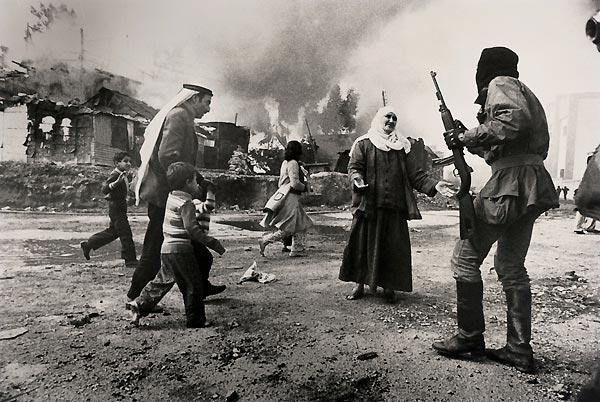
What I did not know then and what casts a different light on the massacre is that the January massacre in Karantina (and Nab’a) was preceded by a massacre and massive looting at the port, on 6 December 1975.  The date is now known as “Black Saturday.”  I already knew that on that day, the LF set up checkpoints in the city and killed hundreds of people.  What I didn’t know was that on the same day, the LF militiamen marched into the grounds of the port and checked everyone’s ID cards (as they were doing at ad hoc checkpoints elsewhere in the city); on that day, they massacred around one hundred Palestinians, Syrian, Kurdish and Egyptian port-workers (among the hundreds of others killed on that day in Beirut), and kidnapped some 300 people (apparently mostly Egyptians) from the port area.

The massacre at the port was accompanied by massive looting of goods stored there, and as I heard in an amazing interview today with an old-timer, the Government of Iraq, for example, which trans-shipped building and infrastructural materials through Beirut lost a vast store of goods (including timber and other construction material) on that day.  The LF on that day took over what was called the Fifth Basin of the port and the basin became an important source of income for them, through extraction of “taxes” from the companies that continued to import, trans-ship, and export via Beirut.  A Wikileaks cable from 1977 for example mentions that Shell Oil officials had to pay up to 40 percent “war tax” on their imports into the Fifth Basin, and “taxes” on imported whiskey and cigarettes similarly became an important source of income for the militias.  All the militias in fact set up ports along the coast and all collected some random form of “customs” from the imports they brought in; with the amount of customs considerably less than what the government of Lebanon would have charged, but considerably more than most other sources of income for the militias.  As another cable from 1985 delineated, the operating costs of these militias were huge:

According to this official, LF operating expenses alone amount to 26 million pounds a month, mostly straight salary payments. This figure provided nothing for ammunition replacement (badly needed), spare parts for equipment (badly needed — according to official LF tanks couldn’t move into action now without significant repair), uniforms, training, etc.

Official noted that LF had re-opened night operations at fifth basin at Beirut port twelve days before uprising because of need for funds, so Ja’ja’ will continue to benefit from this source. On other hand, he said, with Syrians opening roadblock at Madfoun bridge, lf revenues from Barbara checkpoint have disappeared; he opined that Ja’ja’ might go as far as to offer up closing of Barbarah checkpoint as peace offering to Syria now that Syrian action has made it financially irrelevant. Even assuming lf tightens up taxation in areas under its control and perhaps expand fifth basin operations, it will still leave them, he estimated, minimum of 6 million pounds short each month.

So not only does the control of the port give LF a major source of income, it also gives it  strategic control over one of the “four axes of traditional confrontation,” the “hotel district to the port.” (The three other axes are “(2) Martyrs’ Square to Museum; (3) Dekwaneh To Mukalles and Beit Meri; and (4) Ain Rumanneh/Shiyah.”)

What is also interesting is that when Suleiman Franjieh decides to invite in the Syrians to effectively fight on the side of Phalange against Palestinians, the reasoning he uses are as follows: the port of Beirut, which is a major entrepôt for Syria, needs to be defended; but also importantly, Syria is needed to tighten the noose on Palestinian logistics supply line.  In fact a 1976 Wikileaks cable specifically delineates how the Syrians in fact quickly got to work on the latter:

As Syrian clamp-down on Lebanese ports continues, Palestinians and leftists concerned over supply lines into country. Effective surrounding of Tripoli now leaves Tyre only leftist controlled port with open roads to hinterland. Tyre is already scene of resupply efforts. Much larger traffic through port could provoke strong Israeli reaction. However, Israel may want to keep pot boiling in Lebanon and ensure Palestinian preoccupation elsewhere.
Karantina_Massacre

So, the takeover of the port and the massacres there (and elsewhere in Beirut) on 6 December 1975 preceded by six weeks the massacres at Karantina.  What I did not know about this particular massacre (and the one at Nab’a) was that many of the Karantina and Nab’a residents worked as dockers and stevedores at the Beirut Port, and in fact their killing paved the way for a  “cleansing” of the port from Muslim workers (at least for the duration of the civil war).

And of course the Syrian intervention in Lebanon also gave the Phalange the logistical and military support they needed to conduct the devastating Tal Za’tar Massacre in mid-August 1976.

Fast forward nearly 50 years later.  The Fifth Basin is now a container terminal.  And many of the survivors of those successive massacres are scattered around the world.  Today, the port-workers actually work for private firms under contracts, and these private firms are owned by people with connections to the various sectarian leaders.

A few things have really struck me about this terrible story.

First, that business seems to keep going -and in fact flourishes- in war-time.  In fact, there is a kind of ironic demonstration of this even in today’s Beirut where the war of position hums subcutaneously: as you walk east on Hamra street, the Interior Ministry is hidden deep beneath layers and layers of walls and barricades, whereas there stands the lovely modernist building of Masraf Lubnan, the Bank of Lebanon, gloriously free of barricades.  And of course,  there is that rather grimly funny story about the civil war: that when everything split and there were two governments in operation (and nearly until the very end, but not all the way through) the Bank of Lebanon remained unitary and lent to both governments (at the end of the civil war, however, even the Bank split).

Second, that it is incredibly difficult to draw a line of demarcation between “the state” and “the bourgeoisie” as coherent and autonomous analytic categories.  I think there was a time (and in some settings) where I would have argued that the state has some autonomy, but in Lebanon (as in a few other places I am studying), the state is either straight-up the “executive committee of the bourgeoisie” (albeit a bourgeoisie riven by sectarian and geopolitical interests) or a mechanism through which the businessmen can merrily profit from accumulation by dispossession.  There is of course the direct and violent method of massacres as a mode of dispossession (as mentioned above), but there is also the manner in which Solidere (and so many other investment and real estate firms and other businesses in this country) use the apparatus of the state to underwrite their capital accumulation.  Laws are drafted in ways that benefit the businessmen; title deeds to land are expropriated in ways that benefit these businessmen; bank secrecy laws provide a cover to the way they and their financiers move their money; eminent domain expropriations provide the push; permits for expropriation of land and for its development are granted to those with intimate relations to the state (or in fact to various ministers as is the case with Soldiere, or with Stow Capital) and on and on and on.

Third, I am reading Deb Cowen’s superb book, The Deadly Life of Logistics, and one of the most fascinating chapters is about the easy traffic, the easy transformation, between logistics for war and logistics for commerce.  In fact, as I write this, I am not sure that the two can be separated at all.  She specifically writes about the transformation of the US base in Iraq, Camp Bucca (notorious for being a major site of mass detention during US invasion and occupation of Iraq), into Basra Logistics City.  Cowen perceptively excavates the way both the detention camp and the logistics city operate under the sign of empire. I think in the case of Beirut (and perhaps even Basra and further afield), in addition to the power of the US state (ever-present through its military, its investment firms and its port management experts and managers) there is also transnational and local capital, which is not exactly US based, but which in fact is accumulated locally -through exploitation or expropriation.  And the port of Beirut, battered and exploited, bloodied, abased, and used alternatively as a militia base and as a node of financial extraction, as a site of ethnic cleansing and substate reproduction of militias, presents a weird and endlessly fascinating example of how commerce and war bed each other.

update: as a careful reader has pointed out the LF wasn’t LF yet, it was still the Phalange (or the Kata’ib)…  Apologies about the historical infelicity.

Posted in capital accumulation, infrastructure, labour, logistics, Middle East, militaries, ports, shipping conditions, transport, war | Leave a comment

Mohammad Al Fayed and the ports business

It seems like Mohammad al-Fayed (of Harrod’s fame – and obviously many other ventures) was also in the port business.   In 1964, he entered a deal with Papa Doc Duvalier of Haiti, whereby he invested $5 million in the harbours, established pilotage and ports, and in return was to receive the income from the port.  Not sure what happened in reality, but it is fascinating to see that Fayed’s reach was so wide.  He was in the deal apparently with a couple of other characters. The New York Times article states that

Other much‐discussed individ­uals here include an Iranian, Prince Aboubasar Azod, and an American, Georg Mohrenschild. Prince Azod has announced that he plans to organize a large tourist and industrial project in the neglected south­ern peninsula of Haiti. Mr. Mohrens.child is prospect­ing for oil and minerals. He is being compensated with a share in a government sisal Opera­tion.

Fayed of course also had interested in the UAE, where he was part owner of Costain construction company.  Costain is of interest to me because it was the firm that dredged the Jabal Ali harbour, and has also been involved in other construction work related to transport there (including airport terminals there, and also in Bahrain).  Today, the Middle East connection for Costain comes via the Kuwaiti Kharafi family who own a majority stake in the firm.  Costain’s website has some interesting little trivia about its work in the Middle East, including the following:

More than 10,500 drawings were needed to design the £232 million Dubai Dry Dock.

The £500 million Mina Jebel Ali port and industrial development in Dubai required Costain to dredge 107 million cubic metres of sand, sandstone and rock.


Posted in capital accumulation, construction, finance and insurance, infrastructure, logistics, Middle East, political economy, ports | Leave a comment

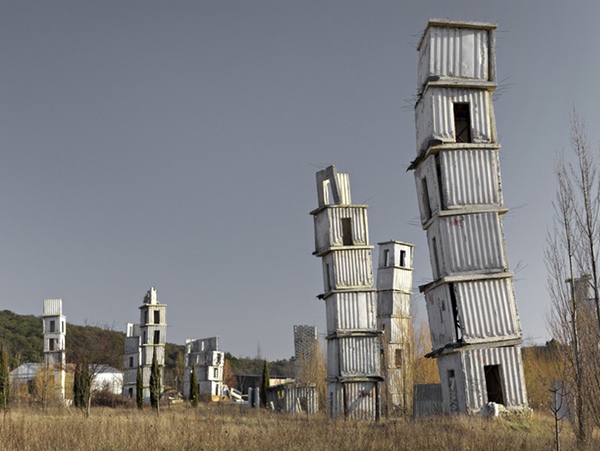
“steampunk shipping containers”

Barjac Anselm Kiefer


And here is the story.

Posted in shipping conditions | Leave a comment

Pirates Pirates Pirates

They are EVERYWHERE!  Here is Michael Dirda writing about campy pirates:

Many [film pirates] are also distinctly camp. The first pirate most of us encounter is Captain Hook, who, as played by Cyril Ritchard in the Mary Martin version of Peter Pan, glories in the mincing affectation and extravagance of a boisterous drag queen (there were, in fact, cross-dressing female pirates, like Mary Read and Anne Bonny). Johnny Depp as the bejeweled Jack Sparrow continues this tradition, as did, in a more wholesome manner, Burt Lancaster, who portrayed The Crimson Pirate in the film of that name with uncontainable exuberance and a smile as big as a mainsail. Think, too, of Wesley, played by Carey Elwes, as the almost foppish Dread Pirate Roberts in The Princess Bride. Such figures aren’t villains; they are self-aware performance artists. Being stagey and colorful is their life.


Posted in literature, piracy, readings, seafaring | Leave a comment

Shipping Alliances

The world’s top three shipping lines are, in order, Maersk (Denmark’s second largest company after Lego), MSC (a privately-held Italian firm), and CMA CGM (a French firm).  Some time ago, they decided that they were going to start up an alliance, P3, that would have allowed them to share vessels, thus streamlining which ports they would travel to and through what routes.  Bloomberg reported,

The companies had planned to commit 255 vessels deployed on 29 trade loops to a joint center that would have run a combined fleet independently. Maersk was slated to contribute 42 percent of the total, including its Triple-E class, the largest-ever container ships with a capacity of 18,000 boxes.

Although the US and EU regulators seemed to be fine with what in effect was going to be a kind of cartelisation-lite, the Chinese put the kibosh on it.  They apparently felt that the

“closely coordinated joint operations” proposed in P3 would also have been substantially different from the “loose cooperation” of current alliances, the ministry said. The two main existing accords are G6, which includes Germany’s Hapag-Lloyd AG and five Asian carriers, and CKYHE, which features Cosco Container Lines Co., the Chinese No. 1.

Now, however, it looks like the alliance has become 2M (Maersk and MSC), but the Chinese are still concerned about the alliance in effect moving one-third of the world’s cargo around the globe. Meanwhile, CMA CGM is making an alliance with the Gulf-based UASC (United Arab Shipping Company) and the Chinese CSCL (Chinese Shipping Container Line) [as an aside, I am really hoping this agreement doesn’t affect my trip in January].

This is interesting to me for several reasons.  First, of course all shipping is now dead fascinating to me, because of my interest, but that CMA has entered a deal with a Chinese firm AND an Arab firm (the first not surprising, the second much more interesting) is pretty fascinating.

Second, UASC is an interesting company itself, and its history traces some of the shifts in the Gulf transport: originally headquartered in Kuwait, it has now shifted its centre of gravity to Dubai.

Third, this alliance will of course affect the routes of ships, and therefore the traffic (and fees) destined for the ports of the Arabian Peninsula. Currently, the Middle East’s biggest container ports are Jebel Ali (ranked 9th in the world and operated by DP World); Jeddah (at no. 30 and its terminals operated by Gulftainer and DP World); Khor Fakkan (at 35 and operated by Gulftainer); Port Said (at 37 and operated by Suez Canal Container Terminal the majoruty of whose shares are held by the Maersk-owned but independentAPM Terminals; and thereafter by Chinese COSCO, the Suez Canal Co, Egyptian National Bank and private investors); and Salalah (at 39 and operated by APM Terminals).  Something to follow in the time to come.

Fourthly (and somewhat tangentially), CMA is itself owned by a Lebanese-born, LSE-educated, Marseille-based guy named Jacques Saade.  Saade seems to have become interested in container shipping when he was doing an internship in the US and saw the US military use containers for transport.

Update: So, Lego isn’t the biggest company in Denmark.  AP Moller-Maersk is: http://www.prodenmark.com/danish-companies/largest-danish-companies/


Posted in capital accumulation, infrastructure, logistics, Middle East, political economy, ports, shipping conditions, transport | Leave a comment

Derek Gregory on Logistics

Derek Gregory has a post that weaves together Deb Cowen’s new book (which I await anxiously) and Charmaine Chua’s post, and loads of important links to Derek’s own work on military logistics.

Posted in capital accumulation, logistics, war | Leave a comment

Logistical Chokepoints

Charmaine Chua writes on the politics of logistical chokepoints:

Sped along by transport deregulation and an associated wave of firm competition and consolidation, the containerization of bulk goods now allows a single dockworker to do what it took an army to accomplish in the past. Innovations in production technologies, such as flexible production, demand-driven manufacturing, mixed model production, and the just-in-time organization of inventory and delivery systems ensure that risks of interruption are reduced by limiting overheads, building ‘fault tolerance’ into logistics systems, and collecting and distributing data about the demand and supply of commodities at ever quicker speeds. Above all, logistics workers now choreograph and coordinate these circulatory flows across great international distance, so that workers across the global supply chain are pitted against each other to increase the competition for scarce jobs, drive down wages, and exploit wage differentials between core and periphery. So massive is the operation of these circulatory flows that over 90% of world trade by value travels across the sea via the behemoth container ships and oil tankers of the shipping industry. If that statistic does not surprise you, try this anecdote: it is now cheaper to ship freshly caught fish from the West Coast of the United States to China to be deboned and filleted by Chinese workers and then shipped back again, than it is to pay for the cost of that work under U.S. labor regulations.


Posted in bureacuracy, capital accumulation, logistics, political economy, transport | Leave a comment

Other uses of ships

The Guardian reports that the Libyan legislature has taken refuge in a Greek car ferry:

A Greek car ferry has been hired as last-minute accommodation for Libya‘s embattled parliament, which has fled the country’s civil war to the small eastern town of Tobruk.

The 17,000-ton Elyros liner has been deployed, complete with its Greek crew, as a floating hotel for a legislature clinging to power in the Libyan city that is last stop before the Egyptian border.

Posted in infrastructure, Middle East, ports, ships, transport, war | Leave a comment