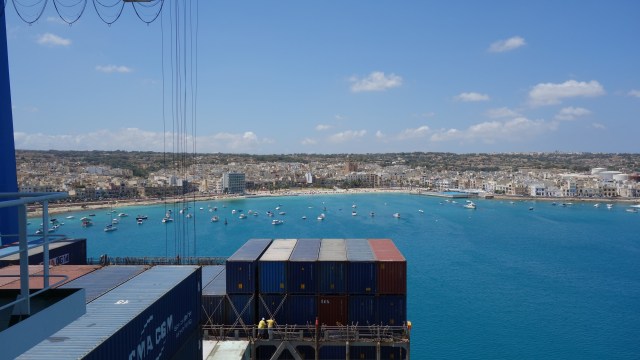
Malta-Dubai; 11 August 2016 – Day 2, at sea in the Mediterranean

11 August 2016

10.35 (Ship time. My phone’s GPS says it is actually 11.35)

The Mediterranean; steaming towards Damietta

The Mediterranean is such a lonely sea. Its vastness is such that one doesn’t really see ships passing except in the far distance and the AIS screen shows ships so far that they do not appear on the horizon at all. Bojan the deck cadet talks about how the air and light in the Mediterranean so exceed in their pleasure and beauty the pollution of the sea and the air in China. And Marco the second mate talks about the difficulty of port visits with all the demand of manoeuvering the ship. It seems that the proliferation of ports is what makes the work difficult – as it requires attentiveness, presence, difficulty. And apparently there is a hierarchy of access to port passes. And the second mate is far low on the totem pole.

This hierarchy is also present at meals. The officers’ table is different than the cadets’ table. And I get to eat on my own beyond a partition. There is an interesting difference though between Callisto and Corte Real: Corte Real had a far more formal dining culture. The master sat at the head of the table; his wife to his right and the chief mate to his left and then the chief engineer, and then the officers in descending order of rank. Here, everyone just grabs a seat and sits next to one another. The captain is sometimes in the middle of the table and sometimes at the end of it. This may have something to do with how the chef dictates the culture of dining on board this ship. With the captain being new to the ship, the ethics of eating must have been established by the chef, who also does not serve the officers by plate, but rather provides the foot buffet style and everyone gets to serve themselves (which frankly, I prefer, as I get to serve myself as much or as little as I desire). If this is the case, then it is interesting that a crew member gets to determine the shape and rigidity of the shipboard hierarchy, at least at mealtimes.

I have also told Lysandro (the messman) that I wouldn’t mind trying some of the crew’s food. The officers’ food –like last time- is a bit inconsistent. The roast chicken and the goulash were delicious, but the fish was absolutely terrible. I am hoping to try Filipino adobo or chicken curry instead. We shall see.

Nice coffee is abundant on the ship too, thankfully, and I have a little box of Danish cookies in my cabin for when I feel peckish. I have not asked about booze and shall refrain, but interestingly Lysandro was telling me that the Filipino crew do not really do karaoke like the crew on Corte Real did almost every night. Also interestingly, the Filipino crew here is into working out with weighs and playing table-tennis, which is also different than the men of Corte Real. On Corte Real, the Balkan officers were into weight-lifting, but the Croatian men on Callisto seem far less into having those enormous muscly arms and have far more ordinary bodies.

Being so familiar with shipboard life means that already, two days into being at sea, I have settled into an iron routine: coffee for breakfast, a run on the treadmill, a couple of hours of sunbathing and reading on my deck, an hour of hanging out in the wheelhouse, lunch, a nap, some reading and writing, and perhaps a walk along the deck, although there seems to be a lot more ceremony involved with walking around the deck on Callisto. The third mate even wanted me to wear overalls, which thankfully turned out not to be necessary. But I did wear a helmet and carried a radio –the latter of which I didn’t have to do on Corte Real. The layout of the deck is also different on this ship – and you can glance on the lower-deck aft, where the previous captain has laid some Astroturf, apparently for twice-weekly football games (according to Bojan). But the current captain doesn’t seem too much into playing football. After the walk, more reading and writing until dinner at 6, and still more writing and reading and perhaps a visit to the wheelhouse. The last two nights, I have been so shattered that I have fallen asleep at 9 or 9.30. I shall definitely get a lot of rest while onboard the ship.

20160811_171200.jpg

As we steam through the Mediterranean further and further towards its southeast corner, the air is becoming more humid and there is a haze on the horizon. The sea is still lonely, but as the sea narrows in its eastern reaches, I suddenly find that my phone is picking up Greek mobile networks. To be handed in this way from network to network is strange – as if there is no way to escape the reach of those webs of communication and transport so central to our lives today. Below us, on the floor of the sea, lie the vast flows of communication cables, pipelines, and wreckage. Layer upon layer of history. Above us, in “the ether”, the microwave emissions, the mobile signals, satellite signals. My phone has already located itself via GPS, and although the ship time is officially GMT+2, my phone is already in the time-zone of North Africa, at GMT+3. So I move in two time zones simultaneously, connected to Greek networks intermittently, and steaming towards Egypt. This anchoring of our time – and also our eastward movement through space- to Greenwich immediately makes me think of the extraordinary reach of the British empire; its insistence on setting the standards of motion and defining the parameters of long-distance shipping. Greenwich as the point zero of ships moving upon the deep.

Later in the evening:

The adobo at dinner was utterly delicious. If I can from here on out avoid the officers’ food and eat the crew’s meals I shall be in clover!

Fascinatingly, a note arrived today from the UK P&I Club (whatever that is), speaking about a new scam at Suez. Apparently some guys board ships at Suez anchorage, claiming to be from United Mediterranean Shipping and conduct “health checks” including taking blood, supposedly on behalf of Suez Canal Company. Then after finishing, they demand a payment from the master. Turns out of course that they are wholly fraudulent. It is fascinating to see the hostility voiced by the officers against the scammers in Suez.
Posted in 2016 Trip, Travels | Leave a comment

Malta-Dubai again; 10 August 2016 – Day 1, Setting Off from Malta

In August 2016, I once again boarded a ship in Malta to travel to Jabal Ali.  I had recorded the previous occasion with giddy excitement, all things seeming new and unfamiliar.  Perhaps the familiarity of the trip, or the fact that I was writing my book proposals (rather than focusing on my diary entries and on reading and reflection) made 2016’s entries quite anaemic in comparison with the previous time. And perhaps that is why it has taken me so long to post these. For more reflexive, more literary deliberations on the nature of containership travel, perhaps it is best to return to my entries from 2015 (the first is here:https://thegamming.org/2015/02/03/wake-up-your-saints/) . They fall under Travels category!

Wednesday 10 August

06.36

Having sailed from Marsaxlokk

It is strange to be on a cargo ship once again. The differences come to the fore at every turn.

First and foremost, I am far more familiar with the workings of the ship, its layout, and even one of the engineers –who had been on Corte Real in January 2015. I am a bit more jaded, a bit less overwhelmed by the sublime vastness of this whole thing, a lot more comfortable wandering about, and asking for things. It really also helps that I am the only passenger, and this time, unlike last time, the only woman onboard. I am not sure how this will affect everything – but thus far everyone has been lovely, although the messman, Lysandro is seating me on my own and beyond a barrier. I feel a bit like I am in a harem. The officers chat with me though (especially if there are no others around) and are friendly and warm.

DSC00635.JPG

But there are also other stuff that will distinguish Callisto from Corte Real. There are so many more port visits than last time: Damietta, then Beirut, then Mersin, then through Suez to Jidda, then Jabal Ali. Navigating past Lebanon and Cyprus should be a treat.

The second thing that is different probably has something to do with this abundance of port visits: the ship is relatively empty of boxes. My window is not obscured by containers. I can see the sea; and light pours into my cabin, which is wonderful. I wonder how long this will last though. The officers were telling me that most of the containers are empty in any case, and they thought that the containers we would pick up in the ports on the way would similarly be empty. It is a bit strange to see all these container racks aboard the ship which are devoid of boxes, and to be able to see the massive (33 tonnes!) cover of the under-deck holds.

20160810_060409.jpg

What is interesting about this relative paucity of boxes is the way they are loaded on deck. There are entire rows that are completely free of boxes, save for the edges. Two containers on top of each other on the very furthest margin of the decks on both port and starboard. Is this for aesthetics’ sake or balance? Does the particular needs of loading ballast dictate the placement of the boxes? The loading of the boxes in each row is fascinating: some are loaded six levels high and then entirely empty rows. On some rows, boxes are bunched towards the centre (with a couple of boxes loaded at the edges again) and for a handful of rows, boxes go all the way across. I am not sure that the box storage spaces in the holds are actually full either. The rows in the aft are all completely full however. Will have to ask the captain about this.

The other major difference is that unlike last time, the residence decks and the wheelhouse are all located atop the engine room. Although I am far above, I can still feel the thrum of the engine, the ship’s beating heart, in my cabin in a way I couldn’t before. This is quite exciting actually.

The other differences are minor: the gym is huge and well appointed. The layout of the wheelhouse differs from Corte Real. There are only 27 officers and crew on board not 35 like last time.

Danilo – one of the crew – actually likes the new Filipino president because he is cleaning up Manila. Lysandro, the messman, used to work on a cruiseship and finds both workplaces as difficult as one another. There are two Chinese engineering trainees on board. And like last time, there is one Filipino officer, but he is a third mate this time, not second mate, like last time. There are also fewer officers altogether. One second mate (not two) and two third mates. And far fewer cadets.

Posted in 2016 Trip, Travels | Leave a comment

Walter Benjamin also traveled on freighters

In 1925, Walter Benjamin travelled on a freighter from Hamburg to ports in the Mediterranean. In their Walter Benjamin: A Critical Life, Howard Eiland and Michael Jennings recount the trip (pp. 240-241):

“On August 19 the ship [a freighter] sailed from Hamburg, with Benjamin in unusually high spirits.  Although he was worried about the possible lack of comfort afforded by this least expensive mode of travel, he was soon not just reassured by delighted: ‘This journey with the so-called freighter is one long aria of the most comfortable situations in life. In every foreign town you bring along your own room, indeed, your own little… vagabond household –; you have nothing to do with hotels, rooms, and fellow guests. Now I am lying on the deck, the evening in Genoa before me, and the sounds of unloading freighters all around me as the modernized “music of the world”’ [Gessamelte Briefe, 3:81]

He enjoyed traveling by freighter so much that he did it again in 1932 (p. 370):

Screen Shot 2016-05-29 at 22.39.23.png

As Marcus Rediker says, it is amazing to realise that the conversations Benjamin had with seafarers inspired his luminous “The Storyteller”.

Posted in Uncategorized | Leave a comment

The Logistics of Counterinsurgency

It was a great pleasure to have an occasion to think through how my previous work on counterinsurgencies connects to my current work on logistics.  The occasion was an invitation to lecture at Georgetown University’s Center for Contemporary Arab Studies. The abstract is as follows:

It is a banal cliche of military thinking that the deployment of coercive forces to the battlefields requires a substantial commitment in logistical support for the transport of goods, materiel, and personnel to the war-zone, the maintenance of forces there, and their eventual withdrawal from there. In counterinsurgency warfare, which is predicated on the deployment of large numbers of forces, persuasion or coercion of civilian populations into supporting the counterinsurgent force, and the transformation of the civilian milieu as much as the military space, this logistical function becomes even more crucial. In this talk I will be thinking through the ways in which the making of logistical infrastructures -roads, ports, warehouses, and transport- has been crucial to the wars the US has waged since 2001 in Southwest Asia, and how these infrastructures in turn transform the social, political, and economic lives of the region they leave behind.

The lecture can be seen here:

https://vimeo.com/165631438


Update (added on 11 May): Upon watching the opening clip of the lecture (the famous “What have the Romans ever done for us” scene from Monty Python’s Life of Brian), Prof Barnett Rubin writes that

It is not widely known that this scene is based on a passage from the Talmud, Tractate Shabbat, 33b:

R. Judah, R. Jose, and R. Simeon were sitting, and Judah, a son of proselytes, was sitting near them. R. Judah commenced [the discussion] by observing, ‘How fine are the works of this people [the Romans]!  They have made streets, they have built bridges, they have erected baths.’ R. Jose was silent. R. Simeon b. Yohai answered and said, ‘All that they made they made for themselves; they built market-places, to set harlots in them; baths, to rejuvenate themselves; bridges, to levy tolls for them.’ Now, Judah the son of proselytes went and related their talk, which reached the government. They decreed: Judah, who exalted [us], shall be exalted.  Jose, who was silent, shall be exiled to Sepphoris; Simeon, who censured, let him be executed.

I absolutely love this, because of course the original Talmudic text even better confirms the argument I make in the lecture.

Posted in Uncategorized | Leave a comment

Lecture on “Capital and Coercion in the Making of Arabian Transport Infrastructures”

I was invited to give a lecture on my current research at the wonderful Center for American Studies and Research at the American University of Beirut.  The abstract for the talk:

In this talk, I will be thinking through the overlapping role of the US and UK militaries and US and UK petroleum companies in the making of non-oil transport infrastructures of the Arabian Peninsula.  In so doing, I am hoping to excavate the ghostly presences of colonial and mercantilist structures so frequently present in metropolitan commercial cooptation of countries of the global South through tracing the role infrastructure construction plays in structuring global labour relations, the movement of capital, and the embroilment of powerful militaries in local politics.

The lecture can be seen here:


Posted in Uncategorized | Leave a comment

Podcast on Logistics with Deb Cowen and Charmaine Chua

I had the good fortune of having an amazing conversation with a couple of extraordinary scholars and friends about logistics and having the conversation recorded in a podcast.

Charmaine Chua (University of Minnesota) is an extraordinary young scholar working on logistical lifeworlds especially around Singapore.  She has a series of wonderful writings at Disorder of Things blog which can be found here.  She and I had a conversation some time ago about our respective containership trips.

Deb Cowen (University of Toronto) should need no introductions to the regular readers of The Gamming. She is the author of the amazing The Deadly Life of Logistics which I reviewed here.

As Charmaine writes in her introduction to the podcast,

Together, we take a look at the increasing ubiquity and prominence of logistics as a mode for organizing social and spatial life. We discuss how this seemingly banal concern with the movement of goods is actually foundational to contemporary global capitalism and imperialism, reshaping patterns of inequality, undermining labor power, and transforming strategies of governance. We also ask: what might a counter-logistical project look like? What role does logistics play in anti-colonial and anti-capitalist struggles across the globe?

We had a brilliant time talking to one another as we always do.  The podcast can be heard over at the Disorder of Things blog.

Posted in Uncategorized | Leave a comment

Logistical Territories

The Financial Times has been doing some fascinating investigative reporting on ISIS finances a great deal of which of course is of interest to me because of the ways in which it ties into the movement of commodities and products across territories.  But what I want to write about here briefly is this wondrous map:

ISIS map

Of course the map is itself of interest: it follows a barrel of oil from the point of production to refineries and for export.

But what is of interest to me is the shape of ISIS-controlled territory.  I have been re-reading Lauren Benton’s magisterial A Search for Sovereignty: Law and Geography in European Empires, 1400-1900. I love how she builds on large bodies of historical and geographical literature to talk about sovereign territories (in her case of empires) as not flat and un-variegated spaces, but as “corridors and enclaves”.

Looking at this map of ISIS sovereign territory reminds me of her corrective geographic conceptualisation of sovereign territories. So much of the territory under ISIS control look like ropes strung across logistical routes, skirting less populated areas, tracing existing roads and transport infrastructures.

Of course, this is precisely the point of Benton’s book: that we think of empires as if they were wholly and monotonously controlled by the metropole, but that in fact this geographic imaginary of a fully controlled space does not correspond to the historical reality. This historical reality was of spaces of control that ran along littoral areas, riverine strings running towards the interior of the country, flatlands and the like.

And these spaces of sovereign control were in fact logistical spaces, transport routes, and routes of war and trade.  So a “real” map of state coercion (policing) and territorial control would have to correspond fairly closely with its transport maps.

Also, tangentially, the map above reminds me of China Mieville’s The City and the City where two cities belonging to two different countries with wholly distinct legal systems overlay one another.  I have used the book as an allegory for other stuff as well (seeing and un-seeing; hegemony; etc.).  But the map of Syria above, with the palimpsest of sovereign control over the territories reminds me a bit of The City and the City.


Posted in Uncategorized | Leave a comment

Colonial precedents for the flags of convenience?

East Indiaman

Ships fly a flag of convenience in order to avoid the regulatory arms of the state or transnational institutions.  But here is a fascinating colonial precedent to the flag of convenience – from 1674:

Thus, when the [East India Company] committees insisted in 1674 that a new Admiralty regulation, which required all English commercial shipping to fly only the English merchant flag, should not apply to Company ships within the boundaries of its charter, they and the Admiralty under Samuel Pepys [seriously?] reached a compromise: Company captains would simply switch their flag for the English “red ensign” when outside of the East Indies. The point specified for the transition, however, was not the Cape of Good Hope but St. Helena. While contemporary maps might have located the island geographically in the Atlantic or Africa, for the Court of Committees [of the East India Company] it quite clearly was situated conceptually and jurisdictionally “in India.” (Philip Stern, The Company-State: Corporate Sovereignty and the Early Modern Foundations of the British Empire in India, p. 42)

This flag of convenience mattered to the East India Company, because India was the milieu of its monopolistic corporate sovereignty.

Posted in Uncategorized | 2 Comments

Rescue at sea

This wonderful piece by Keith David Watenpaugh reflects on why fishermen rescue migrants at costs to their livelihood:

This last July, as the Mediterranean refugees were still being largely ignored by the EU,PBS Newshour’s Lisa Desai interviewed Captain Slaheddin of a Tunisian fishing boat that sails from the port town of Zarzis.  As the captain explained:

One time we rescued 10 migrants. [though in Arabic he used the work for refugee, al-laji’. When they got on the boat two of them started praying. It gave me chills, all over my body. We are fisherman. We are here to make a living. We are not here to rescue people, but we have a feeling of humanity. So if I find someone on the sea I will save him…

It’s a powerful feeling to see someone helpless, hungry and being burned by the sun. It’s very hard: you are in front of someone who is calling for help.

Captain Slaheddin used the very old Arabic word al-bashariyya for the concept of humanity, rather than the modern neologism al-insaniyya, which an Arabic-speaker familiar with the concept of human rights would probably use.  The older word carries with it a broader sense of the feeling of corporeal human and human-ness – the feeling of belonging to a humankind, as opposed to an animal or supernatural kind. That solidarity of the human against the vastness of the sea and an empathetic consciousness of how small and fragile human life is in the face of it is what moved him to rescue.  Like most fisherman, Captain Slaheddin most likely grew up fishing as the son of a fisherman and had seen the terrible price the Mediterranean can exact throughout his entire life.

Posted in Uncategorized | Leave a comment

Shooting the animals

This post does not strictly have to do with shipping but it is fascinating and it has taken me on a tangent (and I love these tangents that end up weaving the world together).  I am reading the memoirs of Violet Dickson, whose husband Harold Dickson (formerly Political Agent in Bahrain, latterly the Political Agent in Kuwait) served in Bushehr as Political Resident between 1928 and 1929.

Her account of the time in Bushehr is brief, but there is this short and oblique reference to the devastation left in British wake:

Bushire is almost an island, being completely cut off at high tide except for a causeway across to the mainland.  This causeway was known as the mashaila, and on the edge of this salty muddy stretch we came across the bones and dry carcases of hundreds of animals -mules, horses, and cattle, which, we learnt later, had been shot by our troops when leaving the country after the First World War. (p. 68).

In an earlier post, I had written about the Tangsiri revolt against the British.  What I hadn’t mentioned in that earlier post -and which I did not know- was that the Tangsiri grievances antedated the First World War, and according to this site (which is a cheerleader for British imperial military conquest), the Royal Navy “had destroyed many of Dilwar’s fishing and cargo vessels in 1913 during a dispute over piracy.”  Piracy, of course, has largely been used by imperial powers as a euphemism to indicate an indigenous group’s refusal to pay taxes or customs or fees to the empire.  The same site also helpfully lists the massive force deployed against the ragtag army of Tangsiri rebels:

“On 10 August 1915 a British expedition left Bushire to carry out punitive measures against Dilwar. The ships involved were:

  • “HMS Juno (Captain D St A Wake) – 11 x 6-inch, 8 x 12-pounder and 1 x 3-pounder guns.
  • “HMS Pyramus – 8 x 4-inch and 8 x 3-pounder guns.
  • “HMIMS Lawrence – 4 x 4-inch and 4 x 6-pounder guns.
  • “HMIMS Dalhousie – 6 x 6-pounder guns.

“The designated landing party, under Commander Viscount Kelburn, Royal Navy (HMS Pyramus), consisted of:

  • “Captain G Carpenter, Royal Marine Light Infantry (RMLI), with 50 NCOs and marines and from HMS Juno.
  • “9 marines from HMS Pyramus.
  • “11 Petty Officers and seamen from HMS Juno manning machine guns.
  • “A demolition party of 1 Warrant Officer and 20 men from HMS Juno.
  • “4 signallers from HMS Juno.
  • “1 Medical Officer and 10 stretcher bearers from HMS Juno.
  • “24 Seedie Boys (locally enlisted stokers) acting as ammunition and machine gun carriers.
  • “Major C E H Wintle with one officer and 280 sepoys of the 96th Berar Infantry.
  • “5 machine guns.”

“Once in the fort the British destroyed it and New Dilwar. Wintle then commanded a fighting withdrawal back through the sepoy company at Old Dilwar and then all the way back to the beach. Naval guns and the machine guns covered this withdrawal which was completed with the loss of only six men wounded. ..The Tangistanis were believed to have lost a considerable number of men.”

South Persia Rifles

The South Persia Rifles

When a few months later the Tangsiris attacked the British in Bushehr, they were bloodily repelled and the British used local collaborators, allies and proxies to drive back the rebels.  The South Persia Rifles (the British were remarkably unimaginative in naming their proxy militias, cf. King’s African Rifles, e.g.), under the command of Percy Sykes (of the Sykes-Picot fame) were crucial for suppression of the southern revolts from  1915 onwards.

The Tangsir revolt was followed by the Qashqa’i revolt(s), led by Mirza Ismail Khan Qashaqa’i, Sawlat al-Dawla (also transcribed as Soulat al-Doule), Sardar Ashayer.  An oral history account of the revolt by Sawlat al-Dawla’s son traces the causes of the revolt, and recounts how their defeat by a combination of Spanish Influenza (then decimating the world), typhoid, and British force.

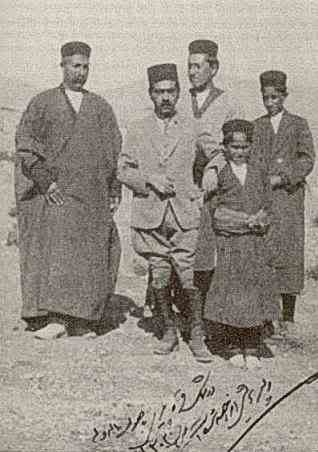
Sawlat al-Dawla (far left) with his sons, who themselves led subsequent revolts against the British and Reza Khan Pahlavi, and later the Revolutionary Guards

Sawlat al-Dawla (far left) with his sons, who themselves led subsequent revolts against the British and Reza Khan Pahlavi, and later the Revolutionary Guards

While Qashqai factionalism aided this eventual defeat, a regional famine brought on by war and the British expropriation of food and supplies for their forces and British brutality via their proxies, the South Persia Rifles, were also factors in the Qashaqa’is eventual defeat in 1918-1919.  As Steven Ward recounts in his book on Iranian military history,

“the South Persia Rifles’ operations became more punitive, directly attacking the tribal strongholds, destroying crops, and seizing livestock to deprive the tribal chiefs of the means to sustain conflict.” (p. 119).

The killings of animals Dickson cryptically recounts must refer to this destruction of the tribes’ logistical apparatuses.  Or else, to the British destroying their own supplies as they withdrew from the region, lest they leave anything of value to the troublesome “natives”.

Posted in empire, ports, war | Leave a comment