BBC 3 Free Thinking interview with Matthew Sweet

Matthew Sweet of BBC Free Thinking was a brilliant reader of the book, having read closely and with an eye for fetching detail. We talked for about half an hour, and the interview can be heard here (my part of the interview starts at 27:40 but the earlier part of the programme is really interesting too):

https://www.bbc.co.uk/programmes/m000fgxm

Posted in capital accumulation, empire, imperialism & colonialism, environment, free ports/zones, infrastructure, labour, Middle East, political economy, ports, shipping conditions, transport, Travels, Uncategorized | Leave a comment

Recent lecture: Tankers and Tycoons

Here is a link to a talk I have given a few times, most recently at the Harvard Graduate School of Design. It is a talk I am hoping to turn into an article, but which requires a bit more work (and archival research) still:

Posted in imperialism & colonialism, labour, logistics, Middle East, oil, political economy, shipping conditions, ships, transport, Uncategorized | Leave a comment

Publication: A World Built on Sand and Oil

This is probably one of my favourite publications, in part because I was pushed and pushed by Lapham Quarterly‘s superb editors. The essay compares the trade in oil and sand today to think through maritime transportation, the building of infrastructures, the world of commerce, and such other ideas.

Excerpt:

Oil and sand are not often commodities conjoined in discussions of global trade. The first is the motive engine of industry and transportation, fuel for heating and illumination, the spirit that animates much global politics. Even when priced cheaply—as I write, the price of oil hovers around fifty dollars per barrel (or just under four hundred dollars per ton)—it is considered precious. Humble, ordinary, oft-overlooked sand is, by contrast, the second most consumed good in the world by volume after water. It makes concrete and glass and electronics possible. According to the UN Environment Programme, at least fifty billion tons of sand (often measured in aggregate with gravel) are used annually, in contrast with four billion tons of oil. But sand is not often thought of as valuable: its trade is more domestic than global, and its market price per ton is under nine dollars in the United States and far less than that in the rest of the world.

But there are similarities, too. While China is the biggest consumer of both products, the United States follows close behind as the world’s second-largest consumer of oil and the third-largest user of sand. Depending on its market price, crude oil is often the first or second most exported good in the world by value. Today’s relatively low prices put crude oil exports in second place, after automobiles. At the end of 2015, the U.S. government rescinded a forty-year ban on the export of crude oil from the States, and since then the country has aggressively reentered the global oil market, becoming the world’s third-largest exporter of petroleum and its refined products, behind Saudi Arabia and Russia. (Despite being the largest oil producer, the U.S. is not the world’s largest exporter, because it consumes most of what it produces.) The vast majority of the trade in sand is domestic, and the U.S. and China extract the sand they need for construction and industry from their own territories. The world’s biggest importer of sand, however, is Singapore, which uses a great volume of the stuff in its frenetic projects of land reclamation.

The two commodities converge in one other regard. Their commodification and trade hold mirrors to global inequalities and ecological plunder. Both are produced over eons, the one a product of fossilization of prehistoric flora and fauna, the other the debris of rocks’ encounter with wind and water. Both tar and dirt symbolize inferior material. And yet the moment at which they became pivotal to industrialization and urbanization, rocks are blasted, wells are drilled to sepulchral depths, rivers are dredged, beaches are bulldozed away to enable the transformation of these natural resources into commodities. The inexorable proliferation of oil and sand on the global circuits of trade tells us about the shape-shifting ways of production, colonial forms of exploitation, and our reckless wrecking of the global environmental commons. It is about how the commodification of prosaic everyday things affects lives here, now, and half a world away.

The article can be found here: https://www.laphamsquarterly.org/trade/world-built-sand-and-oil

Posted in capital accumulation, construction, empire, imperialism & colonialism, environment, infrastructure, Middle East, oil, ports, transport, Uncategorized | Leave a comment

Publication: The infrastructural power of the military

Drawing on extensive research in the archives of the US Army Corps of Engineers, this article again draws on my concomitant interest in militaries and infrastructure. “The infrastructural power of the military: The geoeconomic role of the US Army Corps of Engineers in the Arabian Peninsula” is inspired by the writings of Neil Smith and Deb Cowen on geoeconomics, and was published in the European Journal of International Relations 24(4) in 2018 and can be found here: https://doi.org/10.1177/1354066117742955

Abstract: In analysing the role of the US in the global expansion of capitalist relations, most critical accounts see the US military’s invasion and conquest of various states as paving the way for the arrival of US businesses and capitalist relations. However, beyond this somewhat simplified image, and even in peacetime, the US military has been a major geoeconomic actor that has wielded its infrastructural power via its US Army Corps of Engineers’ overseas activities. The transformation of global economies in the 20th century has depended on the capitalisation of the newly independent states and the consolidation of liberal capitalist relations in the subsequent decades. The US Army Corps of Engineers has not only extended lucrative contracts to private firms (based not only in the US and host country, but also in geopolitically allied states), but also, and perhaps most important, has itself established a grammar of capitalist relations. It has done so by forging both physical infrastructures (roads, ports, utilities and telecommunications infrastructures) and virtual capitalist infrastructures through its practices of contracting, purchasing, design, accounting, regulatory processes and specific regimes of labour and private property ownership.

Posted in capital accumulation, construction, empire, empire, imperialism & colonialism, infrastructure, labour, logistics, Middle East, militaries, political economy, transport, Uncategorized | Leave a comment

Publication: The Roads to Power: The Infrastructure of Counterinsurgency

It has been years since I posted here, but I am going to quickly provide some links to various publications related to the project here.

The first is an article that conjugates my research on transport infrastructures with my counterinsurgency research. “The Roads to Power: The Infrastructure of Counterinsurgency” was published in World Policy Journal 34(1) in 2017 and can be found here: https://doi.org/10.1215/07402775-3903604

Abstract: From the Napoleonic era to the present day, waging war has gone hand in hand with building roads. Laleh Khalili, politics professor at the School of Oriental and African Studies at the University of London, describes how both U.S. forces in Afghanistan and Israeli authorities in Palestine use road construction to impose security and economic regimes on local populations.

Posted in construction, empire, empire, imperialism & colonialism, imperialism & colonialism, infrastructure, logistics, militaries, transport, Uncategorized | Leave a comment

Domination, Dispossession and Struggle in the Making of Infrastructure and Logistics

Last night (20 February), Deb Cowen (Toronto), Charmaine Chua (Oberlin), Rafeef Ziadah (SOAS) and I had a conversation about the politics of infrastructure and logistics.  Here is the recording for the event:

Posted in capital accumulation, empire, imperialism & colonialism, finance and insurance, infrastructure, logistics, Middle East, Uncategorized | Leave a comment

Offshore

In one of the most significant environmental decisions the Trump administration has taken, a ban on offshore drilling was lifted on 4 January 2018.  The New York Times reported:

While the plan puts the administration squarely on the side of the energy industry and against environmental groups, it also puts the White House at odds with a number of coastal states that oppose offshore drilling. Some of those states are led by Republicans, like Gov. Rick Scott of Florida, where the tourism industry was hit hard by the Deepwater Horizon rig disaster in 2010 that killed 11 people and spilled millions of gallons of oil into the Gulf of Mexico. […]

The governors of New Jersey, Delaware, Maryland, Virginia, North Carolina, South Carolina, California, Oregon and Washington have all opposed offshore drilling plans. Virginia’s governor-elect, Ralph S. Northam, a Democrat, said in a statement Thursday that expanding drilling would jeopardize his state’s tourism and fishing industries, as well as military installations. Gov. Roy Cooper of North Carolina, also a Democrat, called drilling a “critical threat” to his state’s economy.

It would be fascinating to see what sorts of controversies and contentions between the states and the federal government may emerge after this decision. Interestingly the designation of “continental shelf” as a legal maritime category emerged in mid-20th century precisely out of such a controversy over whether the states or the federal US government had the right and control of the subsea resources contiguous with a given state.

In September 1945, Harry Truman issued an executive order to declare that the US federal territory extended to the edge of its continental shelf – in order to ensure that the US could drill for oil and gas beneath the sea undeterred. Executive Order 9633, specifically stated that

Having concern for the urgency of conserving and prudently utilizing its natural resources, the Government of the United States regards the natural resources of the subsoil and sea bed of the continental shelf beneath the high seas but contiguous to the coasts of the United States as appertaining to the United States, subject to its jurisdiction and control. In cases where the continental shelf extends to the shores of another State, or is shared with an adjacent State, the boundary shall be determined by the United States and the State concerned in accordance with equitable principles. The character as high seas of the waters above the continental shelf and the right to their free and unimpeded navigation are in no way thus affected.

Only a couple of years after this declaration, the Federal government had to take the state of California to court,

to determine which government owns, or has paramount rights in and power over, the submerged land off the coast of California between the low water mark and the three-mile limit and has a superior right to take or authorize the taking of the vast quantities of oil and gas underneath that land (much of which has already been, and more of which is about to be, taken by or under authority of the State).

As Justice Black wrote in his summary of the case, California, “acting pursuant to state statutes but without authority from the United States, has negotiated and executed numerous leases with persons and corporations purporting to authorize them to enter upon the described ocean area to take petroleum, gas, and other mineral deposits, and that the lessees have done so, paying to California large sums of money in rents and royalties for the petroleum products taken.”

Notably, in deciding the case for the Federal government, the Supreme Court judges invoked the sovereignty of the United States among the family of nations, and even more remarkably, the centrality of security concerns (“protect[ing] this country against dangers to the security and tranquility of its people”).
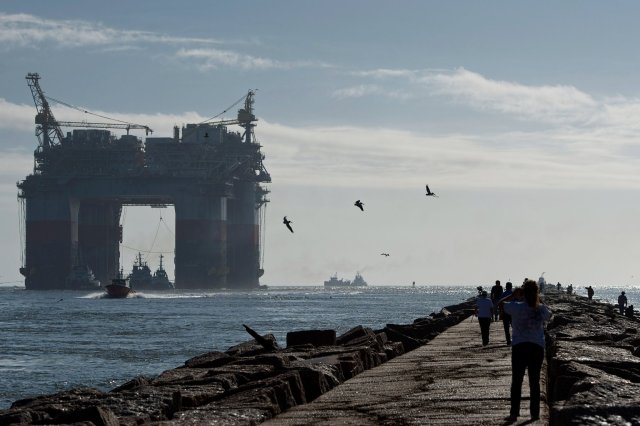
Tugboats pulling offshore drilling platform Gulf of Mexico 2013

Tugboats pulled a Chevron drilling platform toward the Gulf of Mexico in 2013. The Trump administration said Thursday it would open most of the country’s offshore waters to oil and gas drilling.CreditEddie Seal/Bloomberg, via Getty Images

Court decisions were consolidated via legislation when in 1953, the US Congress enacted the Submerged Lands Act which gave the control of the continental shelf to the federal government (the above act has now been subsumed into the Outer Continental Shelf Act) and was slightly modified by the Energy Policy Act of 2005, which, inter alia, set up a fund for oil spills and passed on some of the profits from the lease of the subsea resources to the coastal states.

Of course all of this has to be seen in light of the Deepwater Horizon disaster of 2010 which led to an immediate moratorium on drilling in the oceans (lasting only a few months), and eventually to the decision made in the last few weeks of Obama’s time in office to ban these offshore drilling licenses in the Atlantic and in the Arctic.

As the New York Times article reports, the Trump administration repeal of the ban on offshore drilling is part of a larger GOP plan to roll back even the most anaemic environmental legislation in order to facilitate further mineral exploration:

Last month Congress opened the Arctic National Wildlife Refuge, or ANWR, to oil and gas drilling as part of the tax overhaul. And last week the Interior Department rescinded an Obama-era rule that would have added regulations for hydraulic fracturing, or fracking, on federal and tribal lands. It also repealed offshore drilling safety regulations that were put in place after the Deepwater Horizon spill.

Whether there will be takers for the new Atlantic offshore licenses, however, remains to be seen. The low price of oil is a concern for the oil companies wanting to make investments in capital-intensive exploration.  However, people who see the expansion of petroleum exploration and opening up of new fields as a form of “energy independence” for the US (really a nativist fantasy) may want to pay attention to who the investors in the new oil exploration ventures (and especially fracking operations) are.  Forbes reported in September 2016 that Saudi Arabia has been buying into refineries in the US (like many other Gulf countries), while in December 2017, the Wall Street Journal reported that Saudi Arabia was looking to invest in US shale oil (and fracking). Of course the US oil industry, both upstream and downstream, is fully internationalised, so it is not at all surprising that the Saudis, like Qataris, Kuwaitis, the British, Dutch, Chinese and others have invested in these industries. But it is possible that if there is a legal fight coming over offshore exploration licenses, the players may end up being more and other than the states and federal government, I suspect.

Posted in environment, infrastructure, oil, political economy | 1 Comment

Religious fable about infrastructure

Source: Siyar al-Muluk by Nizam al-Mulk (died, 1092). Translation by Navīd Zarrinnal:

“”They say when Umar was about to leave this world, his son asked him: “When will I see you?”
Umar replied: “In the next world.”
His son said: “I want to see you sooner.”
Replied: “the first night, after my death, or on the second or third night, you shall see me in your dream.”

Twelve years passed but no dream of his father came to the son, until one night. In the dream, he asked: “Father, didn’t you say I would see you in the first three nights?”

Umar replied: “A Baghdad bridge was damaged and the officials responsible had not repaired it; sheep were passing and one fell upon a hole and broke his leg. For twelve years now, I was held to account.””

گویند عبدالله بن عمر بن خطاب، به وقت بیرون رفتن پدرش از دنیا، عمر بن خطاب، رضی الله عنه، پرسید که “ای پدر ترا کی بینم؟”
گفت: “بدان جهان!”
گفت: “زودتر می خواهم.”
گفت: ” شب اول یا شب دوم یا شب سوم، مرا در خواب بینی.”
دوازده سال برآمد که او را به خواب ندید. پس از دوازده سال به خواب دید. گفت: “یا پدر نگفته بودی که پسِ سه شب ترا بینم؟”
گفت:” مشغول بودم که در سواد بغداد پلی بیران(خراب) شده بود و گماشتگان تیمارِ آبادان کردن آن نداشته بودند. گوسفندان بر آن می گذشتند. گوسفندی را بر آن پل دست به سوراخی فروشد و بشکست. تا اکنون جواب آن می دادم

Posted in infrastructure, Uncategorized | Leave a comment

The use of free ports to stash arts

Interesting older item from New York Times on the use of free ports to stash away artworks (and other contraband):

The drab free port zone near the Geneva city center, a compound of blocky gray and vanilla warehouses surrounded by train tracks, roads and a barbed-wire fence, looks like the kind of place where beauty goes to die. But within its walls, crated or sealed cheek by jowl in cramped storage vaults, are more than a million of some of the most exquisite artworks ever made.

[…]

With their controlled climates, confidential record keeping and enormous potential for tax savings, free ports have become the parking lot of choice for high-net-worth buyers looking to round out investment portfolios with art.

[…]

Free ports originated in the 19th century for the temporary storage of goods like grain, tea and industrial goods. In the last few decades, however, a handful of them — including Geneva’s — have increasingly come to operate as storage lockers for the superrich. Located in tax-friendly countries and cities, free ports offer savings and security that collectors and dealers find almost irresistible. (Someone who buys a $50 million painting at auction in New York, for example, is staring at a $4.4 million sales tax bill. Ship it to a free port, and the bill disappears, at least until you decide to bring it back to New York.)

At least four major free ports in Switzerland specialize in storing art and other luxury goods like wine and jewelry, and there are four more — most newly minted — around the world: Singapore (2010); Monaco (2012); Luxembourg (2014); and Newark, Del., (2015).

Concerned by the rapid growth of these private storage spaces and worried that they could become havens for contraband and money laundering, Swiss officials initiated an audit in 2012, the results of which were published two years ago. The results revealed a huge increase in the value of goods stored in some warehouses since 2007, led by an increase in high-value goods like art. Though the audit did not specifically measure the increase in stored artworks, it estimated that there were more than 1.2 million pieces of art in the Geneva Free Port alone, some of which had not left the buildings in decades.


Posted in capital accumulation, finance and insurance, free ports/zones, Uncategorized | Leave a comment

The poetry of medieval maritime travel

I have been reading Arab navigation manuals and travelogues, and there is such poetry in the navigation manuals in particular. It is the liminality of the navigation texts in particular – between art and science, familiar and wholly other.  I just love the enumeration of the principles of navigation for example, by Ahmad Ibn Majid al-Najdi (who, some say, is the master-navigator who in a fit of drunkenness, revealed the route to India to a disconsolate Vasco de Gama beached in East Africa).  These are:

  • Manazil (lunar mansions)
  • Akhnan (rhumbs)
  • Diyar (routes)
  • Masafat (distances)
  • Bashiyat (latitudes)
  • Qiyas (measurements of the stars)
  • Isharat [coastal and maritime] signs (e.g. tides, currents, landmarks, water colouration etc)
  • Hulul al-Shams wa al-Qamar (revolutions of the sun and the moon)
  • Al ryah wa l-mawasim (winds and seasons)
  • Mawasim al-Bahr (seasons of the sea)
  • Alat al-Safina (the ship’s instruments)
  • Siyasat (politics on board, i.e. relations with the crew and passengers)

I especially love the politics element.  Here is a beautiful passage from Najdi himself:

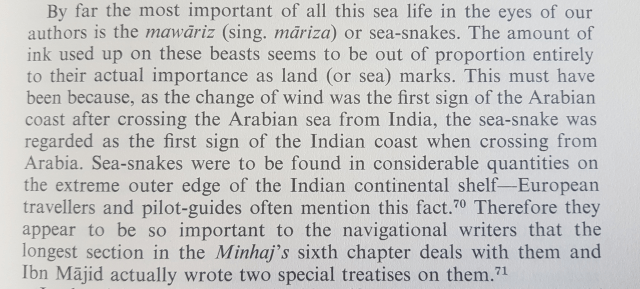
Know oh reader, that sailing the sea has many principles. Understand them: the first is the knowledge of lunar mansions and rhumbs and routes, distances, bashiyat, latitude measuring, signs (of land), the courses of the sun and moon, the winds and their reasons, and the seasons of the sea, the instruments of the ship. .. It is desirable that you should know about risings and “southings” and the methods of taking latitude measurements and their variations and graduations, the risings and settings of the stars, their latitudes, longitudes and distances and their passing the meridian… It is also desirable that you should know all the coasts and their landfalls and their various guides such as mud, or grass, animals or fish, sea-snakes and winds. You should consider the tides, and the sea currents and the islands on every route… (p. 77)

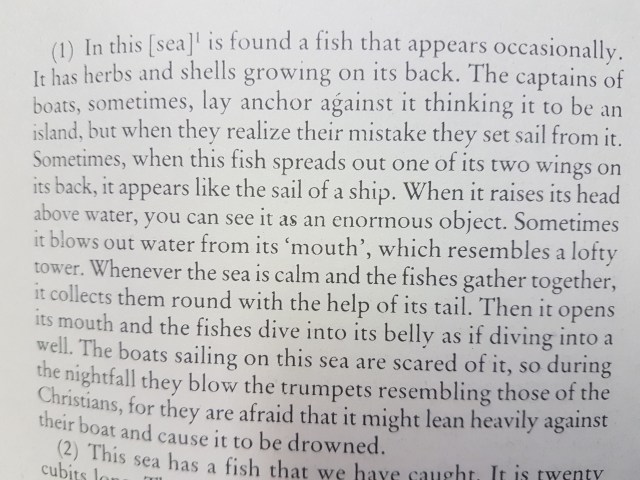
I also love the sense of wonder in these accounts.  Here is the utterly wonderful and observant Sulayman al-Tajir, an itinerant merchant from Siraf (on the southern coast of what is today Iran), describing a sperm whale in the 9th century AD:

20170913_141201_001.jpg

“This sea” is of course the Indian Ocean. And I love the sense of fear and wonder in the account.  The masterful translator and annotator of Najdi also points out Najdi’s fascination with sea-snakes:

seasnakes.png

Sources for the above:

Al-Najdi, Ahmad b Majid. 1971. Arab Navigation in the Indian Ocean Before the Coming of the Portuguese; being a translation of Kitāb al-Fawāʾid fī uṣūl al-baḥr waʾl-qawāʾid of Aḥmad b. Mājid al-Najdī. Ed. G.R. Tibbetts. London: The Royal Asiatic Society of Great Britain and Ireland.

and

Akhbar al Sin wa’l Hind by Sulayman al-Tajir in  Ahmad, S. Maqbul. 1989. Arabic Classical Accounts of India and China. Shimla: Indian Institute of Advanced Study.

Update: a colleague insists that I better emphasise that the De Gama connection has been totally debunked, since de Gama’s guide was actually a “Gujarati Moor” – which Al Najdi was not!

Posted in Middle East, seafaring, the sea, Travels, Uncategorized | 2 Comments