Interview from 2017 with Salvage Magazine

Logistics, Counterinsurgency and the War on Terror: An Interview with Laleh Khalili

by  | March 16, 2017

George Souvlis: By way of introduction, could you explain what personal experiences strongly influenced you, politically and academically?

Laleh Khalili: I grew up in Iran in the 1970s and early 1980s and being the daughter of Iranian leftist revolutionaries – and later political prisoners and later still exiles – indelibly marked the way I look at the work. On the one hand, growing up in an intellectual leftist household meant introduction to a rich seam of literature and history – not only those of Europeans, but also of Russians and Latin Americans. It meant that names like Che Guevara and George Habash, Angela Davis and the Black Panthers, Ho Chi Minh and General Giap, Salvador Allende and Fidel Castro, Sartre, De Beauvoir, Genet, and Costa Gavras, Garcia Marquez and Cortazar and Neruda, Kazantzakis and Gorky and so many others were familiar and their politics considered familiar.

On the other hand, my parents’ experiences of incarceration and exile and the resultant dislocation, decimation and devastation made me acutely alive to the workings of this form of violence and inevitably wove world-historic events into the fabric of my personal life.

Without these two sets of influences –both intellectual and experiential– I don’t think I would have ever produced the kinds of academic works I eventually produced.

Your first study, Heroes and Martyrs of Palestine, deals with the ways which dispossessed Palestinians have commemorated their past. Could you tell us how about how this has informed the Palestinian nationalist movement? Why it was so crucial? In which ways it influenced the political struggles of the Palestinian people?

I started off by wanting to do some sort of banal doctoral research project on “coping mechanism” of Palestinian refugees in Lebanon or some other such anaemic liberal claptrap. After arriving in the refugee camp that so generously hosted me, it became clear to me that history and memory were resources that were not only instrumentally used by the camp (and local and national) leadership but one which structured the way ordinary refugees told the story of themselves as political subjects. And it seemed to me that these narratives fit within particular narrative genres that were influenced by broader political attachments and structures of the time. When I was conducting my fieldwork, in the early 2000s, Palestinians were in a liminal moment. Oslo’s spectacular failure (so lucidly foretold by Edward Said) was somewhat irrelevant to the refugees in Lebanon who saw the whole process as a kind of betrayal of their right of return. The narrative structure of commemoration was tragic. The prevalent mood of the stories they told, they way my interlocutors framed stories of the past, was of defeat, even if people still celebrated the efficacy of self-sacrifice and the resilience of sumud (or steadfastness). By contrast, in the heady days of the 1960s and 1970s when Palestinian armed struggle had been ascendant, the genre of the commemoration was heroic, and both official and popular narratives celebrated resistance and struggle on and off the battlefield. For me the stark difference had to do not only with the crushing devastation of Palestinian political organizations in the Lebanese civil war but also with a global shift from the era of Third Worldist struggle and solidarity to one in which NGOisation had become the prevalent mode of advancing claims. This global shift from political to a decidedly depoliticizing ethos echoes also in the transformation of the genres of memory from epic to tragic.

In 2010 you co-edited Policing and Prisons in the Middle East. What is the role of prisons in the contemporary Islam, and how has this changed in the era of Neoliberalism? Why has there been such an expansion of the prison system nowadays in Middle East? Does the Foucauldian interpretive scheme about the role of the penal system in West work for the Middle East?

We were really not interested in contemporary Islam. Our contributors all worked on the modern Middle East and what we all really wanted to see was the extent to which the emergence of policing and incarceration were innovations in the region or absorbed and coopted existing forms of domination, discipline and violence. Some of the contributors are of course very much interested in the Foucauldian discussion of discipline, but some of the volume’s contributors were also hesitant about classifying all forms of policing or incarceration as the modern disciplinary or biopolitical form of power. In fact, for us, it was crucial to ground each of the contributions in the very specific spatial and temporal context out of which it arose. As such, the volume includes chapters on French colonial policing in the Syrian desert in the 1920s and 30s; biopolitics of Israeli colonization of Palestine; the police organization in Turkey; policing in Egyptian-governed Gaza of the 1950s and early 1960s; policing spaces of dissent in Jordan; the role of “private” or parastatal actors in the Abu Ghraib prison; the representational and organization value policewomen in Bahrain bestow on the organisation; as well as the extraordinary resistance and self-sacrifice of prisoners in Syria, Iran, and Turkey.

The proliferation of prisons – and especially political prisons – in the Middle East of course reflects the extent to which the task of governing intransigent populations in the region is brutally coercive. The more disciplinary, Foucauldian, reformative penal project is not a familiar sight in the Middle East, but of course that is unsurprising, given that Foucault himself saw the disciplinary prison as an institution specifically grounded in a particular historic context, rather than as a universally generalizable meta-concept (as many Foucauldians have).

In your article “The Location of Palestine in Global Counterinsurgencies” you make the argument that Palestine has been used as a laboratory for counterinsurgency strategies, and has acted as a crucial node of global counterinsurgencies. Why has this been the case? What are the main differences between old and new forms of counterinsurgency? To what extent is counterinsurgency an inseparable aspect of colonial rule?

Palestine is a fascinating –though of course also dispiriting– case because not only was it a temporally and geographically central node in the movement of British colonial policing and pacification practices, doctrines and personnel, but because Palestine continues to remain colonized and subject to an ongoing brutal attempt at pacification by the Israeli state. What makes Palestine particularly interesting is the ways in which the Israeli security apparatuses –including its juridical and administrative bodies– have absorbed British counterinsurgency practices, doctrines, laws and discourses and innovated further. During the Mandatory period, Palestine served as a laboratory in which forms of collective punishment, siege of cities and villages, the building of walls, and the usage of civilians as hostages and human shields, and utilization of laws (for example indefinite administrative detention without trials) was perfected. Some of these tactics were imported from other places where the British were fighting counterinsurgencies, including Ireland and the Northwest Frontier Province. The practices (and the personnel) were then exported to later locales where the British continued to fight against anticolonial forces, including Malaya, Cyprus, and Kenya. Israel has similarly transformed Palestine into a laboratory where it tests not only weaponry (including drones) but also new/old methods of pacification (including caloric control, whereby the amount of food allowed into Gaza is reduced as a form of punishment). These methods and equipment are then exported to other places where states are waging their own wars of counterinsurgency including Indonesia in East Timor and Colombia.

Counterinsurgency can of course be separated from colonial rule including where a state suppresses a rebellious population through liberal or illiberal counterinsurgency measures. The brutal violence of counterinsurgency in Syria is one such example.

However, it seems to me that liberal counterinsurgencies, where the counterinsurgent state professes adherence to law is a twentieth century colonial invention.

Do you think there is a gendered aspect of counterinsurgencies?

I argue that gender works in a variety of ways in counterinsurgencies. My own focus has been on US counterinsurgencies in Iraq and Afghanistan. In these places, gender is always already cross-hatched with race, social class and geopolitical/geographic location. So, to give you some examples, at the so called tip of the spear, where counterinsurgency violence is enacted on the bodies of Iraqis and Afghans, Iraqi and Afghan men are effemnisied, Iraq and Afghan private spaces are opened up to the counterinsurgent gaze and coercion, and Iraqi and Afghan prisoners are subjected to sexually humiliating forms of torture. Gender is present there in the horrifying images of Abu Ghraib not only in the sexual torture of Iraqi men, but also in the ways in which US military women –often of working class white backgrounds- are placed in the position of torturer and leash-holder. Gender plays out in narratives of rescue and liberation so often deployed as an alibi for liberal intervention. In the imperial metropoles, a kind of imperial feminism is in operation whereby women involved in counterinsurgency think tanks and government positions try to carve a place in the elite security echelons for women themselves without necessarily adopting the “tough” or masculine personas, without reflecting on their imperial role, and ultimately celebrating their advancement to the driving seat of the machinery of killing as a kind of universal liberatory advance for all women.

In your article “Scholar, Pope, Soldier and Spy” you make strong case about the existence of a dialectical relationship between liberalism and counterinsurgency. Could you explain how these two are connected?

I am not entirely sure that the relationship is dialectical so much as symbiotic. Or at least it is so between the liberal counterinsurgencies of states like the US, Britain and others that profess to adherence to law and administration, and claim (and it is important to emphasise that their claims are often belied by the outcomes) that their methods are softer, more humane, even humanitarian. In the kind of moral claims made by these counterinsurgents –that they act out of virtue, democratic intentions, or attentiveness to human suffering– without ever attending to the consequences of counterinsurgent violence that is of interest to me in that article.

Could you talk a bit about your book Time in the Shadows, and the research behind it?

Time in the Shadows is interested in taking seriously the claim of liberal counterinsurgents that their methods of counterinsurgency are different than those of illiberal regimes. What I mean by this is I aim to understand whether there is a difference between the way a state like the US tries to pacify an intransigent population in Iraq and the way, for example, Russia does in Chechnya. To do so, I look at how carceral methods have come to replace methods of mass slaughter. By carceral methods I mean not only prisoner-of-war camps writ large, but also “black prisons”, extraterritorial forms of incarceration (in islands, offshore or with clients), and the mass incarceration of civilians (which has a long history going back to the concentration camps of Boer War, the Malayan New Villages and Vietnamese Strategic Hamlets to the wall-building that has characterized US counterinsurgency in Baghdad and Israeli offensive pacification measures in Palestine).

I trace the contemporary practices both of the US and the Israelis to colonial precedents exercised by the British and French against anticolonial forces. I do so by showing how the US and Israelis actively learned specific doctrines and practices from the British and the French and the both embodied and discursive conduits of this learning.

The research for the book drew on more than a dozen archives, dozens of interviews with former prisoners and detainees, guards, doctrine writers and the like, and prison memoirs and various other documents.

The other case with which you deal in the aforementioned study in Time In The Shadows is the U. S. war on Terror. Do you think that it signaled a shift of paradigm in terms of the surveillance methods, methods that have since then have been used by the imperialist powers? Do you believe that the war on terror still continues? What has changed the last fifteen years since its launch? Do these shifts go in hand in hand with the wider transformations of the US imperialism?

One of the most significant shifts has been the end of counterinsurgency in Iraq and a kind of retreat of counterinsurgency doctrine altogether and its replacement with counterterrorism discourse, a dependence on drones (instead of soldiers on the ground), and a ramping up of dependence on proxy or client forces both military and political. Twentieth century history of counterinsurgency shows this cyclical swing between the more hands-on and large-scale military intervention counterinsurgents prefer and the more concentrated forms of coercion (delivered whether aerially or though lethal and surveillance-heavy counterterrorism methods) and often through proxies. This toggling between these two forms often happens because of the abject failure of tactics of counterinsurgency, but even more so because of public exhaustion or disillusionment with the unfulfilled promises of counterinsurgency (nation-building being the foremost of these promises). Whether the pendulum swings back depends on the extent to which counterinsurgent forces can insist on the primacy of their methods and persuade politicians and publics of the efficacy of their method and the probity of their promises.

As for shifts in surveillance methods, there are two issues at play here. One is technological innovations; everything from drone surveillance to data-mining to tapping of internet cables all point to technological advances that can affect modalities of surveillance, the kind of data gathered, and the vulnerability of both dissident forces and ordinary publics to state coercion. The second is the extent to which states can persuade the majority of the publics of the necessity of these forms of surveillance because of the threat of terror. What is immensely dispiriting at the moment is to see how brutal terror attacks in European capitals have led to states of emergency, regimes of surveillance and control (both locally and globally), systemic monitoring of suspect populations (like the Prevent programme in the UK and Muslim registries in the US), and a public indifference towards the brutality of these forms of surveillance as long as they are exercised on black and brown bodies. The massive rightward shift in the politics not only of the US and Europe, but worldwide, does not bode well for the vulnerable populations subjected to this politically normalized form of repressive surveillance.

Could you tell us a bit about your current research on shipping and global logistics?

My current research is somewhat different than my previous work in that the familial experiences of incarceration and exile do not directly inform them. That said, there is a direct connection to both previous projects on Palestinian forms of commemoration and on travelling counterinsurgency doctrines. I am at the moment completing the fieldwork and archival research for a large project on the emergence of maritime transport and logistics infrastructures in the Arabian Peninsula. What I am focusing on broadly is the centrality of post-Second World War forms of capitalist production and accumulation, of military logistics, and of struggles around labour and citizenship to the geography and history of modern maritime development. I am looking not only at which ports have risen and which have fallen, but also at the ways in which harbours are made, geological features are transformed into legal and commercial categories, the ecological effects of making of harbours, the spectral persistence of historic trade routes in modern transport corridors and a whole range of other relevant factors. As part of the project I have travelled not only to the ports of the Arabian Peninsula, but also to those metropolitan centres where maritime and trade regulations are made and enforced, where finance and insurance finds a home and where histories of trade are archived. But I have also travelled on contrainerships to various ports in the region in order to get a sense of the way the movement of commodities across space is experienced by the seafarers and dockers who make this movement possible, and also to see the variations in practices and dispositifs of trade across different ports.

In some ways the project draws on my broader research interests. My Palestinian commemoration project was about the ways in which transnational discourses and modes of mobilization influence local imaginaries, while my counterinsurgency project was concerned with the transnational movement of peoples, practices, and doctrines of counterinsurgency across time and space. With my ports and maritime transport project I now look at the movement of physical goods across space. Like both projects, my concern with how violence of colonialism or counterinsurgency is exercised and experienced then translates into trying to understand the power of subaltern resistance to, and enmeshment within, power.


The interview was originally published by Salvage magazine at https://salvage.zone/online-exclusive/logistics-counterinsurgency-and-the-war-on-terror-an-interview-with-laleh-khalili/

Posted in logistics, media | Leave a comment

Bottlenecks, Choke Points, and Supply Chains

Screenshot 2020-05-23 at 20.16.28

Yesterday, as part of the Red May socialist festival in Seattle, Charmaine Chua, Deb Cowen, Sandro Mezzadra, Spencer Cox and I chatted about logistics and transport.

Deb we as always absolutely brilliant, talking about how logistics is about so much more than the transportation part of it – and spoke about the way even the production of pork is now part of the logistics; that there is a calculative logic involved whereby the pig becomes the first stage of production of a commodity – pork- and that the raising of pigs is adjusted to its logistical needs (she also showed us the softwares that help manage such production).

Charmaine spoke about how the logistics counterrevolution emerged as a response to the nationalist and anticolonial policies of decolonising nations c. 1950s and 1960s. I can’t wait to read her forthcoming book which will be making this argument.

Sandro spoke about the various ways in which the modalities of organisation we find need to be expanded outside of logistical spaces; and Spencer, who is an organiser with Amazon warehouse workers talked about how there has been a generational gap and a loss of the experiences of organising and mobilisation which is only just being recuperated.

The whole panel (and the q&a) is here:

Posted in infrastructure, logistics | Leave a comment

Shay wa nana podcast

I had a wonderful conversation with Zein El-Amine on his Shay wa Nana radio show on Wednesday 20 May 2020! WPFWFM.org or 89.3 FM in DC area. Zein has lived in Bahrain (on a military base!) and in Saudi Arabia, and like me has an undergraduate degree in engineering, so we had a great time chatting about the book. Here is the podcast:

And if this doesn’t work, you can listen to it at https://wpfwfm.org/radio/programming/archived-shows by scrolling down and searching for Shay wa nana, 20 May 2020.

Posted in media, Middle East, war | Leave a comment

LRB podcast with Rafeef Ziadah

I was supposed to have a lovely launch in the London Review Bookshop, but alas, COVID-19 has shut everything down. So instead, we recorded a podcast which you can listen to here:

https://www.londonreviewbookshop.co.uk/events/past/2020/5/sinews-of-war-and-trade-laleh-khalili-rafeef-ziadah

Posted in free ports/zones, infrastructure, media, Middle East, political economy, Uncategorized | Leave a comment

Interview with Jadaliyya’s New Text Out Now

Laleh Khalili, Sinews of War and Trade: Shipping and Capitalism in the Arabian Peninsula (New Texts Out Now)


Laleh Khalili, Sinews of War and Trade: Shipping and Capitalism in the Arabian Peninsula (Verso, 2020).

Jadaliyya (J): What made you write this book?

Laleh Khalili (LK): Towards the end of 2011, I had just finished the manuscript for Time in the Shadows, research for which had been devastating. For years, I had been speaking to torture and detention victims, reading about histories of violence, and lurking on military blogs. I wanted to research something that did not entail plumbing the depths of human cruelty and violence in such a raw, intimate way. My parents had been political prisoners in Iran, and hearing about the confinement and torture of my interlocutors felt far closer to the bone than I had anticipated. Around the same time, a good friend, David Hansen-Miller, who was then a researcher for International Transport-Workers’ Federation, encouraged me to shift my research to the conditions of work for dockers and seafarers whose lives and work touched the Arabian Peninsula. I applied for research funding from the Economic and Social Research Council of Britain with great trepidation: this was the first substantial work of political economy I was researching and I felt like a complete newbie to the subject. Then, to my great surprise and delight, the funding came through, and I was suddenly given three years in which to travel and conduct research. It turned out to be the best research decision I had made, even if (especially because?) I still feel like a student of the subject and I am constantly learning something new.

J: What particular topics, issues, and literatures does the book address? 


LK:
It is a sprawling book in many ways (and its word count was already reduced by more than fifty percent before going to the copy editor!), in part because I was so curious about everything having to do with the past, present, and future of maritime commerce in the Western Indian Ocean. The book brings together the infrastructures and peoples who have made and make maritime trade in the Arabian Peninsula possible. The chapters have to do with shipping routes; the construction of the ports; the landside infrastructures that support ports; the legal apparatuses that facilitate commerce; capitalists, technical experts, and colonial officials involved in maritime commerce; and the conjunction between war and commerce at sea. But most important, the book tells the stories of dockers and seafarers and their constant struggle over the course of the long twentieth century to secure not only workplace benefits, but also political rights. 

I was inspired by Allan Sekula’s photo-essays about shipping, Deb Cowen’s paradigm-shifting The Deadly Life of Logistics, Madawi al-Rasheed’s fearless upturning of standard narratives about the countries of the Peninsula, Paul Gilroy and Marcus Rediker’s brilliant accounts of the Atlantic, and Abdulrahman Munif’s Cities of Salt (so many of whose luminous passages appear throughout Sinews). In the process of researching and writing, I also learned from many colleagues and friends whose urgent, innovative, and fresh work on the maritime and the logistical challenged and shaped my thinking: Johan Mathew, Fahad Bishara, Charmaine Chua, Jatin Dua, Katy Fox-Hodess, Naor Ben Yehoyahoda, Sharri Plonski, Matt MacLean, and foremost, Rafeef Ziadah (who was my sounding board, playmate, and co-conspirator throughout).

J: What were the most difficult and the most enjoyable elements of research for the project?

LK: The most difficult by far was finding narratives, stories, and voices that countered the official business and state archives. That is why Munif mattered so much, but so did such things as memoirs of leftwing/labor activists from the region (which is thankfully a proliferating genre) in book form, or in retrospective newspaper interviews, or in autobiographic essays. I used short stories, poems, and novels written by the residents and citizens of the region. I spent quite a bit of time trying to become familiar with songs composed and sung by seafarers, pearl-divers, fishermen, and their wives (who were sometimes widowed, sometimes abandoned, but always eulogizing lost stability and comfort). Not all of these sources appear directly in the book; some might do in subsequent articles; others act as a scaffolding or foundation for my approach to the subject. As for the most enjoyable element of research, it was by far my two containership journeys, both from Malta to Dubai but along different routes, which I chronicled in my blog and analyzed in the book.

J: How does this book connect to and/or depart from your previous work?

LK: I always fear this question, in part because I am a bit like a magpie (or like the fox in Isiah Berlin’s The Hedgehog and the Fox): I am attracted to shiny new projects. Or less flippantly, I shift course to new research projects when something exciting and puzzling catches my eye. And I really like always being a student, learning new things, feeling uncertain and unsure and inexpert in a new field. I think that sense of humility and un-knowingness and uncertainty is intellectually generative. It allows one to be open to new ideas and writings that emerge in the interstices of congealed certitudes and accepted orthodoxies.

That said, if I were to find common threads running through my work, it would be the idea of transnational movement: of ideas and narratives in my first book (Heroes and Martyrs of Palestine); of practices, military doctrines, and counterinsurgents in the second book (Time in the Shadows); and of people, cargo, and capital in Sinews. After I finished Sinews, I noticed that Palestinians are also present in the story, though not as prominently as they were in the first two books. Palestinian migrants—engineers, technocrats, and laborers—built so many of the infrastructures in the Gulf; and their cause inspired so many of the labor protests and strikes in the 1950s, 1960s, and 1970s.

J: Who do you hope will read this book, and what sort of impact would you like it to have?

LK: I intentionally wrote the book in a language and style that I hope will appeal to an intelligent readership beyond the academy. My brilliant husband who is a non-academic read it in manuscript form very closely—and gave ruthless feedback about bits where I was not explaining a concept or its significance well, or where I was using scholarly jargon or style of writing. An old friend who writes for the Financial Times also advised me that I should cut down my sentences in such a way that the reader does not lose track of the thrust of the story. Finally, I tell lots of stories in the book, and I try to theorize with a very light touch. I hope that the book will help illuminate how global maritime trade works today, and to understand the role of the Arab world therein. And I hope that the book will make people look at the Arabian Peninsula and see beyond the clichéd narratives about urban bling, rentierism, security, and exceptional politics. I want to draw out the political similarities and interconnections between, say, Dubai and Singapore, or between the oil producing states of the Gulf and the politics of petroleum production in other parts of the world, not least the United States.

J: What other projects are you working on now?

LK: I have nowhere near exhausted the maritime project yet and I have three or four articles I really want to complete writing: about tankers as precursors of the logistical age; a meditation on the embodied experience of seafarers aboard the ships; about the role of Christian missions serving seafarers; and about carcerality and bordering as disciplinary mechanisms tested upon the bodies of dockers and seafarers. I am also going back to a project I started while I was working on Time in the Shadows about the conjuncture of masculinity and managerialism among US Navy SEALS. I set that one aside in 2012 or 2013 but given the stories about Navy SEALS in the news, and the proliferation of retired Navy SEALS in political and business ranks in the United States, I am slowly going back to it and contemplating a short-ish book dealing with the subject.

Excerpt from the book (pp. 4-6)

Think of a port as a bundle of routes and berths, of roads and rails leading away, of free zones and warehouses and the people who make and populate them. The sea routes are evanescent – whether they are ephemeral foam in the wake of a ship or digital fragments flowing through wires. When harbours are built, the material that goes into the concrete comes not only from this land but from the sea and from other places. Sometimes the roads and rail are built long after the ports, as if in an afterthought. Sometimes the free zones are built before the ports, as if in a fond wish. Geographical features near ports and harbours are remade into legal categories to facilitate their exploitation. Commercial rules; the law, in its multilayered, multivalent complexity; and transnational tribunals all reinforce some version of maritime economic and political relations. All are meant to magic into being the intercourse of commerce.

This is a book about the landside labourers who build the ports and work in them: their collective struggles, their migrations, and their gains and losses. It is also about shipboard workers, their racialisation over the centuries, and the work they do today, with eyes trained to gaze far to sea. I write about the colonial continuities of capital, and about finance and insurance and subterfuge and paternalism and pressure that are the hallmarks of these ports; about kings and bureaucrats, advisers and courtiers, and merchants and industrialists, and middlemen and brokers. And, of course, war – and the mutually constitutive relationship between violence and maritime commerce.

But this book is also specifically about the Arabian Peninsula, written from the sea, gazing at the shores. The historical accounts of the Peninsula are often radically bifurcated – a great deal of excellent works tell the story of the Peninsula as a node in historical Indian Ocean trade; many more modern accounts recount the story of a world undone and redone by oil. If maritime trade is spoken of, it is often in the context of the former, not the latter. No matter that the ports in the Peninsula are some of the biggest and highest-volume in the world. Or that there are more of them, and more people working in them, than ever in history. Or that the connections they forge – not just to destinations for petroleum and petroleum products – are global conduits not just for cargo, but for migrants, capital, new financial instruments, management regimes, and legal categories. This book is what Michael Pearson has called an ‘amphibious’ story, ‘moving between the sea and the land’ in telling the story of maritime transportation infrastructures in the Peninsula.

My interest in the area arose partially because of how the ports of the Peninsula seem to manifestly crystallise the confluence of military/naval interest, capital accumulation, and labour. I was also interested in the region because I have found that so much writing about the Peninsula exceptionalises the area or focusses on tired old scholarly clichés (whether around rentierism or the security role of the Persian Gulf). I have wanted to better understand a region whose fortunes are so tightly tied to not only other Arab countries of the Middle East but to South Asia, East Africa, East Asia, and the metropoles of Europe and North America.

The book draws on my research in several archives, including US and UK national archives, India Office Records, the UK Maritime Museum archives, the papers of Lloyd’s of London at the Liverpool Maritime archives, those of Grey Mackenzie/P&O at the London Metropolitan Archives, the British Petroleum archives, papers related to Aramco and Oman at Georgetown University Archives, and several other university archives in the US and UK where private papers of relevant historical figures are held. Other research materials include back issues of a vast range of newspapers, trade magazines, business journals and the like (some via online databases, others from the dusty shelves of libraries); memoirs, poetry, and novels written by people in the region, in businesses related to the region, or visiting the region; and vast repositories of statistics and reports produced by transnational organisations, think tanks, and management consulting firms, and the region’s governments. I also draw on landside visits to most of the main cargo ports of the region (except for those in Saudi Arabia and Yemen), interviews with a range of businessmen, government officials, workers, activists, and others with stakes in the business throughout the Peninsula, as well as my own travel on two different container ships (some of the largest on the seas today) which afforded me shipboard visits to the ports in the regions (including Jeddah in Saudi Arabia).

This is an untidy book. It is curious about everything and hungry to tell stories. Mike Davis writes about one of the sprawling chapters in his idiosyncratic, absorbing, magisterial City of Quartz that ‘I became so attached to every sacred morsel of facts about picket fences and dog doo-doos that I failed to edit the chapter down to a reasonable length. I soon came to fear that I had made a suicidal mistake. “No one”, I told myself, “will ever read this”.’

I also became obsessed with everything maritime: ports and ships and the routes that led to them. The strange conjunctures of capitalism and trade and migrant labour and geopolitics and oil and dirt and filth and violence that make the sector are no less fascinating because they are made so invisible.

As sprawling as the book may be, it does not aim to be comprehensive. It does not sketch out reviews of scholarly literature, nor does it mention all possible sources about a given subject (though it cites whatever it quotes or paraphrases and what ideas have influenced its arguments). I have not alluded to a huge swathe of academic scholarship not because I did not read it or because I did not deem it worthy, but because this book wanted to do something else: it wanted to tell stories. Stories about how ports and maritime transport infrastructures have emerged out of the conjuncture of so many histories, struggles, conflicts, and plans (half-formed, implemented, and failed).


This post was originally published at https://www.jadaliyya.com/Details/41118/Laleh-Khalili,-Sinews-of-War-and-Trade-Shipping-and-Capitalism-in-the-Arabian-Peninsula-New-Texts-Out-Now

Posted in capital accumulation, construction, logistics, Middle East, militaries, political economy, seafaring, Uncategorized | Leave a comment

This Is Hell!

So incredibly incredibly excited to be speaking to Chuck Mertz of This Is Hell! We talked a lot about capital and maritime trade — and quite a bit about the effects of COVID-19 on maritime trade. You can listen to the podcast here:

Posted in capital accumulation, empire, imperialism & colonialism, environment, finance and insurance, infrastructure, logistics, Middle East, militaries, political economy, ports, transport, Uncategorized | Leave a comment

Interstitial Podcast

I spoke with the brilliant David Huber of the Interstitial podcast, which you can listen to here:

https://thinkbelt.org/shows/interstitial/sinews-of-war-and-trade-laleh-khalili

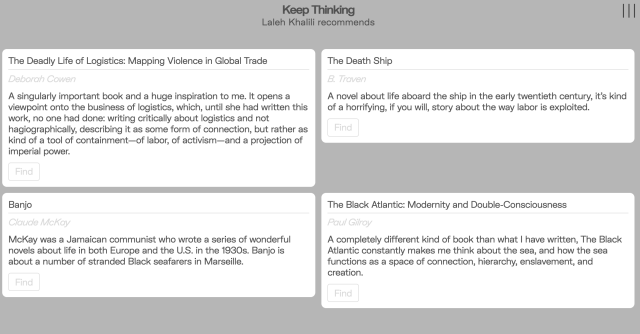
He asked me to suggest 4 books and I had to think on my feet, so of course I suggested the following: 2 novels and 2 brilliant books that have shaped all my thinking!

Screenshot 2020-05-13 at 09.21.13

Posted in capital accumulation, empire, imperialism & colonialism, labour, literature, Middle East, political economy, ports, seafaring, Uncategorized | Leave a comment

Abandoned Seafarers

Abandoned at Sea: Sailors and COVID-19

Ff83425630b746a6ab8ed6537e2b8bae_18-

The stranded Indian crew members on board MSC Grandiosa, docked in Italy at present (Al Jazeera)

On the list of COVID-19 afflicted countries tallied by the Johns Hopkins University Corona Resource Centre there is one entry that is not like the others: a cruise ship, the Diamond Princess. With 712 confirmed cases (out of 3,711 passengers and crew) and thirteen dead, at the time of this writing the cruise ship’s number of cases falls somewhere between those of Latvia and Lebanon. The ship, which flies the British flag, was quarantined in Yokohama, Japan, on 2 January 2020, after which, the number of those onboard who tested positive rapidly escalated. Although the world press, and especially the press in Britain, focused on the stories of passengers complaining about the quarantine, very few news outlets reported that of the 712 confirmed cases, nearly 150 were members of the crew, many of them from Indonesia and the Philippines. The quarantine had only really been enacted for the passengers, with the crew members still being forced to work and sleep in close quarters, often sharing tiny cabins with other crew members, some of whom were symptomatic.

The Diamond Princess was owned by Carnival Cruises who also own another cruise ship company, Holland America, whose ship Zaandam was also beset by COVID-19. Before passengers began manifesting symptoms, the ship had visited Uruguay and the Falklands, with passengers disembarking and touring the ports. Then, the United States declared a COVID-19 emergency in mid-March and Holland America halted all cruises. By then it was too late for Zaandam. The passengers socialised, danced and ate together and wandered around the ship unimpeded, while the virus began to take hold. As ports in South America denied entry to cruise ships, though still allowing ships to refuel and restock foods, more and more elderly travellers began coughing. With hundreds of ill passengers and crew and four dead bodies onboard, Zaandam was turned away from port after port, eventually met by another Holland America ship, Rotterdam, which carried COVID tests, and medical staff and supplies. What the hundreds of crew members aboard Rotterdam did not know when their rendezvous began was that they were going to receive passengers from Zaandam. And with no comprehensive testing of the transfer passengers, the Rotterdam crew was exposed to the virus. Finally, after two weeks at sea, Panama allowed both ships to steam through the Canal, and the two cruise ships landed in Florida on 2 April 2020, the passengers released by Holland America to take commercial flights home with few precautions and little or no testing. The crew remained onboard, quarantined off the coast of Florida.

In Australia, 2,700 passengers were allowed to disembark from the stricken Ruby Princess on 19 March, despite many who exhibited symptoms of COVID-19. The cruise ship is thought to have been the source of at least half of all Australian cases. Hundreds of the ship’s passengers were diagnosed with COVID-19 and 18 have died. As of this writing, the ship is at anchor in Port Kembla, New South Wales, with 66 ill crew members on board, and eleven others evacuated to hospitals in Sydney.

The highest number of COVID cases per passenger, however, occurred on a luxury cruise ship specialising in travel to the South Pole. Only a day after a media report celebrated Antarctica’s status as the only continent unaffected by COVID-19, the cruise ship Greg Mortimer reported that nearly 60 percent of the 217 people onboard had tested positive for COVID-19. The ship had steamed towards Antarctica despite the closure of many South American ports and the declaration of pandemic status in countries around the world.

The fate of cruise ship companies has dimmed, at least temporarily. Carnival, the world’s largest cruise operator has suspended all cruises until the end of June and laid off 26% of its 150,000-strong workforce; they were not furloughed and therefore they have no access to bridging government funds or any certainties about whether they can be rehired by the company. Carnival’s stock prices are down 70% since January 2020. The US has denied a government bailout to Carnival, as the corporation is registered in the Bahamas, where it pays a paltry $71 million in taxes on $20.8 billion in revenue, at the astonishing rate of a fraction of one percent. The company faces investigations in Australia and lawsuits in the United States. However, Carnival has also seen a significant injection of capital from, inter alia, the Saudi state investment company, the Public Investment Fund. We know less about the fate of the tens of thousands of laid off workers.

An Unequal Maritime Economy

Ships have historically been significant vectors of pandemics. The influenza pandemic of 1918–1920 is thought to have been transported by merchant vessels and demobilising warships from continent to continent and coast to coast. As empires, global trade, and long-distance wars wind the corners of the world together ever more tightly, the same conduits of travel for passengers, soldiers, sailors, and cargos also act as pathways for pathogens. The naval ships of the world’s great military powers today still transmit illness across the seas. The aircraft carriers USS Theodore Roosevelt and the French Charles de Gaulle each have seen more than 650 of their sailors infected. No one knows whom they may have exposed in their transnational travels in the Pacific and the Mediterranean.

The effect of the pandemic on the maritime economy has been dramatic and well documented. Certainly, the firing of the commander of the Theodore Roosevelt and the scandal around the number of the infected sailors on the Charles de Gaulle—the most infectious case after the effects of the virus were well known—have been reported on the front pages of newspapers in the United States and France respectively. National GDPs have plunged (China’s first quarter 2020 GDP contracted by 6.8%), as has global trade. The World Trade Organisation predicted a fall in merchandise trade of between 13 and 32 percent. As much as 90 percent of this cargo is conveyed by ship to their final destination. In China, whose ports handle 30% of the planet’s freight, lockdowns forced ports to operate with skeleton crews, radically slowing both exports and imports, and in some places effectively shutting down the port entirely. Just as its main cargo ports were slowly returning to normal by the end of February, ports elsewhere were seeing drops in their cargo processing: in the busy port of Long Beach California, by a staggering 50 to 75 percent. Other container terminals in the US and Europe have reduced operations or shut down entirely. The Asia-Europe and Asia-Pacific route (and their reverse) have seen a massive drop in carriage, with hundreds of trips cancelled, and many other ships steaming with no cargo.

Not all maritime businesses are suffering, however. An oil price war between Saudi Arabia and Russia commenced in early March, with Saudi Aramco deploying its excess capacity to pump oil at the very moment when demand for petroleum and its products plummeted. The price of oil dropped so dramatically that, soon, fracking companies in the United States were facing bankruptcy and the benchmark price of West Texas Intermediate swooped below zero, meaning that traders, faced with saturated storage spaces, had to pay to not take delivery of produced oil. As oil flowed out of the ground and land-bound storage capacity was quickly filled, producers looked to seaborne storage. At the time of this writing, some 60 Very Large and Ultra Large Crude Carriers (VLCCs and ULCCs, some with carrying capacity of up to 2 million barrels) and many other smaller tankers have been chartered to store oil at sea, in what some call the greatest oil glut in history. The owners of ULCCs and VLCCs are able to charge rates as high as $335,000 per day and the stock of tanker companies skyrocketed by as much as 19 percent.

In all this, the pandemic has starkly delineated the inequalities of race, class, gender and geography worldwide. As in other pandemics, those communities already suffering from poverty, neglect, lower life expectancy and higher chronic illness and mortality rates are also those who are afflicted more severely and die in larger numbers because of the virus. However, one of the distinguishing features of COVID-19, as compared with past pandemics, has been that—at least in its earliest stages of transnational transmission—the most significant carriers of the virus have been the affluent, well-resourced, and seasoned international travellers from the global North. Though aeroplane travel has been the primary means of transmission, the stories recounted above of only a handful of ships indicates that leisure travellers aboard luxury cruise ships have carried the virus to the furthest reaches of the world, including the supposedly pristine Antarctica.

The social fractures the pandemic has revealed on land are well-reported: so many “essential workers” are working-class people of colour, and so many are extensively exposed day after day to the virus. In some US states, fully a third of hospitalised COVID patients are people of colour. In the Anglophone world, the proportion of medical professionals of colour who have died because of COVID far outstrips their percentages in the public or even among healthcare workers. As anxiety about the fraying supply chains—especially for food—increases, so does the callousness with which workers all along these chains are treated. Many employers are not providing factory, logistics, and warehouse workers, delivery drivers, and others in essential but badly paid services with paid sick leave if they are self-isolating and provide them with little—and more often no—protective wear as many are forced to work in close quarters with one another or close contact with consumers. One response of workers to the intensified rates of exploitation and COVID exposure has been to strike all along these supply chains.

At sea, the feeling of abandonment is even more pronounced.

Once the passengers of “hot” cruise ships disembarked, public attention largely shifted away from the ships themselves. But many of those ships are at anchor with crew members on board, under a condition of quarantine familiar from past centuries. Some are aboard empty cruise ships, unable to dock at any ports, unable to fly home, sometimes with dwindling supplies. Some will remain onboard ships even when their contracts end and they are no longer paid; others have seen a reduction in pay while they continue to perform necessary maintenance on the docked ships. Aboard the Ruby Princess, some 1,400 crew members remain in isolation, unable to disembark. Of those, nearly ten percent have tested positive for COVID-19. The close quarters of a cruise ship (even with crew members now allowed to lodge in passenger rooms), and the daily delivery of food by handlers who could themselves be ill act as accelerants for the virus. Dozens of cruise ships near the US coast are similar hothouses for confined seafarers. On many of these ships, the non-US crew have their passports locked in the captain’s office, and even if they could book that rare flight home, they would not be allowed off the ship without their passports.

But it is not only the crews of cruise ships who are suffering such fates. The seafarers working cargo ships—container vessels, tankers, automobile carriers and the like—who come to the end of their contracts, sometimes after nine months at sea, are unable to return home. As many as 100,000 seafarers have come to the end of their contracts but remain aboard ships, unable to travel home because of restrictions on flights. Seafarers on smaller ships have been abandoned. Indian fishermen are afloat on the coast of Iran, unable to return to India, without any prospect of repatriation by the state, and with dwindling supplies of food. Towards the end of March, the Indian government advised its seafarers not to sign off ships or try to return to home as borders were closed. Of the sailors abandoned across the world, some 40,000 of them are Indian. Perhaps more alarmingly, even if a seafarer has been able to disembark, their arrival at home has sometimes been met with suspicion, and there have been instances of seafarers being stigmatised and shunned by their friends, neighbours, and landlords who fear they may be carrying the virus.

Ghost Ships and Abandoned Sailors

Hunger ships, abandoned sailors, and ghost ships haunt modern literary seascapes. The plaintive cry of the protagonist of B. Traven’s 1926 novel The Death Ship  was about everyday working conditions aboard ships, where seafarers felt they had no recourse, not even to their own governments:

We are always hungry because a shipping company cannot compete with the freight rates of other companies if the sailors get food fit for human beings. The ship must go to the ground port, because the company would be bankrupt if the insurance money would not save her. We do not die in shining armor, we the gladiators of today. We die in rags, without mattresses or blankets…. We die in silence, in the stoke-hold. We see the sea breaking in through the cracked hull. We can no longer go up and out. We are caught.

The feeling of being caught is now experienced by many. The most universal response to the COVID-19 pandemic has been containment: the contraction of spaces in which people can move and the closing of borders, confinement to one’s household, closed off businesses, a surveilled, policed and closed-off country. But within and amidst these fixed spaces, the poorer, the less powerful, and the racialised still have to move—as delivery drivers, logistics and transport operators, and any other essential workers commuting between work and home.

Migrants and refugees—many of whom, by necessity, are part of the maritime world—are often forgotten. The migrants and refugees trapped in island camps are one such exposed, endangered, and relatively invisible category. Another are mobile people at sea. With European countries closing their borders, the civil rescue NGO Sea Watch has reported that one migrant boat in the Mediterranean has sunk and three others are in distress. Meanwhile, in the absence of safe harbour guarantees by European ports, other rescue organisations have ceased operation. The coronavirus has provided the alibi the European states have always sought for denying entry to desperate migrants and for abandoning them to illness in camps.

The similar condition of invisibility and abandonment at sea now experienced by quarantined seafarers is only an intensification of the vulnerability constantly present in seafarers’ ordinary working conditions. Even at the best of times—that is,  working on ships registered in countries which observe health and safety rules, and labour and environmental regulations—seafarers are constantly exposed to physical injuries and mental pressures. Cargo ships almost never have doctors onboard, not to mention ventilators or other sophisticated medical equipment. Living spaces are cramped and crew members share cabins with one another. If a seafarer is injured or becomes seriously ill, they almost always have to wait until arrival at a port that will allow disembarktion to be hospitalised or repatriated. Modern cargo ports are often far from city centres and turnaround times for ship loading and unloading is now so swift that seafarers rarely experience adequate shore leave. Ordinary crew members often spend nine months at sea and a month off, while officers have shorter—but still months-long—contracts. Everyday seafaring is hard work, contoured by exhausting schedules, loneliness while confined in close quarters, melancholy and anxiety. A survey commissioned by the International Transport-Workers’ Federation and conducted by Yale University has shown that more seafarers suffered from depression and have contemplated suicide than the general population or any other occupation.

In a pandemic, with cities and borders closed, shore leave and crew changes not permitted by transit ports, welfare visits to ships disallowed, and no clear or consistent end in sight for such restrictions, the world’s 1.6 million seafarers have been feeling anxious—about their own fate, about their families’ health, about their income now and availability of work in the near future. Predictions about when or how global trade may recover are at best wildly speculative. At this moment, the only thing we know for certain is that the very scale and scope of mobility that has so dramatically defined this age of trade is also the factor that undergirds the abandonment and isolation of seafarers aboard ships. In what ways this moment will redefine the parameters of work, encourage yet more fantasies of automation or economies of scale, or ignite new waves of political mobilisation among seafarers remains to be seen.


This post was originally published at https://www.versobooks.com/blogs/4692-abandoned-at-sea-sailors-and-covid-19

Update: When I first wrote the piece, the numbers were at 100,000; now, today, the numbers seem to be up to 150,000.

Update 2/Correction: Thanks to Conor Ryan who wrote to me that “the Greg Mortimer goes to the Southern Ocean rather than South Pole”!


Posted in labour, logistics, political economy, ports, seafaring, shipping conditions | 1 Comment

Interview with Philip Wohlstetter

For a couple of years now I have really wanted to attend the Red May socialist festival in Seattle, but sadly the timing (and the physical distance) have gotten in the way. This year, because of COVID-19, I ended up being able to attend the festival (virtually). I was interviewed by Philip Wohlstetter not only on Sinews of War and Trade, but also about my trajectory – from Iran to Texas and New York and beyond- and also about my other books:


Posted in capital accumulation, empire, finance and insurance, infrastructure, labour, logistics, Melville, Middle East, militaries, oil, political economy, ports, Uncategorized | Leave a comment

Sinews of War and Trade website

The brilliant Rafeef Ziadah and Katy Fox-Hodess were instrumental in researching and building the project website, http://sinewswartrade.com/

The project website provides a wealth of information about maritime transportation and the surrounding infrastructures in the Arabian Peninsula. It mines both historic and contemporary sources to populate the data spreadsheets and the data-visualisation that give a quick sense of logistics and maritime work in the countries of the Gulf as well as Yemen!

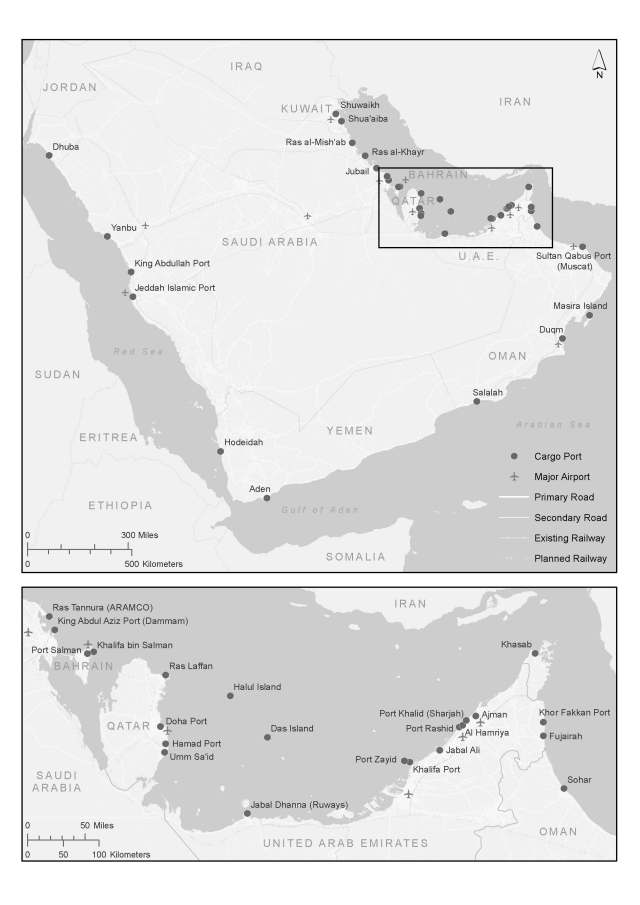
Eseld Imms designed the site. She is also the brilliant map-maker for the book, Sinews of War and Trade. The map below is the one that appeared in the book.

@MapOfPorts.jpg

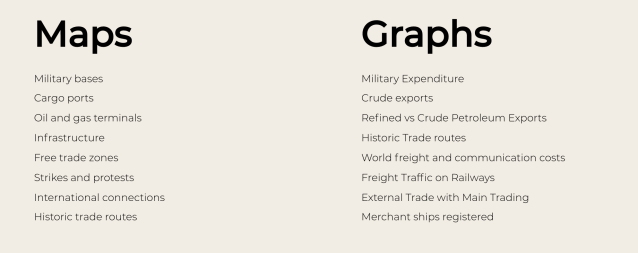
The website includes rich info sheets for all the countries of the peninsula as well as the following maps and graphs: Screenshot 2020-04-15 at 14.46.16.png

Posted in construction, environment, free ports/zones, infrastructure, Middle East, militaries, political economy, ports, transport, Uncategorized | 2 Comments