Golden Dawn recruited by shipping magnates to break unions

‘[Golden Dawn] created battalions against their political opponents, and then they rented them out, to whoever wanted to rent them,” he told Channel 4 News.

In one of the most important cases, a network of businessmen active in the shipping industry allegedly involved Golden Dawn in their continuing struggle against the stubborn unions which wouldn’t accept lower wages and less rights.

“We know for a fact there was a direct payment from the bosses of the shipbuilding industry in Perama,” Mr Kabayiannis said, in relation to a donation to the party in the volume of £240,000.’

From this Channel 4 news item (h/t Craig Gilmore).

Posted in capital accumulation, infrastructure, labour, logistics, political economy, ports, transport | Leave a comment

The blue banana

Last week, huge protests took place in Brussels, with the trade unions reporting some 130,000-150,000 people showing up; and major clashes with the police.  The protests in fact have been going on for some time now.  And in the April protests, “hundreds of marchers adorned in the orange bibs of the BTB-ABVV docker’s union from Antwerp ripped up paving stones to throw at riot police, who responded with blasts from two water cannons.”

The protests are about pressures from the European Union to undermine protections for workers’ rights.  As one report explains

The Belgian dockers’ main grievance is a 40-year-old “Law Major” that grants social advantages, and protects them from social dumping. The country’s Flemish-speaking Liberals want to reform it, arguing that it harms the port’s competitiveness.

On 25 March, the European Commission sent a formal notice to Belgium asking for changes to the law – which protects 8000 workers – to be made within two months.

At the 6 November protests, Al Jazeera reports that “Workers and staff at steel firms, the ports of Antwerp and Zeebrugge, the post office and in education were also planning to stage a work slowdown.” And there is going to be a strike on 24 November.

This absolutely fantastic piece in Italian sheds some light on the roots of the proceedings. Its author, Giorgio Gräppi, works on globalisation and migration issues and has some very interesting reflections on the causes of the strike (I don’t read Italian, but Google Translate seems to butcher the language far less than it does other languages).  I just want to point to some of these reflections that are definitely worth thinking about:

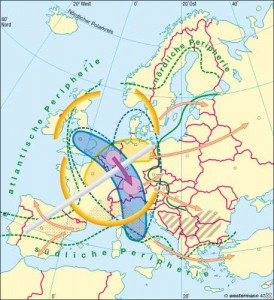
First, is the “blue banana.”  As Gräppi explains, in 1989 a new geoeconomic model of development emerged which placed the focus of European industrial development in the zone shaped like a blue banana:

Blue Banana

The prediction/plan is now a reality with a supply chain trade  magazine reporting that “‘Blue Banana’ leads the way in European logistics.”  The top European ports (Rotterdam at 11; Hamburg at 15; Antwerp at 16; Bremer at 25) are all within this powerhouse economic industrial zone.  The same trade magazine article writes,

“For instance, a population of 143 million can be reached by lorry within nine hours from Antwerp. This increases to 190 million people for Frankfurt, the city with the largest population catchment in our analysis,” Barnekow said.

Liege in Belgium and Lille in northern France were cited as cities offering a particularly good compromise between market access and reduced costs. The report also said northern Italy offered good potential for distribution activities, as freight traffic through northern Adriatic ports is expected to increase.

Gräppi quotes a Prologis report from 2013 on European logistics.  The report (PDF) begins ominously enough:

Europe has a larger population and a higher combined Gross Domestic Product (GDP) than the U.S., yet it has 4.5 times less Class-A logistics space.  In this context, the reconfiguration of the European supply chain and the rise of e-commerce means there is significant development potential for modern, efficient distribution facilities across the region. The questions facing developers, owners, managers, and their customers, are: “Where are the most strategic logistics locations in Europe, and why?”

The report then begins to evaluate some 100 European ports and score them “against 13 criteria, which were grouped into four categories; 1) Proximity to Customers and Suppliers, 2) Labor & Government, 3) Real Estate, and 4) Infrastructure.”  Predictably, “labour and government” means that low labour costs and ” low regulation barriers” make ports more palatable.  The report specifically quotes “hourly labor costs (incl. wages & salaries and other costs) ranging from €3.70 and €4.40 in Bulgaria and Romania respectively to €37.20 in Denmark and €38.10 in Sweden. Spain scored highest (5th) for the ‘cost of labor’ driver outside Central & Eastern Europe.”

As Gräppi  writes, Prologis’ “ranking functions as a sort of rating for an industry that responds more and more to the logic of a financial nature.”  What Gräppi argues is that these rankings processes essentially place all the ports in competition with one another and placing downward pressure on wages, demanding further flexibility of labour.  Even more importantly Gräppi  argues that when people claim that the automation of jobs essentially necessitates removal of humans from the process of production (the problem of unemployment), they are ignoring the fact that even the digital instruments and automation technologies have to be manufactured somewhere.  This global scale influences policies at a fundamental level.  As Gräppi  writes,

[the protesting port workers’] main enemy, as well as the policies of the Belgian Government, is the EU’s attempt to liberalize port policy at the continental level, to overcome the current organization on a national scale… [It] is clear that liberalization imposed on a continental scale would pressurise even those ports where today the bargaining power of workers is higher.

Perhaps especially those ports where the bargaining power of workers is higher.  Gräppi’s reflections on these massive changes and what they mean for labour-organising are worth reading at length (even if one has to do so via Google Translate).

But there is another point of interest for me:

As Gräppi explains (and the Prologis report passingly mentions), there is also now some talk of developing “Romania Pan-Regional, an area identified in the triangle between Timisoara, Bucharest and Brasov.”  Incidentally, the emergence of these new logistics mega-hubs (or corridors, gateways, logistic cities, and other varying appellations) is something Deb Cowen wrote about in her brilliant book (which focused specifically on Basra Logistics City (on the site of Camp Bucca) and on the new air-sea hub to be built on Clark Airbase in the Philippines).   The Prologis report says that Romania Pan-Regional “owes its top 10 rank primarily to very good scores on Real Estate and Labor & Government categories.” I wonder of the triangle between Timisoara, Bucharest and Brasov teems with old and disused Soviet air or army bases.    But even more interestingly, what will probably end up accelerating the growth of the logistics industry in Romania is this little news item:

A Pentagon statement said the two sides “finalized an agreement for Romania to support logistics into and out of Afghanistan, including both personnel and cargo movement.” Further details about the terms of the agreement with Romania were not made publicly available.

The United States currently has more than 50,000 troops in Afghanistan, and will need to transfer huge quantities of vehicles and weapons out of the country over the next year to meet the deadline of withdrawing combat forces by the end of 2014. The United States has been paying tens of millions of dollars annually to use the Manas base in Kyrgyzstan [but the US contract with Manas expires in July 2014].

And there is trans-continental scale for you!


Posted in capital accumulation, finance and insurance, infrastructure, labour, logistics, political economy, ports, transport, war | Leave a comment

More amazing maps

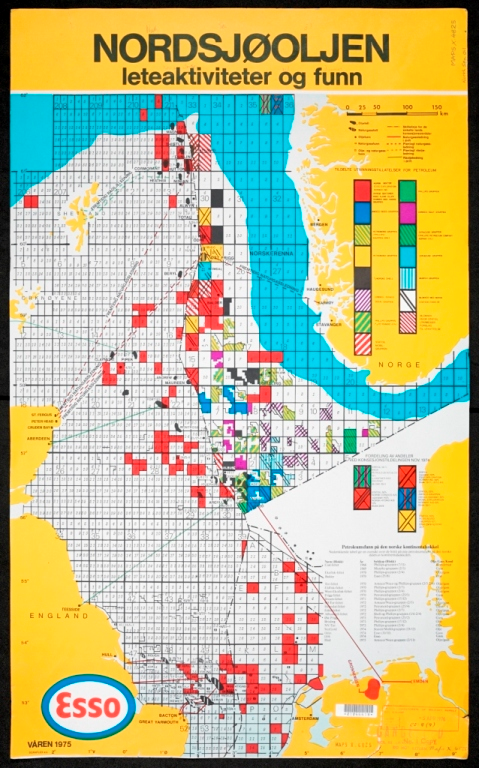
The British Library Map Collection includes this amazing map:

North Sea map

They explain the controversy around this map:

… in the 1970s in Britain, suffering from the  Middle East oil embargo, with economic malaise and high unemployment, it was argued as such. There is a deep blue area on the map which curved around Norway on the map, signifying deeper water. It was argued by some that this ‘Norwegian Trench’ limited Norway’s continental shelf to the area within that trench. However, Norway’s eventual area of the North Sea got was far greater, encompassing the giant Esofisk oil field which is visible at the lower centre of the map. So desperate had Britain been to realise the benefits of the North Sea oil revenue that it ceded more to Norway just to avoid protracted negotiations. It was called by critics ‘the most generous present in English history’. 


Posted in oil, the sea | Leave a comment

Block the Boat

One of the most trenchant points that Deb Cowen makes in her superb book, The Deadly Life of Logistics, is that labour mobilisation is a form of “obstruction” that is securitised by shipping companies and states and crushed, precisely because it becomes a kind of chokepoint for the circulation of goods.  And if the goods cannot circulate, capital is not capital.

Now, we hear about “Block the Boat”,  another kind of corporeal obstruction which specifically targets shipping as a means of disrupting the smooth flow of specific instances of national capital.  This occurred with South African apartheid, and is now happening again with Israeli shipping.  The Block the Boat movement is a coalition of BDS and labour activists who are obstructing the unloading of Israeli ships  belonging to Zim Shipping Company in West Coast US ports.

As the Jacobin account of the movement explains,

The Palestinian General Federation of Trade Unions (PGFTU) has called on workers worldwide, and Bay Area workers in particular, to refuse to facilitate the commerce of Zim and other Israeli companies as part of BDS. This call was supported by COSATU, the Coalition of South African Trade Unions.

US unions have for the most part been slow to respond, due in part to the deep and longstanding influence of the Histadrut and its US counterpart, the Jewish Labor Committee (JLC). […] The organization is primarily concerned … with enforcing a pro-Israel line in elite labor and Democratic Party circles, including through its cozy relationship with the AFL-CIO. In 2009, the JLC co-founded the group Trade Unions Linking Israel and Palestine (TULIP), whose specific purpose is to prevent trade union support for BDS and undermine it where it already exists.

Given this political climate, it’s remarkable that this summer’s Block the Boat action in Oakland was able to succeed — and only due to mass community participation and solidarity from the rank and file of the Bay Area dockworkers’ union, the International Longshore and Warehouse Union (ILWU) Local 10. While the JLC and other Zionist organizations wield great influence over the AFL-CIO, the ILWU actually broke with the AFL-CIO as recently as August 2013. The union’s slogan is “An injury to one is an injury to all,” and their history bears out their commitment to international solidarity.

It was a strike by Local 10 that kept a South African ship from offloading its cargo for eleven days in 1984. In 1978, Local 10 refused to load weapons parts that were supposed to be sent to Chile’s brutal military dictatorship. During the Occupy protests, the union refused to work as part of the general strike called for by Occupy Oakland and other activists. Local 10 member Clarence Thomas traces the union’s history of honoring direct actions back eighty years: “[w]e’ve respected community picket lines since 1935, when Local 10 workers refused to load metal that was bound for the war machines of fascist Italy and Japan.”

As First Look tells us, Zim is a particularly apt target of blockade because of the ways in which its concerns converge with those of the state of Israel:

Zim has drawn particular ire for its role in shipping Israeli armaments. In the words of Block the Boat organizer Lara Kiswani in an interview about the movement earlier this year: “…Zim also transports weaponry: Israeli-made weaponry and Israeli-made military vehicles into the United States”, adding that, “some of the more consumer-based products are not Israeli, but the weaponry and the military products are Israeli.”


Posted in labour, logistics, Middle East, ports, transport | Leave a comment

Carbon Capital in Motion

I have already written about ships as workplaces, and of workers held captive on ships.  Now, the NY Times reports on a massive floating refinery which is going to look for fossil fuels in the Indian Ocean.   The ship is HUGE:

More than 530 yards long and 80 yards wide, it was constructed with 260,000 metric tons of steel, more than was used in the entire original World Trade Center complex, and it’s expected to displace 600,000 metric tons of water, or as much as six aircraft carriers. Even the paint job is huge: Most big vessels dry-dock every five years for a new coat, but Prelude’s paint is supposed to last 25 years. It will produce more natural gas than Hong Kong needs in a year.

And the reason it is now feasible to construct such a massive “facility” is because of the way natural gas can be extracted at more reasonable costs:

Right now it is under construction in a South Korean shipyard on Geoje, the island where Samsung Heavy Industries makes large ships and drilling platforms. Prelude is designed to take advantage of inaccessible or “stranded” natural-gas deposits, stranded because until recently they cost too much to make their capture worthwhile. In North Dakota, for example, most natural gas released from oil drilling is burned off because of infrastructural limitations and the expense of recovering it. “A project like this wasn’t an economical prospect for decades, but now things are changing,” says Francis O’Sullivan, the director of research at M.I.T.’s Energy Initiative. Owing to shifts in oil prices and a change in the climate of energy arbitrage, a vast amount of usable natural gas — an estimated three trillion cubic feet of it — is now profitable and waiting to be tapped within an area called Browse Basin, under the Indian Ocean, roughly 125 miles northwest of Australia. That’s where Prelude will soon be towed, then fixed to what “The Biogeography of the Australian North West Shelf” describes as “the relatively featureless sedimentary sea floor plains.”

A few questions come up: What about the people who work on the ship?  Does the fact that Shell refuses to call the ship a “ship” and calls it a “facility” have anything to do with varying labour regulations?  Or legal ones?  What about questions of territoriality and the rights of exploration?   Who owns the rights to this Browse Basin (other than Shell of course)?  And what are the environmental effects of having floating fossil fuel factories and production lines floating on seas?


Posted in capital accumulation, environment, infrastructure, oil, political economy, ships | Leave a comment

The Deadly Life of Logistics

My review of Deb Cowen’s wonderful new book, The Deadly Life of Logistics, is now out.  I write

The Deadly Life of Logisticsis organised around a series of themes whose interconnections are clear throughout: the integral conjuncture between the discourses of management studies and of logistics; the securitisation of labour; and perhaps most important, the illusory boundaries produced between the domains of “economics” and “politics” and between “civilian” and “military”, which again and again structures practices and political relations around piracy, labour unrest, “supply chain security”, and the making of “logistics cities” out of the ruins and wreckage of endless wars.

Read more on the blog-site of EPD –Society and Space.


Posted in logistics, political economy, transport, war | Leave a comment

Tangsir

I grew up with a number of Persian-language classic novels on the bookshelves of our house.  Throughout my childhood (I was a precocious reader) and teenage years, I tended towards Sadeq Hedayat and Simin Daneshvar and Jalal Al-e-Ahmad.  A bit predictable really.  My father was from the south; Jahrom, specifically.  He had a soft spot for a number of novels and non-fiction books written about the south, and sometimes in the vernacular(s) of the region.  Somehow I was never interested.

Tangsir_movie_poster

But age does wonderful things to one’s reading habits and tastes (cf. Moby Dick).

I decided this year, when visiting my mother, to re-read Sadeq Chubak‘s Tangsir (1963) which sits on her bookshelves now -the same hardbound 2nd edition I knew in my childhood, published Tehran in Esfand 1346 (or roughly February 1968) with its price (220 Riyals) embossed on the back cover.  It was a moving experience reading it.  Two sentences were underlined in the book; one to the effect that one’s integrity mattered more than anything else in the world, including one’s family; and the second that living for 40 years with honour was more worthwhile than living 100 without it.  Given the particular political and biographical trajectories of my father, his having underlined those particular sentences was poignant.

But what really struck me about the story was not simply the “heroic anger” of Zar-Muhammad, the hero of the book.  It was the intensity of the feel of the places Chubak wrote about.  And the vividness of the story’s setting.  And the way it was historically situated.  The opening of the novel in particular is stunning: its description of the infernal humidity of the coast in summer, the relentlessness of sunshine, makes the reader feel sweaty and thirsty.   Its description of sacred trees -under one of which the hero of the book, Mohammad, shelters from the sun- is lovely and affecting in its portrayal of heterodoxy (when we live in such orthodox times).  The book’s wonderful glossary itself is extraordinarily readable.  And its matter-of-fact portrayal of plurality of publics in Iran: an important character turns out to be an Armenian shop-keeper who supplies the English and others with alcohol.

Tangsir

But even more, it is the geography of Bushehr -and of the sea- the book celebrates.  Chubak maps Bushehr through the city’s various neighbourhoods and their relationship to politics, economic production, and the sea.  And the British.

The British established a residency in Bushehr in 1763.  The city served as a transit point on the trade route from India and a base of trade with the Persian empire. The British then went on to occupy Bushehr outright after they defeated the Iranians in the 1856-1857 Anglo-Persian War, and stayed there for the next 20 years (the residency shifted to Bahrain in 1947).

In the meantime, a large number of English words have become part of Persian (in the south “tomato” is called “tamateh”), and the British with their Indian Army soldiers became quotidian fixtures in Iranian lives and imaginations throughout the southern parts of Iran (Simin Daneshvar’s fabulous Savushun has indelible images of the British and Indian soldiers in Shiraz) – their politics and politicians were already long affixed in the halls of power and in the political machinations of the Iranians.

What Tangsir does is to imagine Bushehr sometime in the late 1920s.  The central story is not really related to the British, although they loom large in the background of the story.  But what was amazing -like many many other things- was the awareness of how inadequate and incomplete my education in Iranian history has been.  A historical figure invoked by Mohammad is Rais Ali Delvari who apparently fought against the British and “died in Mohammad’s arms.”

Ali Delvari

Ali Delvari (1882-1915) was born in Tangestan, and while in his twenties he took up arms against the occupying British and ended up being killed in the fight (Check out this mesmerising little video by a storyteller who tells the story of Delvari).  The details that come out in Chubak’s story are brilliant: Martin guns, the provisioning of weapons, the incorporation of weapons and their names into Farsi and the Persianisation of their names.  Interestingly, British histories would want to draw our attention to the Germans doing the provisioning (specifically one Wilhelm Wassmuss who seems to have been a pretty colourful character, so colourful that Christopher Sykes wrote a biography of him, like he did of Orde Wingate).

There is something fascinating in all of this: those most insistently resisting the British -at least in the South- seem to have been “tribes”: Qashqayis, Laristanis, Tangestanis.  And of course one of the first thing that Reza Pahlavi does when he comes to power is to bring the tribes to heel; to disarm and disperse and sedentarise them.  Chubak records the moment, the caesura, between the popular uprisings against the British and the moment in which these popular groups are subsumed into and subordinated by the state.  And the people he portrays embody a history so often left out of the textbooks.

And finally, the sea.  The sea is -unlike the British- not in the background.  Its corporeality – sense and smell and look, its calm and physicality- are there from the very first scene until the very last.  Mohammad was once a helmsman on the Iranian Navy’s sole gunboat, Persepolis (ignore the linked URL’s contemptuous tone if you can. It is very obviously written  by an Englishman).  The scene in which Mohammad fights a swordfish is extraordinary and beautiful and terrifying all at once. And the sea acts as the possible escape route and the originary point for emigration to Kuwait or Bahrain (incidentally, in the story, Dubai is a backwater; Sharjah is a place where politics and commerce happens; and Kuwait and Bahrain are considered cities on par with Bushehr).  The sea is there in the cuts and callouses of Mohammad’s hands and feet.  The haze of its salty humid air cushions the palm groves.  Its fish are dried, fried, grilled and cooked with rice and bread and dates. What Chubak does brilliantly -beside the invocation of histories excluded from the national canon- is to give a sense of the place which is also so often, literally and figuratively, on the margins of Iranian national imaginary.

Posted in literature, Middle East | Leave a comment

Navigating through the arctic

Rather terrifying to think that the ice has melted so much that ships can navigate through:

The polar route to the port of Bayuquan, China, is about 40 percent shorter than the route through the Panama Canal, according to Fednav. Through fuel savings, the company expects to reduce its greenhouse gas emissions during the voyage by about 1,300 metric tons (1,430 tons).

http://news.discovery.com/earth/oceans/cargo-ship-is-first-to-solo-the-northwest-passage-141002.htm

Posted in capital accumulation, environment, shipping conditions | Leave a comment

Oil and logistics

Fascinating piece from Guernica magazine about how more and more ex-soldiers and military logistics firms are going into the oil business:

This concentration of former service members owes partly to the fact that military training makes many uniquely suited for work in the domestic oil and gas industry. That, at least, has been Dave’s experience. The job center referred him to a fellow military man who runs a local nonprofit for veterans. When this man learned Dave’s skills, he immediately escorted him to B&G Roustabout Services, a growing oilfield service company, which hired Dave on the spot to work as a pipeline mapper.

Meanwhile, DynCorp International, Dave’s former employer, is also attracted by Williston. The military contractor specialized in providing logistical support to the armed forces during the Iraq and Afghanistan wars, and may soon join the ranks of defense companies that have found ways to segue their expertise into oil and gas.

“They and other defense logistics providers are very attracted by this sense that there’s all of this exploration activity and a lot less infrastructure to make it all possible,” said Kathryn Seitz of Avascent, a Washington, DC-based consulting firm that focuses on the aerospace and defense industries. The press office of DynCorp stated that the company is not currently engaged in any oil and gas projects, and that it doesn’t discuss internal strategic plans.

Posted in capital accumulation, infrastructure, logistics, militaries, oil, political economy, transport | Leave a comment

The Leisure of Transport

I have had -broadly speaking- four large and interconnected set of research interests thus far: Palestinian commemoration of political violence -massacres and battles, heroes and martyrs; the counterinsurgency work of US, Israel and colonial militaries; the politics and political economy of leisure and pleasure; and now my transport stuff.  In a previous post I managed to connect my transport project to my first research concern… And now I want to briefly talk about the links between spaces of leisure and their transport links – but in London not in Beirut (where I “researched” bars and beaches. Really).

Last March, after some 15 years, I started running again.  I happen to live in a part of London that affords me loads of fabulous urban running routes. In fact, it is rather striking the amount of green space this city has.   Parks accessible to public form around 10% of the land, and if farmlands, wasteland with vegetation, private/neighbourhood parks and the like were included some 39% of London land is green space.

What has been striking for me though is that my most favourite running routes along/among/within these green spaces tend to be transport-related (surprise! surprise!).

The routes I love the best are those along the canals.  This city has A LOT of canals, which is unsurprising given the centrality of barge transport in the early 19th century for moving goods from the docks on the mouth of the River Thames inland, or from inland (and up north) via the Grand Union Canal southwards and outwards.  Regent’s Canal, for example, was intended to connect the Limehouse Basin to Paddington.  I try to run along that canal at least once a week, going from the Broadway Market either down to the Limehouse Basin or further east to Hackney Wick or the Olympic Park.  I love running along this route because one gets a sense of the variations in wealth, gentrification, neighbourhood character, and the post-industrial landscape of London before it becomes wholly twee (which it is doing at an unbelievable speed).

The endpoint of one of these routes is the now wholly gentrified Limehouse Basin which is probably occupied by bankers and other well-to-do younger people.  There is really no traces left of the working history of this basin on the Thames which was accessible from the sea. The Limehouse Basin was in the 19th century nicknamed “the collier dock”, via which coal was transported to gasworks and electricity grids along the river. But Limehouse Basin and the canals also kept the city’s food refrigerated.  I did a quick search in Jstor for “Limehouse Basin” and found this delightful item in The Journal of the Society of Arts from 1873 about ice transport.  Yup.  Ice:

The ice harvest, as conducted in America and on the Norwegian lakes and fjords, is an interesting operation. It commences when the ice is about a foot thick, and the first step is to plane off the snow, or rough surface ice, with an instrument, drawn by horses, called the ice-plane. When the required superficies is cleared, the ice-ploughs, which are like saws with plough-handles to them, and drawn by horses, set to work. Their business is to mark out the ice-field into squares of from two to three feet, like a chess-board, penetrating the surface from one to three inches. The blocks of ice, weighing from two to three hundred weight, are then easily detached by gentle taps on wedges, or by the use of a kind of crow-bar, and floated through an opening in the ice, or canals, to the ice houses, where they are stored most carefully with layers of sawdust between them, for shipment as required. Vessels carrying 500 tons and upwards bring them to London, where they are unloaded at the Surrey Docks, or Limehouse Basin, and thence conveyed to the different ice-stores, in barges on the canals, or other means of transport. The quantity of ice used in the metropolitan district annually has risen to high dimensions during the last few years. Perhaps it would not be an exaggeration to put it at 60,000 tons, not including the “rough” ice, collected from ponds, rivers, and canals in the neighbourhood of London. Some of the large merchants get rid of more than 10,000 tons in the year. The stores are immense, one belonging to Mr. Leftwich, for instance, being 44 feet across and 108 feet deep, and holding 4,000 tons. Yet our metropolitan consumption does not equal that of Boston or New York. It is only of late years, comparatively speaking, that we have taken to ice. Americans have long looked on it as a necessity, and not merely as a luxury. They use it almost as freely in the winter as in the summer. The moderate and, indeed, free use of iced drinks in hot weather is certainly wholesome, and, as a rule, there is no more danger in taking them when the body is very hot than in bathing in that state. It is a popular error to suppose that the shock in either case is dangerous. It is satisfactory to find that ices and iced drinks are now within the reach of the very poor, the former being obtainable at almost every street corner for the modest sum of a half-penny. Generally speaking they are wholesome, and even at this low figure it is said a very handsome profit is made out of them.

Independently of the personal pleasure derived from the use of ice as a luxury, it is a valuable article for a variety of purposes. Without it we could not have the supply of fish which now come in such large quantities from distant fishing grounds to our markets. It is true that its application does, to a certain extent, deteriorate from the flavour of fish, but it is better to get a good supply of fish with the use of ice than that it should be limited without it. Without ice it would be impossible to lay telegraphic cables of great length in warm latitudes, for the gutta-percha with which they are encased would melt. To obviate this, tanks containing ice are placed in contiguity to the tanks containing the cables. By the use of ice brewers are enabled to sell their beer cheaper. In former times, when ice was very dear, brewers generally could only brew once a week, in consequence of the time taken for “the wort” to cool. By icing the tanks this can now be done in a few hours, and brewing goes on every day. By the use of ice the ova of salmon and other fish, as well as the eggs of birds, can be transported thousands of miles ; and thus new and useful forms of animal life are diffused throughout the world. For medical and surgical purposes the value of ice is inestimable. For many affections of the head, such as sun-strokes, its application is most beneficial, and in numerous cases iced drinks produce the best possible results; while, for surgical operations, the employment of ice to deaden pain and arrest haemorrhage is now considered indispensable. Thousands of tons are used annually in our metropolitan hospitals. Such are some of the uses of ice, and we may, therefore, be grateful that such an abundant supply of cheap ice is always at hand for these and other purposes.

Soooo….   Limehouse Basin and the canals were crucial for carrying both coal and ice – and probably a million other things too.  Some of the sense of these places having been working places is preserved in the names of bridges and cottages on the canal, but otherwise, most of the route is gorgeous green gardens and beautiful Victorian warehouses that have been turned into posh lofts.

My other favourite run is the one along the south side of the Thames from Greenwich eastward (although a run in the Docklands is pretty amazing as well).  The flood barriers -which look like gorgeous space pods- are amazing to look at and their operations are of course also wonders of engineering – the technological sublime yet again.  And lo-and-behold, Costain engineering company had a hand in building them.  Costain, of course, was also involved in the dredging and construction of Jabal Ali Port in Dubai (and as I wrote in a previous post, was at one point partially owned by Muhammad Al-Fayed).

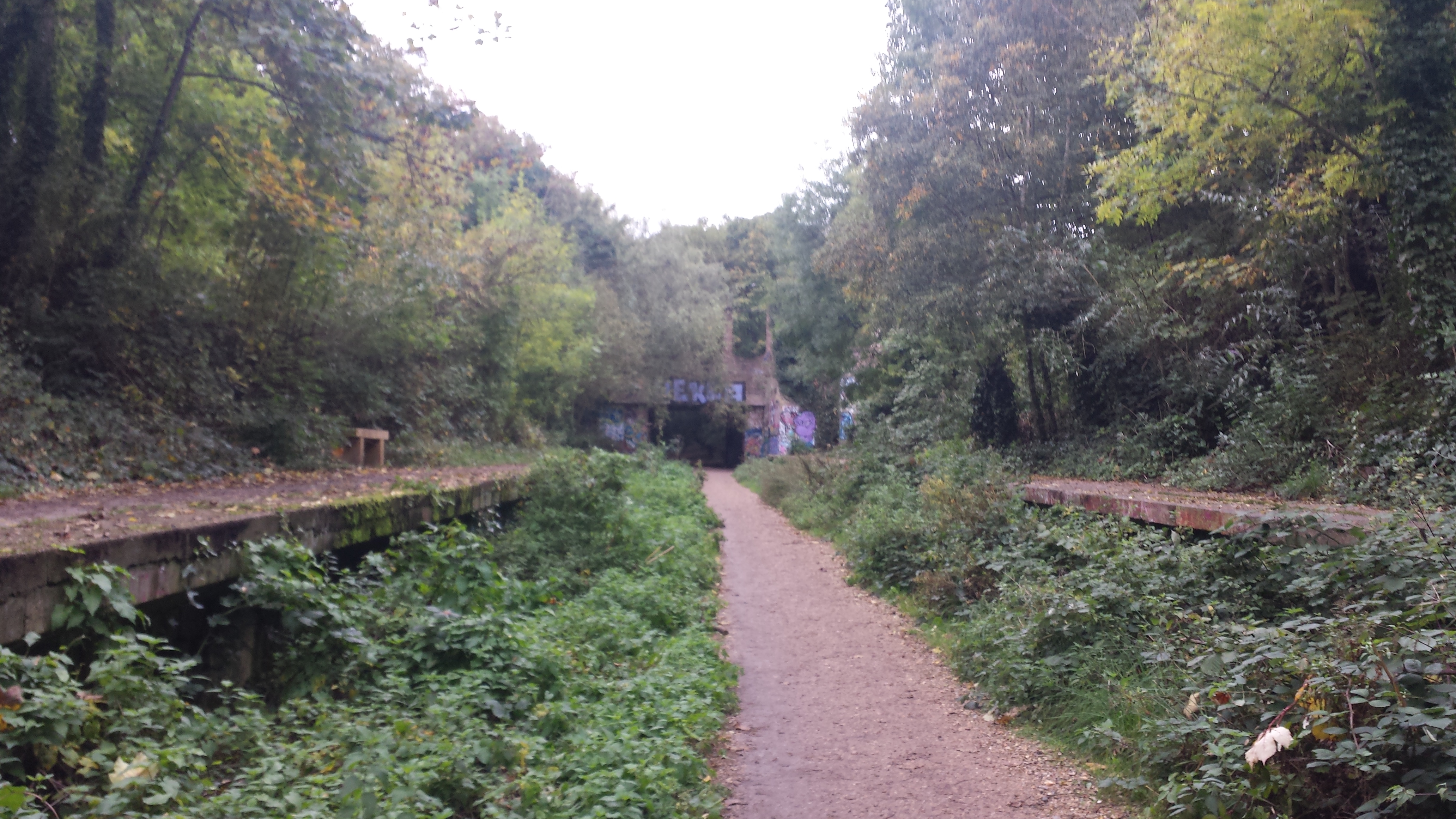
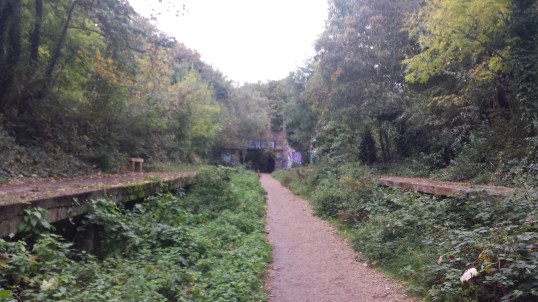
Finally, a new running route I have recently discovered (and yes, you can for ten years live less than a mile away from incredible gems such as this and not know about them) is the Parkland Walk.  The former railway along this wondrous disused rail path was first built in the late 1860s to connect the various bits of North London together.
Parkland

The path went all the way to Alexandra Palace which was a kind of “people’s palace” – for the education, entertainment and edification of the masses.  But as the transport routes changed and motorways ploughed through the city, this particular railway was no longer needed.  The trains stopped rolling in 1970 and the tracks were removed a year later, according to the official history.  And now this lovely path goes from Finsbury Park through Highgate to further north.

But I mention these routes because I think it is rather amazing that such wonderful places of leisure exist in London – this is partially because I have been writing about leisure practices in Lebanon, and it is disheartening to read about the processes of enclosure going on there: beach after public beach being taken over by private concerns, and public spaces being closed off to the public.  The wonderful Dictaphone group’s work is all about this enclosure of public spaces and the accumulation by dispossession that accompanies it.

In London though, we are the beneficiaries on the one hand of capitalist accumulation and imperial extraction of resources and on the other hand of a brief shining moment during which private or commercial spaces could be taken over by the state and transformed into parks and green spaces.  Richard Drayton’s amazing book about Kew Gardens excavates the direct imperial links to one of the most important and well-known green spaces in the city.  But we would not have Limehouse Basin, or the canals system, or the massive reservoires, or the need to feed and electrify and refrigerate if London had not been the most important of industrial hubs, the banking destination for capital accumulated domestically and abroad, and the world metropole for the largest empire of its time.

The Docklands Museum and the Maritime Museum in Greenwich both highlight this history of imperial connections beautifully.  The former is housed the West India Quay warehouses where the sugar produced off the back of slave labour in the Caribbean would arrive by ship to be stored or distributed.  People could afford ice as luxury and fish that had been transported because this was a wealthy city whose wealth has been extracted from trade, slavery, empire, all of them in a way, theft.

But so much of this wealth was extracted and much of which is sitting in the coffers of the rich.   But what is fascinating is that in the aftermath of the Second World War, the resultant national pact not only led to the making of that great national institution, NHS, but also to the nationalisation of so much green space and parklands in the city and countryside.  We are the beneficiaries of this politics.  The alternative would be the Lebanese option, where access to the beaches is classed and requires the payment of a fee, public spaces and even memorials are privatised, the two ostensibly public parks are always closed or policed by private security firms, and one place that remains open to the public is the Corniche.  About which more later.


Posted in capital accumulation, construction, empire, imperialism & colonialism, infrastructure, logistics, political economy, transport | Leave a comment