Marsaxlokk-Jabal-Ali: Besotted with the sea

6 February 2015

“For a ship is a bit of terra firma cut off from the main; it is a state in itself; and the captain is its king.” (Melville, White-Jacket – did Conrad plagiarise Melville as I often think he does?  See the Conrad quote I use as an epigram)

This might have been one of the best decisions I have ever made in my life. I am besotted with this time-place in ways I never imagined one could love a time-place, given my unapologetically worldly rootlessness.  Or maybe I do have an experience of this feeling, but it was always so fleeting, so viewed through the lens of the spectacle that is New York.  This besottedness with the shipboard experience is a bit like how I love New York at twilight.

Everyone loves New York a little: It is embedded in our memories, our visual cortex, because we have seen it on screens big and small. We know it before even visiting it.  New York at twilight is the spectacular time-place par excellence and I have loved it the way I feel the surge of desire, of ecstasy, in being aboard this enormous ship. The same intense, ephemeral sense of utter happiness. Utter contentedness. The same sense of utter astonishment at being alive and for being here, in this moment made of metal and machinery, swell, sea air, distance and depth and the familiar courtesy and community of shipboard life.  The pink twilight of polluted air in New York is like no other urban chronotope (or is it what Foucault calls heterochronies; heterotopias located in time). And the darkness in that quietly humming wheelroom tonight made me feel exhilarated in the same way a New York twilight might.  The one lasts as long as twilight lasts – the other you can carry with you all day. And all night.  And even as you sleep.  Were I to be reincarnated, I would come back to steam the seas.

I have quoted Foucault on the ship as heterotopia elsewhere – but again I want to recall that even Foucault falls for the seductiveness of the sea; and of the ship ploughing a furrow through the sea:

Brothels and colonies are two extreme types of heterotopia, and if we think, after all, that the boat is a floating piece of space, a place without a place, that exists by itself, that is closed in on itself and at the same time is given over to the infinity of the sea and that, from port to port, from tack to tack, from brothel to brothel, it goes as far as the colonies in search of the most precious treasures they conceal in their gardens, you will understand why the boat has not only been for our civilization, from the sixteenth century until the present, the great instrument of economic development (I have not been speaking of that today), but has been simultaneously the greatest reserve of the imagination. The ship is the heterotopia par excellence. In civilizations without boats, dreams dry up, espionage takes the place of adventure, and the police take the place of pirates.  

I have to say here that Casarino has gently challenged the kind of timelessness, ahistoricity, Foucault seems to attribute to ships.  In his “Gomorrahs of the Deep”, Casarino writes,

While Foucault’s claim stretches from the sixteenth century onward, I am interested, rather, in the final terminus of the whole process of development of the ship as the heterotopia par excellence. In the nineteenth century the sea narrative, while recording the most glorious historical moment of the ship, was also thoroughly imbued with premonitions of a future—namely, the twentieth century—in which the heterotopia of the ship would be inevitably relegated to the quaint and dusty shelves of cultural marginalia. The nineteenth-century sea narrative freezes the world of the ship into a fleeting image flashing onto the screen of history for one last moment before its disappearance; it captures simultaneously the apogee and the end of the ship as the heterotopia par excellence in Western civilization.
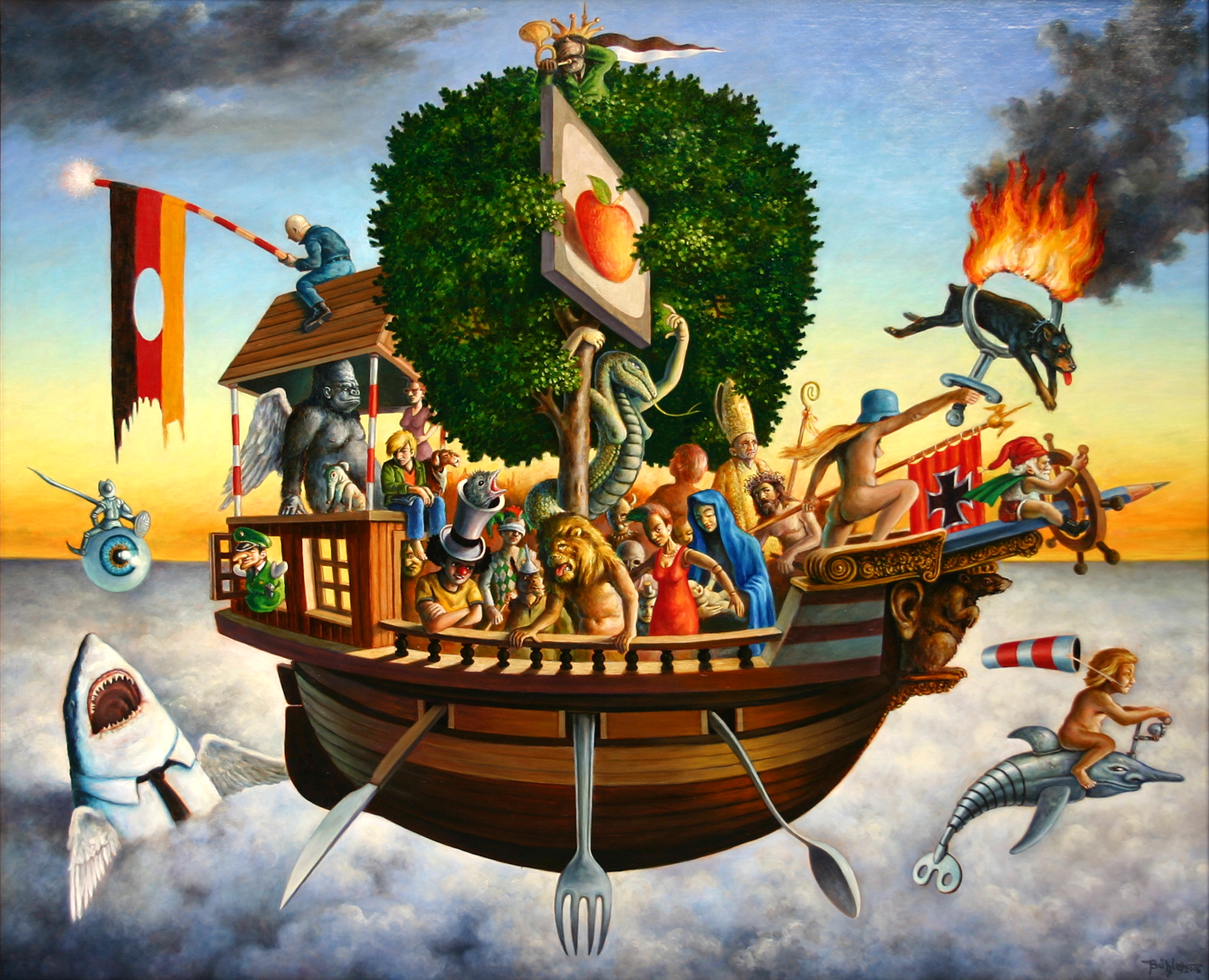
ship of fools

Thomas Bühler’s Narrenschiff (Ship of Fools)

The problem is that Casarino’s entirely persuasive act of historicising ship narratives doesn’t get at that affective specificity, that breathtakingly precise sentimental seascape, that Foucault manages to evoke which feels so much like what I feel right now.  Nor does Casarino really get at the experience and practice of shipboard life itself, even as he writes about sea stories.  He is writing about literature and his insight applies well to them, but not to the ship, nor ships in history. In fact, Foucault in his sweeping trans-historicism recalls Braudel’s long sweep and points to the massive importance of circulation in the economic history of capitalism in the way that Casarino’s narrower focus –on the sailors’ homosociality; the US Navy, and these works of literature– manages to miss.  In a sense, and as always, Allan Sekula gets it right.  Although, Sekula says, Foucault’s words betray a kind of “boyish romanticism”, nevertheless,

Foucault’s historical sources for his understanding precede romanticism. Implicitly, Foucault was returning to the image of the late medieval Narrenschiff, or “ship of fools,” analysed in the first chapter of 1961 Histoire de la folie. The shipborne banishment of the madman produced a voyage that “develops, across a half-real, half-imaginary geography, the madman’s liminal position on the horizon of medieval concerns.” [Madness and Civilization, p. 11].

I am afraid I suffer from a bit of “boyish romanticism” here, genderbending notwithstanding.
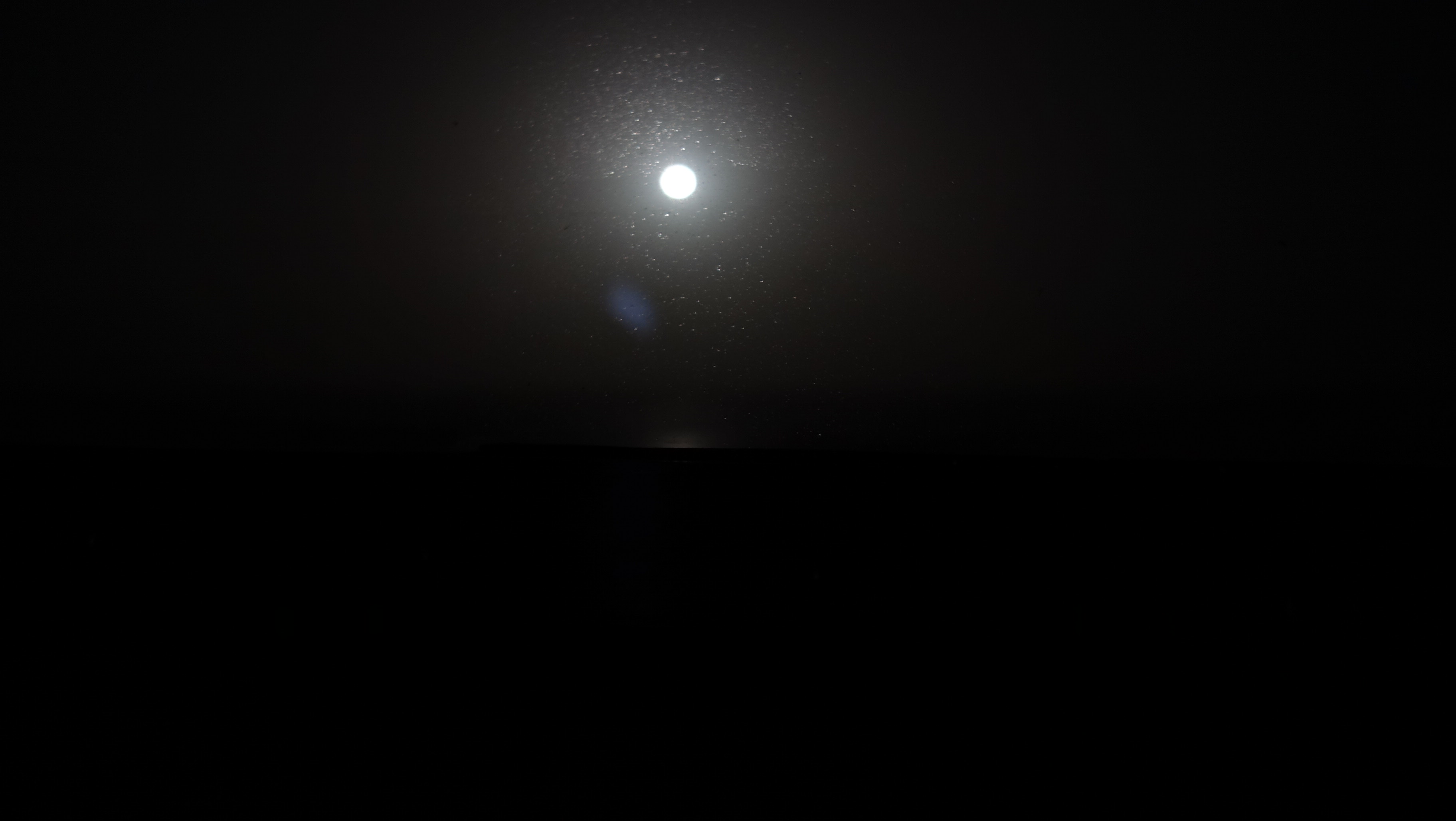
 

DSC00095

The moon on the Mediterranean

I spent two hours in the wheelroom after dinner last night.  Much of it was spent speaking to the Montenegrin third mate whose four-hour shift ended midway through my visit and the Filipino second mate whose shift began midway through my visit.  But some of it was also spent staring through the wide windows at the darkness.  And the sea. And the bank of containers stretching out towards the bow. In that velvety moonlit darkness, the world glows luminous charcoal grey – with the sea and containers different textures and the darkness relieved by a limpid moon, two days after its fullness. Melville in White-Jacket manages to capture this too: “still with brooding darkness on the face of the deep. I love an indefinite, infinite background—a vast, heaving, rolling, mysterious rear” (White-Jacket quotes courtesy of Casarino).

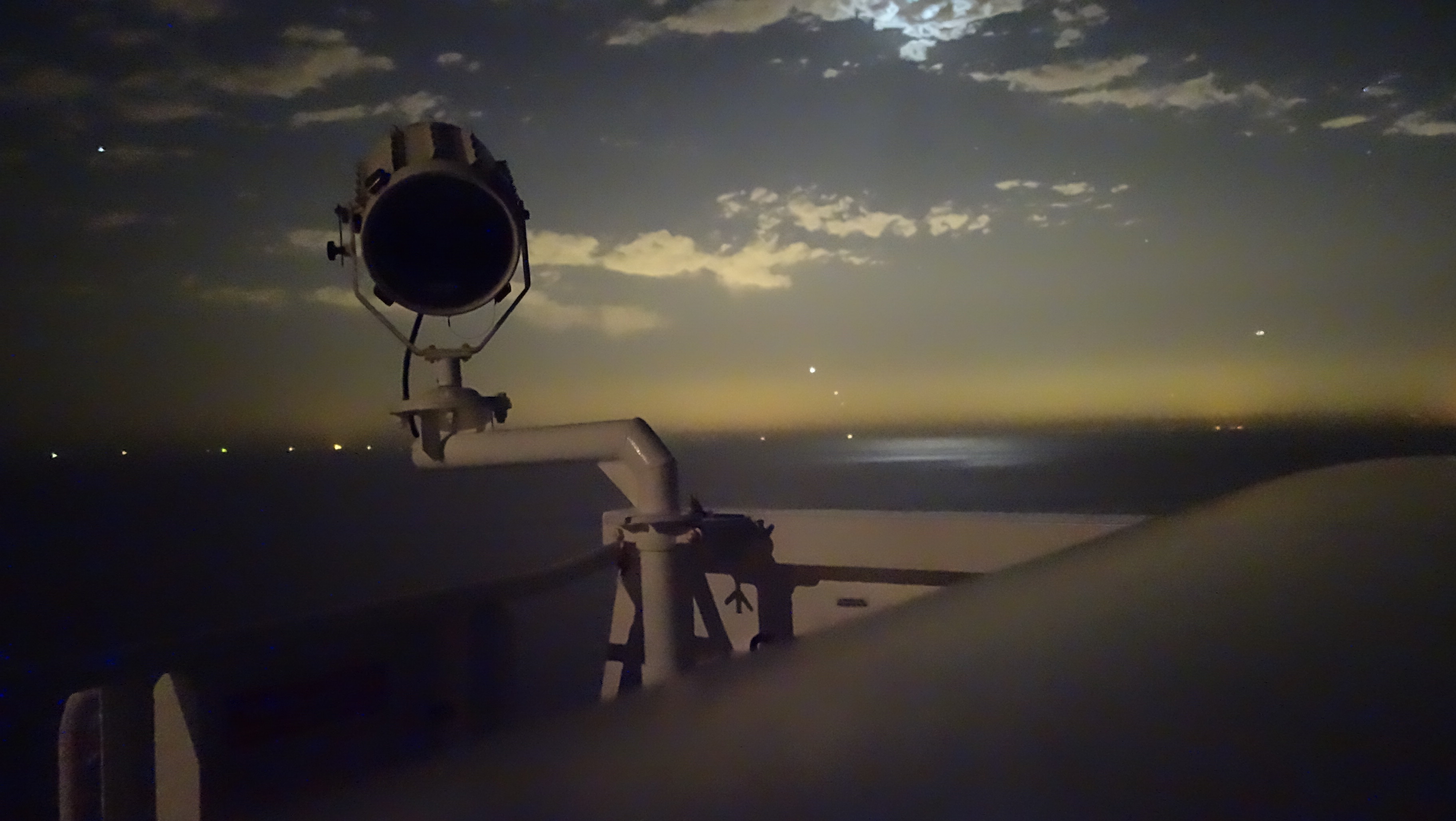
The wheelroom is kept entirely dark at night, curtains separating the moderately lit chartroom from the control instruments..  The second mate told me that on nights not lit by the moon, the officers sometimes bump into each other. He laughed easily and sweetly when remembering the dangers of carrying a coffee into the wheelroom in such darkness.  But tonight was not pitch-black and that glorious moonlit luminosity – with the rhythm of the sounds of the machinery and the bass-line of the thrumming engine and creaking metal is rather thrilling.  The ship is going through the sea at 19 knots at 75 rpm.  Apparently, another officer tells me, the previous chief engineer did not like the engine to go above 90 rpm which limited the speed of the boat.  One wonders about the demands of these two ends of the ship; the engine room in the aft, in the bowels of the ship; the wheelroom in the fore and atop the whole ship. It reminds me a bit of the way the seating arrangements at dinner reflect these hierarchies.  The deck officers sit to the right of the Captain, descending from chief officer down to the third officer (with an empty place always reserved for the Filipino ship’s officer who eats with the Filipino crew); and the engineers sit to his left, from the chief engineer down to the electrician.  And the woman cadet on her first sea-journey sits across from the Captain at the bottom of the table.

There is in that wheelroom a sense of the wonder of the sea. I know I am romanticising, but I am also struck by the ease with which the officers with whom I have spoken openly admit the lure and allure of the sea – at least at first when they go to sea without knowing what awaits them (though some know, being the children of seafarers).  Even the Filipino ship’s officer, speaks of going to the sea as something distinct from remaining behind or travelling to work on another, a strange, shore.  And I suppose between life on the land, with its limited horizons and the inherent conservatism of attachments to a world of everyday pettinesses, I would also opt for a sea that seems so endless, so vast, so deep.  I know I am repeating the prejudices of every person who loved a shore, a coast, port-city, but I think I would rather also throw my lot in with Foucault and his outrageous claim for the dreamworld of places that dream of going to sea, this fragment of infinity.  Or with Ishmael who goes to sea “whenever it is a damp, drizzly November in my soul.”  It isn’t just the dreamworlds, it is also the inevitable detachment from land; the worldliness of a ship such as ours that has at least 4 nationalities of people working aboard it, all speaking across their national boundaries in a language (admittedly imperial) not theirs.  No authenticity-mongering here, as your ship moves from port to port and brothel to brothel, from language to language and time-zone to time-zone.
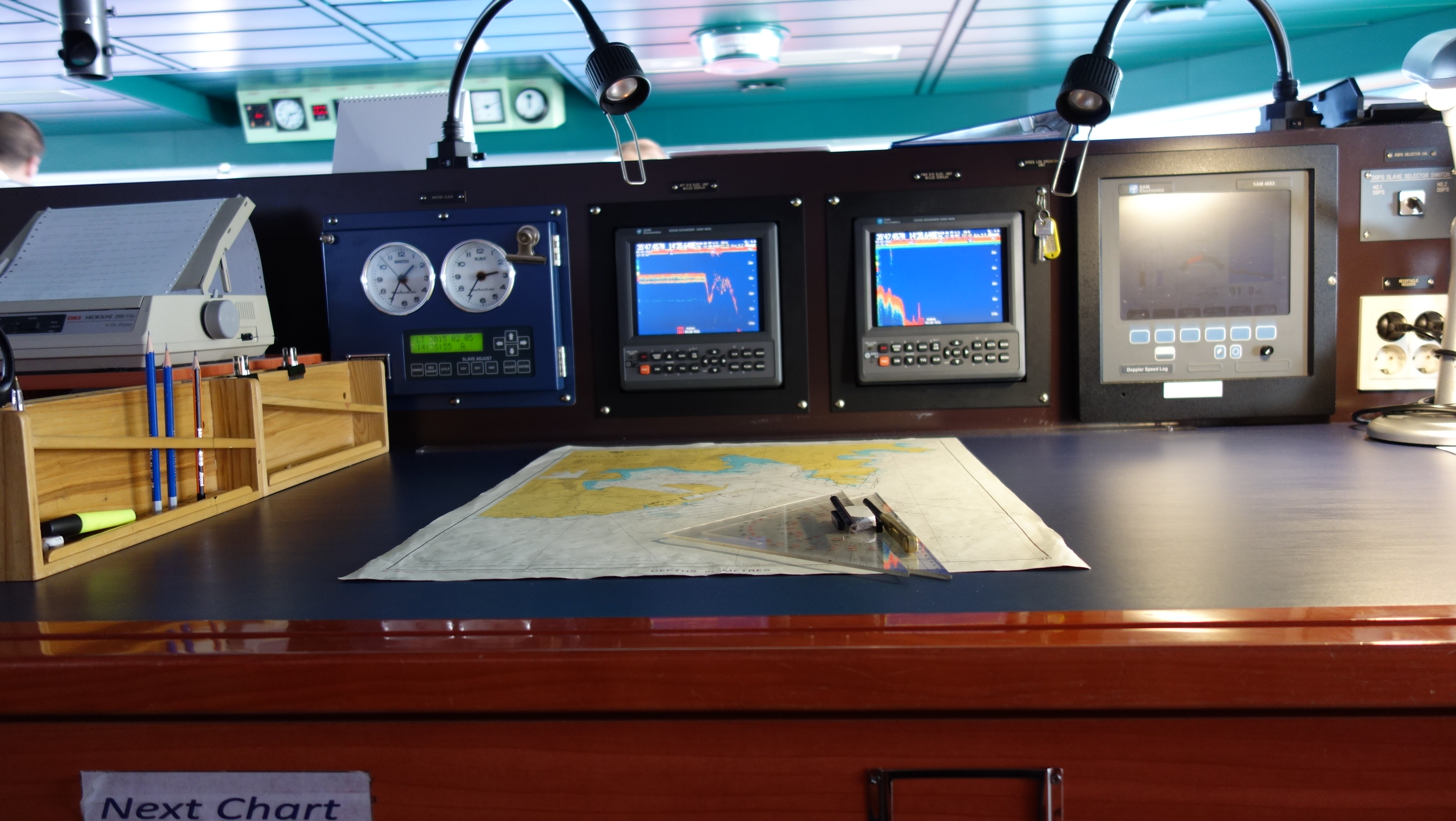
DSC00092

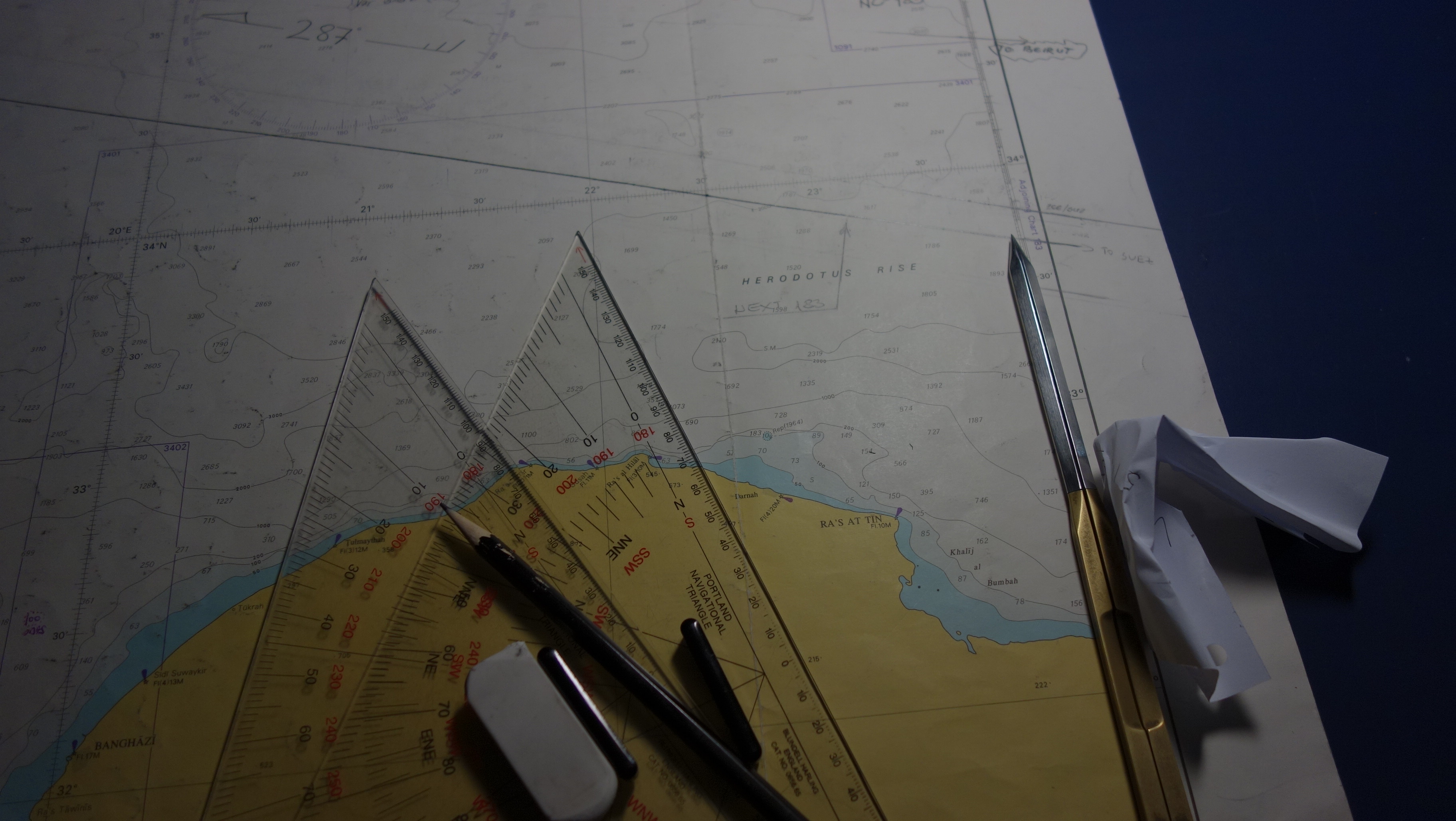
Charting routes on Admiralty charts

DSC00094

Herodotus Rise… Eratosthenes Seamount… Rhodes Abyssal Plain

In that wheelroom, another source of dubious wonder is the Admiralty charts.  It is strange to see the British Empire’s claim to rule the waves (“first printed in 1823,” they say) embodied there in these drawers full of charts with their exquisite details and still more exquisite names for regions of the sea.  I had never thought of a named territoriality of the sea, but there are seamounts and rises, and abyssals and trenches; and they have strange and dreamlike names. And there are ports whose names map worlds, wars, histories (Benghazi, Misurata, Ras Lanuf, as we sail 3 degrees north of Libya).  And the Admiralty map is full of admonishments – about explosives dumping ground in the sea just off Misurata; of a firing range just south of Benghazi which “the government of Libya” (which one?) has closed off to marine traffic. The Admiralty maps warn of oil and gas platforms and installations not marked on the map because of their “complexity and constant change.” And it cautions the ship not to draw its anchor across the seabed– because not all pipelines and undersea cables are marked. And it has something about tunny nets as well.  So, they are not the romantic sublime of staring at an infinite sea, but a rendering of a sea that is already a place of commerce from its dark depths to its variable surfaces and named eddies, seamounts and watery chasms.

I can spend hours staring at these Admiralty maps, with their beautiful topography of the sea and seashore, and with the pencil-drawn lines with which the deck officers mark our angle of travel and interrupted with our position every hour or two (and the ghosts of the previous routes erased already). And as we inexorably speed off this chart to the next, I await our arrival at the head of Suez Canal.


Afternoon
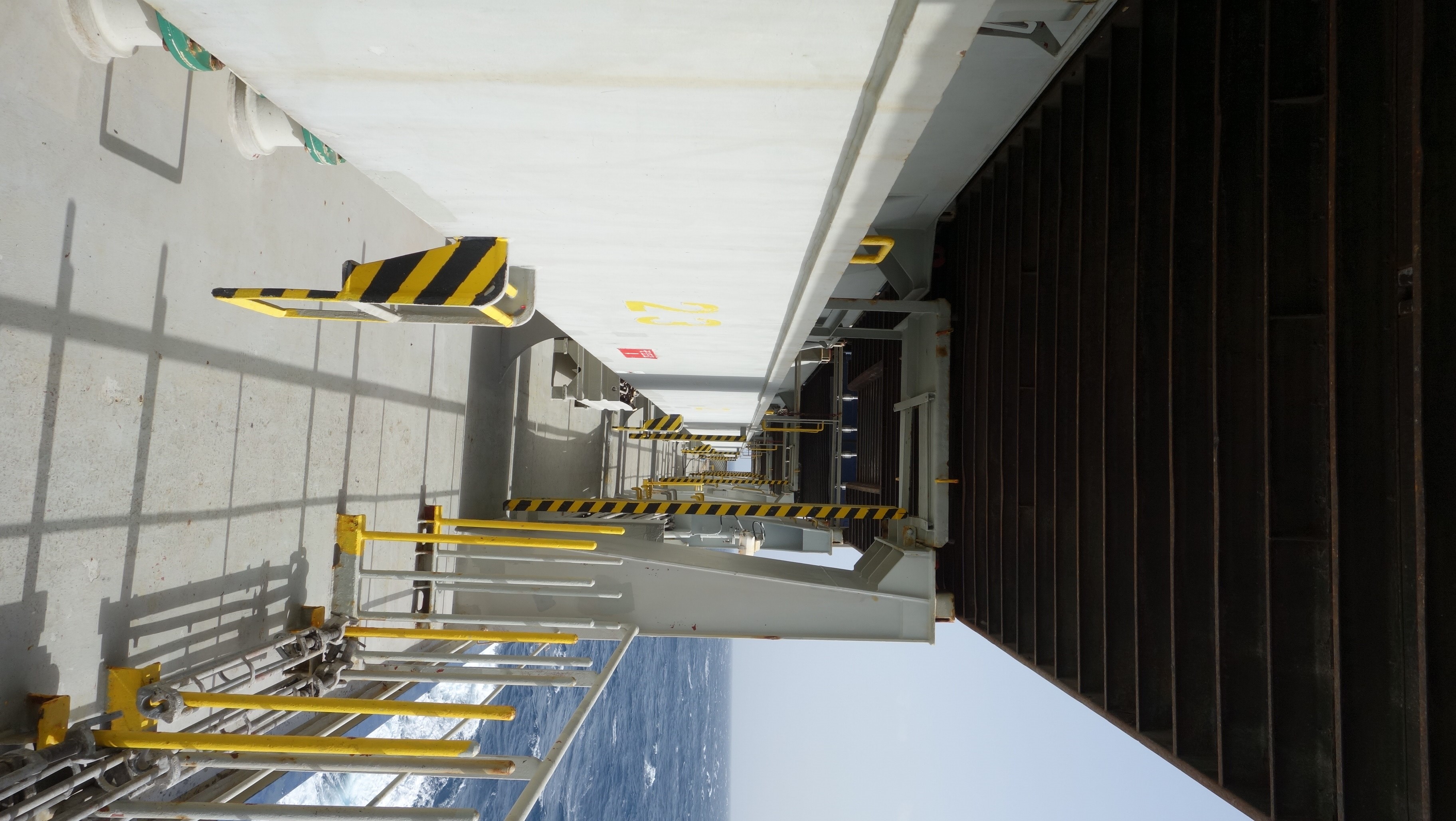
The upper deck under a bank of containers
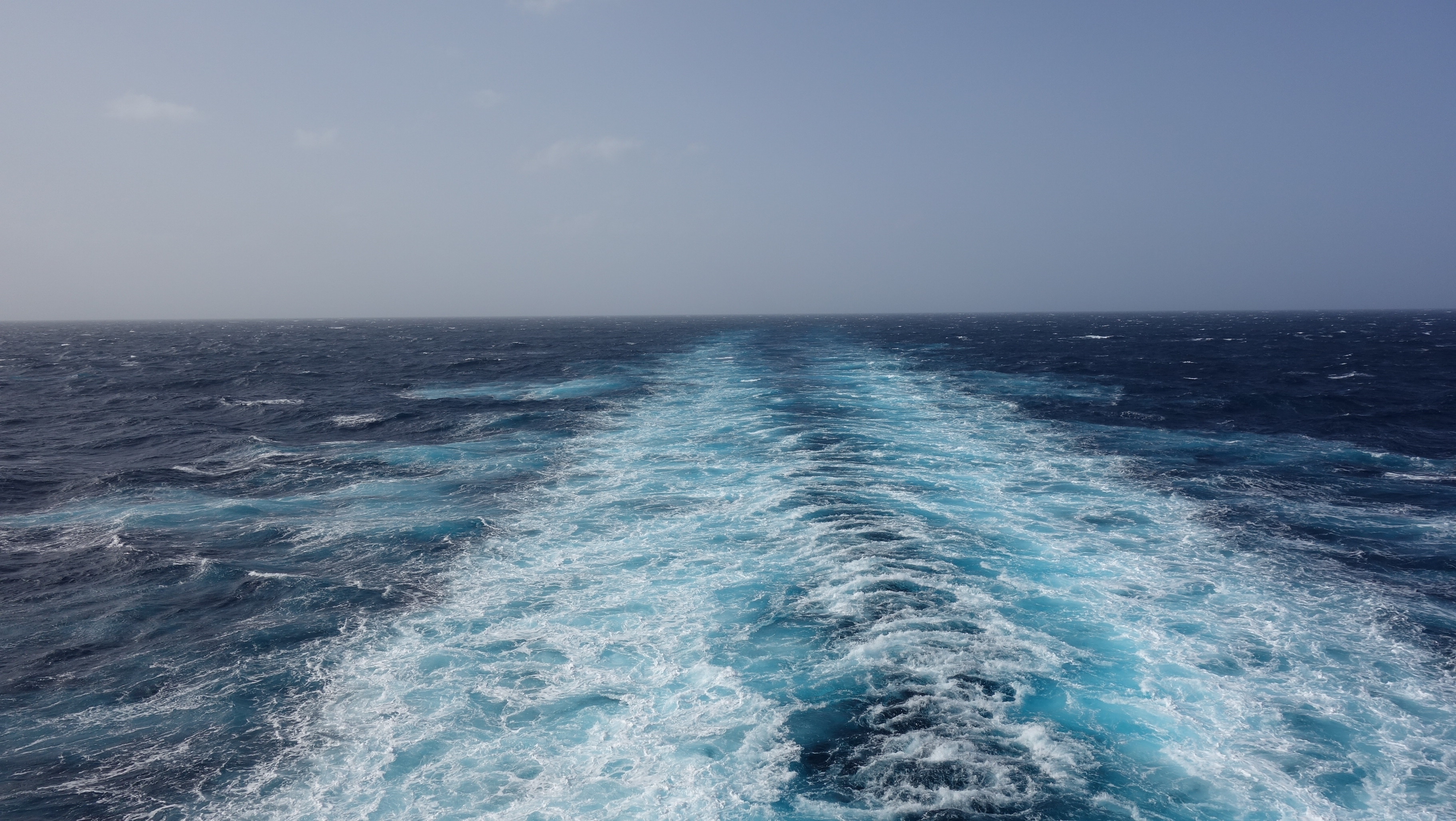
DSC00111

The ship’s wake

The captain told me this morning to feel free to go to the upper deck when I so wish – but to be sure to tell the deck officer. And wear my hardhat.  So I did.  It is a strange world down there.  I now know that my two Germanic co-travellers (Heidi the Swiss-German from Basel and Hilde the German from near Dusseldorf) didn’t actually know that you can walk the entire circumference off the ship.  All you have to do is to go to the upper deck and there, not far off the surface of the sea is a narrow walkway just under the endless banks of containers.  The bow of the ship is serene and so silent in the sunshine, with the surface of the sea so dark blue and so close.  The aft tunnelway under the containers has raised ridges and is incredibly noisy with the sound of engine –the feel of the engine- thrumming through. And the ravished sea brushed to aquamarine blue.  I met the boson and crew members and cadets down there, and will have to spend some time there everyday to see if I can chat with them at all, since this seems to be the one place I can encounter them.  It is where the work goes on – with unrecognisable crew in their helmets, overalls, goggles and various other protective gear, sand the surfaces, paint the rusted bits, clean, tidy, move around amidst the noise. The captain’s wife (who had never left her street or town until the age of 50), goes for walks on this walkway once a day, going around 6 times; with the captain going around 10 times apparently.

I shall return to this walk – lovely in its intimacy with the sea and the crew and the metal flesh of the ship, and the vastness of it all.
Bosch

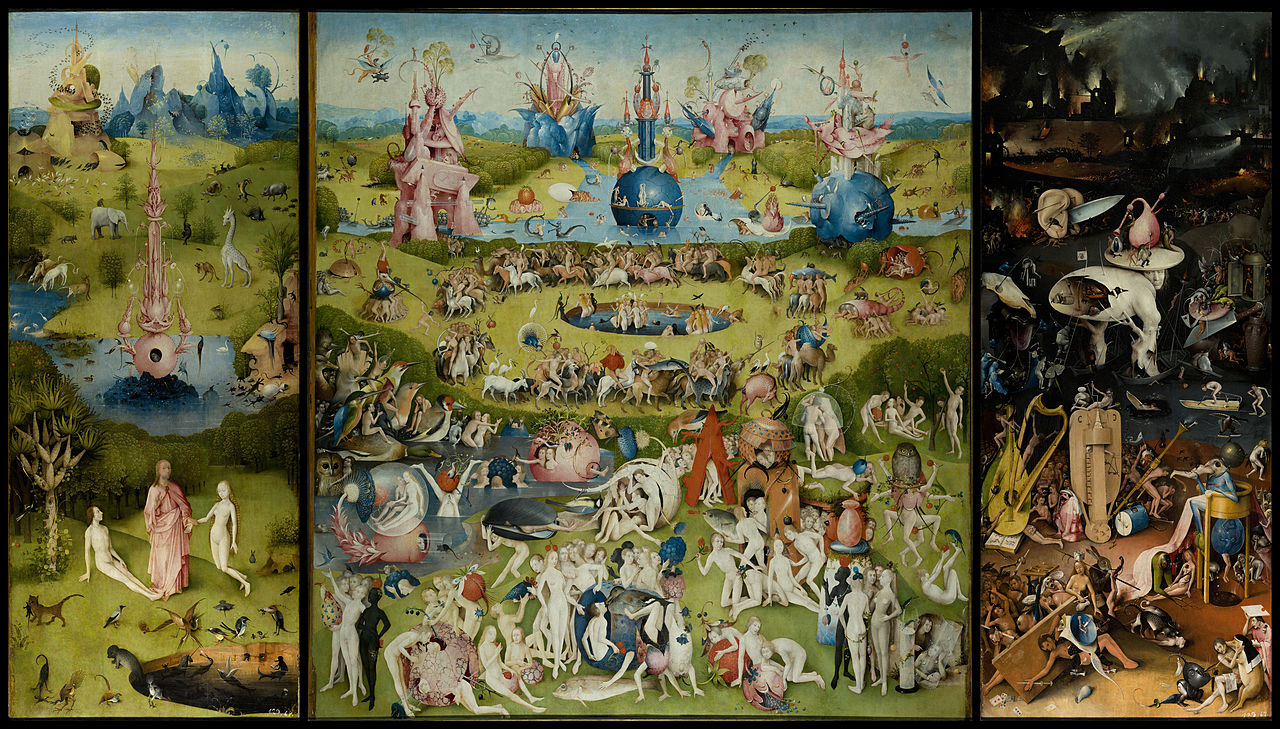
Hieronymus Bosch, “The Garden of Earthly Delights”

Meanwhile, a fragment of a thought/observation: I am not sure what to make of the fact that the reproduction print hanging in our corridor is of Hieronymus Bosch’s vision of heaven, purgatory and hell, with the second taking up the most space in the framed panel.  But there are all sorts of strange signs around the ship.  Down on the Upper Deck, there is a sign about Da’esh not liking French ships and an admonishment to safety at port. On the same deck, the seafarers are told to be vigilant against Asian Gypsy Moths, and hot water, and HP (high pressure?) blasters, and crushed thumbs.  In the wheelroom there is a 2009 notice sent to the authorities of Suez Canal where the Suez Canal pilots are told not to use the accommodation ladders (whatever they are) as elevators.  I was expecting something about sexually transmitted diseases and dangerous women (and men) at ports, but I suppose those kinds of indiscretions need to remain discreet.

STORIES


Having now spent time on the bridge last night and all of this morning, I feel like I have developed friendly enough relations with a number of different people of whom I can now ask questions without feeling I am being a damned nuisance.

The woman cadet, tells us that she wasn’t the only woman in her 5 year training programme.  This is her first ship; she is from seaside town in Croatia and she is neighbours with the ship’s electrician back home (he is one of the officers with whom I came onboard).  Her grandfather was a sailor, but she never knew him; she just wanted to go to the sea and she says that “I don’t care what anyone thinks” about her being a woman.  She is funny and warm, and easy-going and thus far is treated with great respect by everyone.  She ties her long her hair in a tight bun on top of her head, only letting it down at some dinners.  She wears tracksuit trousers and T-shirts and has a big chunky watch on her right wrist.  This morning, one of the ship’s officers spent quite a bit of time showing her how to update charts and calculate upcoming positions for the ships’ logs.  She was telling me that when she was in the cadet school, the professors had put together the material haphazardly; and all in English; so now when she is looking at a wheelroom document in Croatian, she feels like it is written in “Turkish or something.” The power of the technical languages we learn. She was pleased to hear that Darya in Persian means “the sea”; she was destined to become a seafarer, I suppose.  Or she supposes.
Cassiopeia

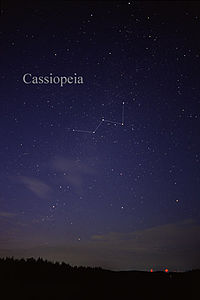
Cassiopeia (from Wikipedia)

The Filipino second mate told me that he has never been to Iran or to New York for that matter. I was a bit surprised, since he had gone to New Jersey, but maybe the seafarers didn’t realise that it only took a short little train trip to go to the big city. Last night, when I was on the bridge, he showed me Cassiopeia and we looked at the bright planet which the sailors’ almanac told us was Venus (in February, Venus and Mars are evening stars; Jupiter, Saturn and Mercury are morning stars). He was taught about recognising stars and navigation by them at his cadet school and on the bridge of the ships on which he first apprenticed.  He has less faith in the durability of the technology than the Europeans seem to have, which may be why he knows more about how to determine where we are in the middle of lonely seas if the machines break down.

He also told me about how different classes of CMA ships have different categories of names (so, for example ships that carry 13,000 TEUs like ours are named after explorers; but there are others named after constellations etc).  He also sweetly confessed that he still gets seasick and can’t sleep when the ship rolls so much as it did when coming through the Bay of Biscay when everything had been tied down, hooked, and stowed away.  He does indeed eat with the crew and was mentioning that he preferred the Filipino food better in any case. Although we chatted a bit both last night and this morning, I have to speak to him longer. He seems lovely, but also very courteously reserved and I really liked how he was teaching the woman cadet the small things you need to learn aboard your first ship.

The Montenegrin third mate was the officer who initiated me into the conversation with various crew members and officers.  He is 26 or 27 and from a small seaside town which has a population of 60,000 people, and he mentioned that he earns $3000 a month where, had he stayed in Montenegro, he would have earned $400. His contract demands that he work 4 months and then take two months break at home.  “The time at home goes just like this.”  He said he was happy to leave Montenegro behind because ever since he was born the same people have been ruling “and Montenegrins put up with it.” Of “exit, voice, loyalty” he has chosen a kind of temporary exit.  But he also mentioned that his father was a seafarer and so the “sea is in our blood.”  He is saving for a life-annuity and has an apartment as investment. It was fascinating that in the darkness of the wheelroom, he was not at all shy speaking; telling stories.  I will have to spend another two hours there tonight and chat with those on duty… I will try and see if I last long enough to maybe meet another shift of workers…

Meanwhile, a couple of his stories:

I asked him if he had ever been on a ship that had lost containers.  He told the story of a ship manufactured in China which he boarded straight from the shipyard. Not far out in the South China Sea, the ship’s engine died.  No matter what they tried, they couldn’t get the engine to work. So they dropped anchor. While at anchor, a storm from Philippines blew in, and the ship was hit with massive swells, some up to 8 or 10 meters high.  The swells were swaying the ship to such an extent that they lost several containers, which fell inside the hold (rather than in the drink).  One happened to be in a non-standard container, as it carried an electricity transformer; when the transformer fell, it descended down an empty column on top of a single container all the way at the bottom, but on its way down it managed to shear off the side of an entire column of 11 containers, damaging them all.  Having fallen on top of a container though saved the ship’s ballast tank as that final container absorbed the shock and the weight of the transformer.  The Chinese ship manufacturer ended up paying for all the damages.  He seems to think that a lot of ship-owners go to the Chinese, because the difference in the cost of a ship between Chinese and Korean ships are $90 million vs $120-140 million. But he (and apparently others) believe that the Chinese ships are not yet as good as Korean ships.  Yet.

I asked him which ports he liked best. He said that his favourite was in fact Malta.  The port has good weather and is close to the town. The Chinese ports are at such distance from the main cities that it makes it impossible to go the city in the evening. He mentioned a port in China which has joined two islands and transformed them into the port, but the two islands are 50 kilometres by a bridge from the mainland. He thought Hamburg is good, but it is cold so much of the year.  He is not particularly fond of one of the big Middle East ports because “their crane operators are crazy.” Apparently, these crane operators seem to operate multiple cranes but all from the same side (starboard at once; or port at once) and it causes the ballast of the ship to be off, making the ship list.  What fascinated me was that for him, the liking of a port was a bundle of things having to do with how much it complicated their work life, but also how much easier or difficult they made leisure.  The new mode of having ports at some very long distances from the cities is not only one way the dockers and seafarers are cut off from the cities it is also an additional pressure on seafarers who cannot play in the ports in the storied way associated with sailors.

One thing that he mentioned that I hadn’t thought about was that the condition they most suffer on board is not so much tedium as exhaustion, especially when traveling between northern-European ports: Southampton, Hamburg, Bremerhaven, Rotterdam, Zeebruggen, and Le Havre  – 6 ports in 10 days. He said it is exhausting, and I can imagine it must be if your sleep is short, fitful and disrupted with all the tasks they seem to have to attend to when at port.

I also briefly met the boson, one of the Filipino crew members, and another friendly cadet whose duty is to check the refrigerated containers (or reefers as they are called on the ship). He mentioned that there are 365 of them on this ship and that takes about 1.5-2 hours a time to check, twice a day. When I expressed a bit of awe, he laughed and said, “Well on my previous ship there were 500; and on that ship, there were no walkways to climb to see the monitors; we had to climb the lashing rods.” I said “Good god, and what if you fall down?” He laughed and said, “Well, you fall down.”



Posted in 2015 Trip, Allan Sekula, capital accumulation, infrastructure, labour, literature, logistics, Melville, ports, readings, the sea | 2 Comments

Areia de Salamanca: The Razzia in the 16th century

5 February 2015

I borrowed Braudel’s discussion of the presidios on the North African coast yesterday to reflect on logistics… But as I read on, there was also the counterinsurgency element against the colonials (about which Braudel seems remarkably sanguine; remarkably without comment):

 Let us imagine the atmosphere in these garrisons. Each was the fief of its captain general, Melilla for many years that of the Medina Sidonia family, Oran that of the Alcaduete family; Tripoli was ceded in 1513 to Hugo de Moncada for life.  The governor reigned with his family and the lords who surrounded him. The favourite pastime of the rulers was the razzia, the planned sortie combining sport with work, and, it must be admitted, strict necessity: it was the duty of the garrisons to police the surrounding districts, protecting their inhabitants and dispersing intruders, collecting pledges, gathering information and requisitioning supplies. Necessity apart however, there was a certain temptation to play soldiers, to lay ambushes in the gardens of Tunis and kidnap unsuspecting farmers arriving to pick fruit or harvest a field of barley; or beyond the sebka at Oran, by turns glistening with salt or covered with water, to surprise douar, the presence of which had been betrayed by hired spies.  This was a more exciting, more dangerous and more profitable sport than hunting wild animals.  Everyone had their share of the booty and the Captain General sometimes took the ‘Quint’ or royal fifth, whether in grain, beasts, or humans.  Sometimes the soldiers themselves, tiring of their everyday fare, would go off in search of adventure, from a desire for fresh food, or money, or simply out of boredom.  In many cases, such raids naturally prevented the establishment of vital good relations between the fortress and its hinterland if, as they were intended to, they spread wide the terror of the name of Spain. Contemporary judgements are far from unanimous on this point.  We must strike hard, says Diego Suárez, and at the same time be accommodating, increase the number of Moros de paz [pacified Moors], the subdued populations who took shelter near the fortress and in turn protected it.  ‘Cuantos más moros más ganancias’, writes the soldier-chronicler, repeating the old proverb that the greater the number of the Moors, the greater the profit –in grain, everyday foods, and livestock. But was it possible to refrain from striking, terrorizing and therefore driving away the precious sources of supplies, without destroying what was by now the traditional way of life and pattern of defence of the presidios, the development, by persuasion or by force, of a zone of influence and protection as indispensable to the Spanish presidios as it was to the Portuguese presidio in Morocco? Without it the fort would have suffocated.

What struck me most forcefully about this passage when I read it last night was not just how degraded the use of the word “peace” was even then (those of us who work on Israel/Palestine sneer when we hear that word; for it means nothing but charlatanry and the consolidation of the asymmetric power of the settler).  It is also two other things: first that the razzia was what the Spanish did in the 16th century. Bugeaud When I was working on my counterinsurgency book, of course I read loads about the razzia as the French used it in the conquest and pacification of Algeria.  Thomas Rid’s “The Nineteenth Century Origins of Counterinsurgency Doctrine” for example argued that “The razzia, a tactic introduced by the French in North Africa around 1840, first thrust tribal populations into the focus of modern operational thinking.” And in his “Razzia: A Turning Point in Modern Strategy,” Rid argues that

The razzia, a tactic of swift and brutal raids used by the French military against recalcitrant tribes in Algeria in the 1840s, was a necessary step in modern military thought. At first glance the destructive and violent razzias stand in stark contrast to the constructive and non-violent bureaux arabes—an institutional ancestor of Provincial Reconstruction Teams. But both were developed in the same conflict and by the same men. These two innovations, this article argues, were also flipsides of the same coin: what today is called war ‘‘among the people.’’ The razzia consequently appears as a necessary historic precursor for contemporary counterinsurgency doctrine.

I myself didn’t make such primary claims for the French invention of razzia. I wish I had known that the Spanish had used it so extensively, rather than thinking of it as a local practice.  But in any case, as I wrote, the French deployed razzia with little reservation:

In the French version of the razzia in Algeria, the French forces “chopped down fruit trees, burned settlements and crops, and seized livestock. Few of the region’s numerous Arab villages escaped destruction. What once had been hillsides ‘teeming with rich crops’ were transformed into blackened wasteland”(quoting Gottman, “Bugeaud, Gallieni, Lyautey,” 236). The razzia served mundane functions (the plunder of crops and cattle alleviated logistical problems of supplies), strategic aims (it destroyed the local bases of the economy), provided the French with prisoners who were used as “barter to pressure the tribe in question into submission,” and terrorized the population (quoting Sullivan, Bugeaud, 123). When even the razzia was not sufficient, an officer serving Bugeaud ordered his subordinates to “kill all the men over the age of fifteen, and put all the women and children abroad ships bound for the Marquesas Islands or elsewhere. In a word, annihilate everyone who does not crawl at our feet like dogs” (quoting Rid, “Razzia,” 620).

So much hearts and minds then!

Posted in 2015 Trip, empire, imperialism & colonialism, militaries, ports, readings, the sea, war | Leave a comment

Grace: Departing Marsaxlokk

Marsaxlokk-Jabal Ali:  At last at sea

5 February 2015

11.00

Occasionally in the night, the ship bumps against the berth and that is when one remembers that one is not on solid ground. I can’t wait for our ship to take off tomorrow, so that I can actually feel the motion, and especially at night. The loading went on all night long and continues to go on.  The cranes had started in the middle of the ship and have now moved to the extremities of the ship and continued with their metallic ballet.  We are still delayed.  Supposed to leave at 8.00 and then 10.00 and then noon; and now I hear 2 or 3.

DSC00074

Marsaxlokk, Malta

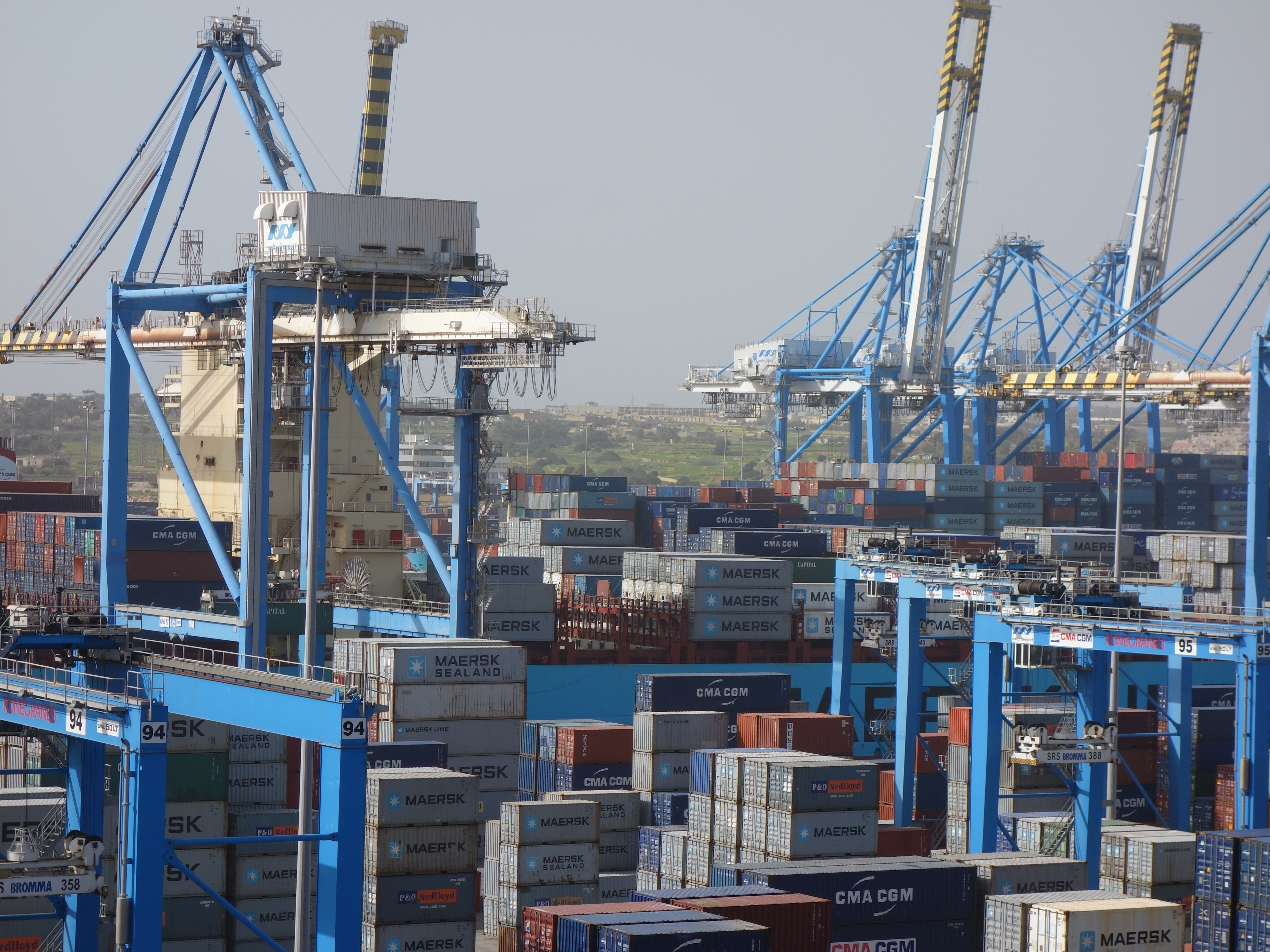
In the port, I can see three smaller CMA CGM ships and a massive Maersk one, which seems to be unloading. At least for now.  This being a transhipment port, the Maersk ship has probably brought in goods from northern Europe which it unloads and then it shall load containers perhaps from southern Europe or North Africa. Braudel’s argument –made already in 1949- that one cannot really study the Mediterranean severed from Northern Europe or the Atlantic regions is exactly accurate.

The port is a hive of movement.  Truck drivers toing and froing between yellow lines; loading cranes with their nino-nino-nino horns moving across the banks of stacked and stored containers and loading them on the flat beds of the trucks.  And now the three massive cranes working on our ship.  I wonder how our lateness affects the schedule of the port and of the ship.  Who pays for this? Who bears the costs?  What do the longshoremen do when the ship is late on arrival and late to depart?

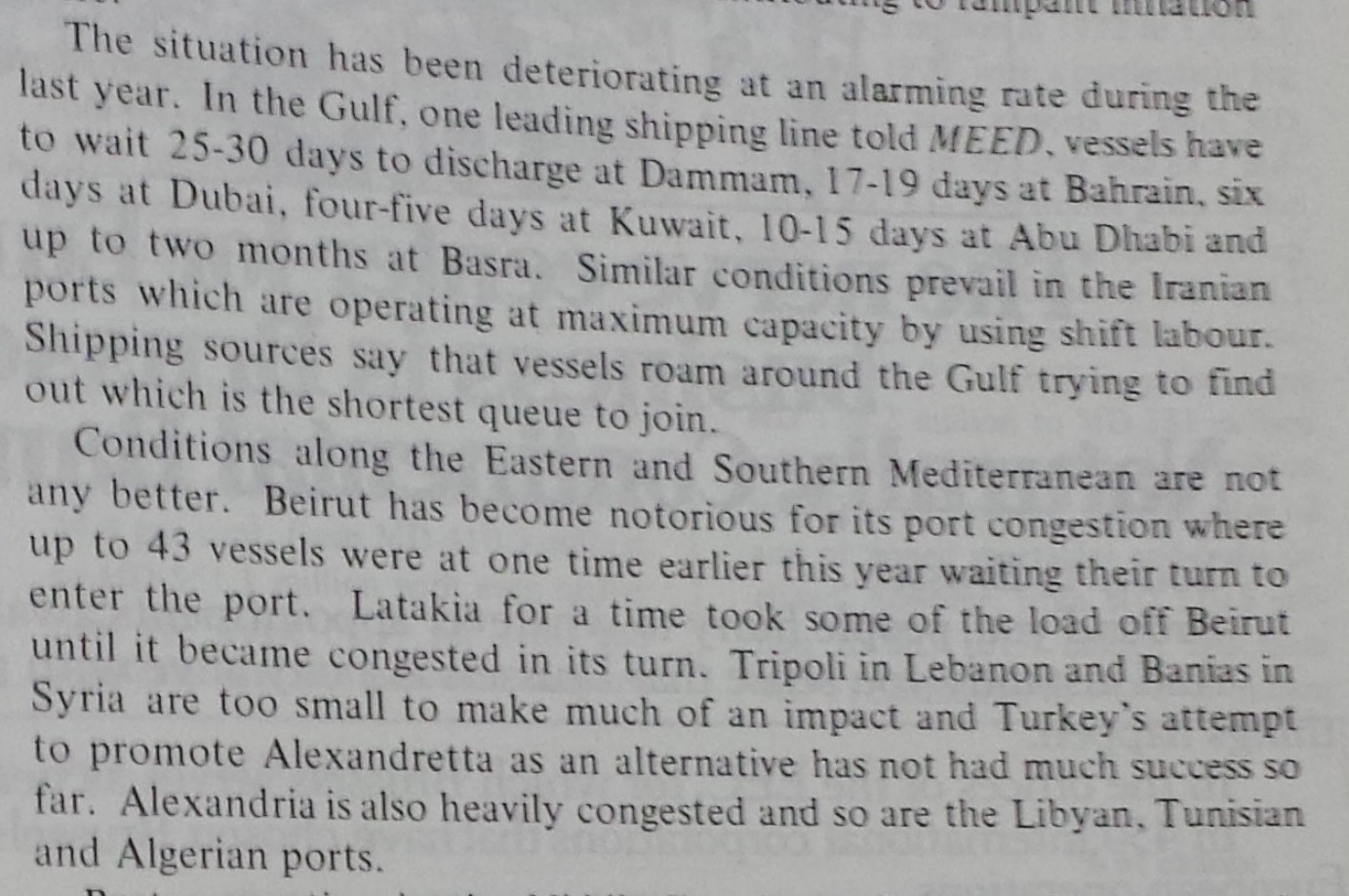
Port congestion

Image from a 1974 MEED editorial.

When one reads about the late 1970s and the  which led to ships queuing up outside Middle Eastern ports for weeks, you wonder about the calculus of port capacity.  About fines and schedules.  About lives of the ordinary seafarers spent waiting.  And the lives of dockers in a whirl of work at unanticipated and urgent moments.  How do the spatial arrangements work in the ports, where there surely is a hierarchy of labour – with those hyper-skilled puzzle-workers who operate cranes in their lonely high aeries.  Do they dream of flight?  Do their hands move in their sleep as if they are manipulating the levers of the cranes, metal beasts suspended from their cranes above high plateaus of colourful metal?

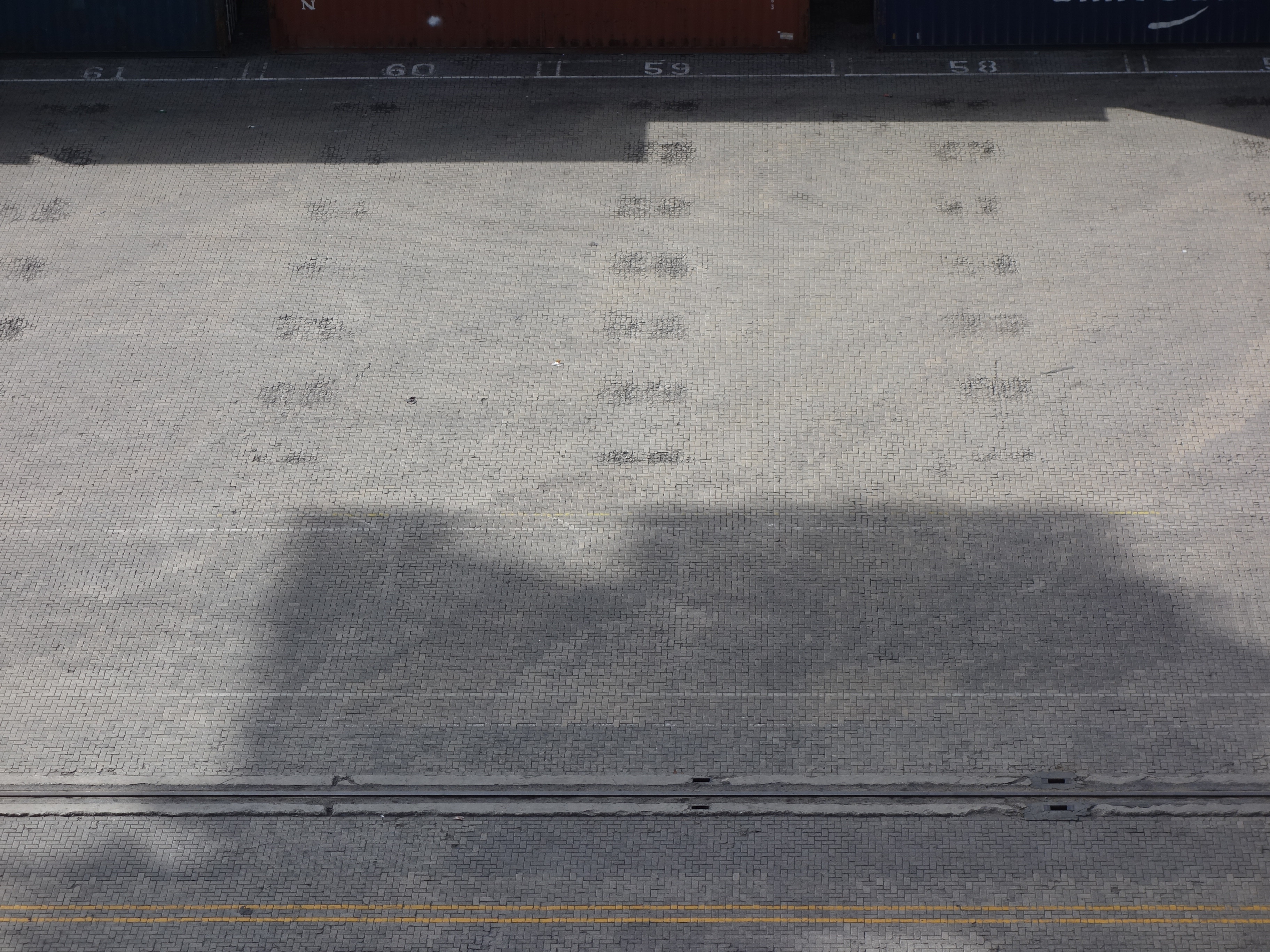
DSC00073

Marsaxlokk, Malta

The strange mixture of music that comes from the port is extraordinary.  Notes being played –by the cranes?  Someone’s phone? The nino-nino of smaller cranes.  The low metallic rattle of trucks moving through the concrete space.  The port’s surface here is bricked.  Why not the ubiquitous concrete? The bricks bear the memory of the containers they carried… Marks left in regular patterns.

The materiality of the port-work is a good antidote to the abstractness of so much that is written about the transformations in capitalism. There are still solid goods being moved here – and Marx’s “annihilation of space by time” begs the question: how will time be abolished?  Certainly, the labour goes faster and faster and the relentless drive to automation removes the bodies that can slow the work down.  But there are still containers to be moved, and the goods to be loaded and all that takes time.  And this interminable wait for departure makes me physically aware of time. But of course Allan Sekula got there a long time ago:

Large-scale material flows remain intractable. Acceleration is not absolute: the hydrodynamics of large-capacity hulls and the power output of diesel engines set a limit to the speed of cargo ships not far beyond that of the first quarter of this [20th] century. It still takes about eight days to cross the Atlantic and about twelve to cross the Pacific. 


15.00

“The passage had begun, and the ship, a fragment detached from the earth, went on lonely and swift like a small planet. Round her the abysses of sky and sea met in an unattainable frontier. A great circular solitude moved with her, ever changing and ever the same, always monotonous and always imposing.”

Joseph Conrad in his unnameable novel


We are now at sea, with the port devoured by the haze at the horizon, and I, liberated from internet.  I can feel the motion of the ship when I am seated or when my body leans against the bones of the ship.  You can feel the resistance of the water as the prow cuts across the grain of the sea.  But the sense of movement is pleasant not disorientating and when standing, my body seems to adjust to it.  Seated, it feels like being swung in a hammock.  From where I sit, I can see that the clothes I have hung to dry are swaying a little, and the pull-and-tug, draw-and-push feel of motion at sea saturates all objects.  I can’t begin to imagine how it must have been crossing through the Channel or Bay of Biscay in a storm, when apparently the containers screeched and wailed and the ship swung from side to side.  I don’t sense seasickness coming on.  Perhaps because I have spent the last hour leaning against the bridge and stare at the sea, my body, my inner ear, my bones, are getting used to the motion. In addition to the movement, there are new sounds – not just the imperceptible thrum of the engine, too low and too bass to be heard, but felt nevertheless in one’s joints, but also smaller metallic sounds, as the ship’s metallic flesh adjusts to the movement of the sea and as the containers shift imperceptibly atop one another.

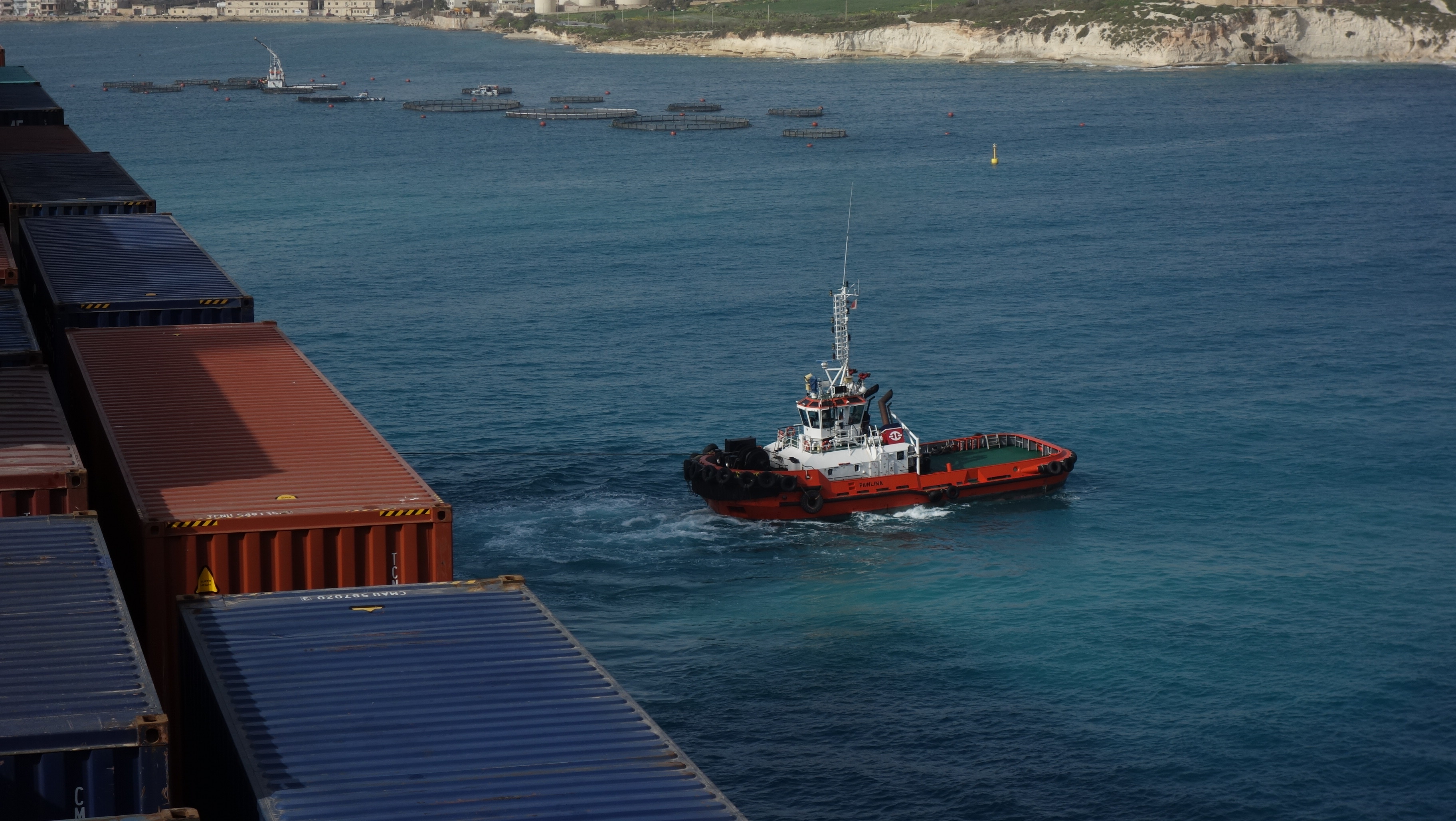
DSC00081

Leaving Marsaxlokk, Malta

To depart from the port, little orange tugboats  had to pull us away from the berth; and two pilots on the two sides of the bridge guided us away from the concrete port at an angle. I am not entirely sure how they got off the ship. I didn’t see a boat close by. This being pulled by tugboats is a kind of majestic and ridiculous movement simultaneously, such bulk being pulled away by two little boats with their powerful engines, being guided through the angular channels.  But once we are in open sea, the ship’s engines are revved up – and it feels incredibly powerful and incredibly silent.

Now that we are at sea, doors are not to be locked and our deck becomes a much more communal space, with a 15.30 coffee in our common room –with good coffee thankfully. The wind is strong outside and it is hard to believe that this behemoth can move across the surface of the water at such speed.  I am anticipating sleep tonight – with the motion of the ship transmitted through the muscles of the ship, and through me.

It is a shame that on none of the decks, we can actually circumnavigate the ship [I later found this to be untrue].  Our space is really the tower underneath the bridge, 50 meters wide at most and open to exploration more vertically than horizontally.  From what I understand, there is no way to go to the bow of the ship.  But I shall ask. It would be rather amazing to do so if at all possible.

Posted in 2015 Trip, labour, political economy, ports, readings, shipping conditions, transport, Travels | Leave a comment

On Battleship Hill

Marsaxlokk-Jabal Ali; On Military Logistics in the Age of Philip II

4 February 2015

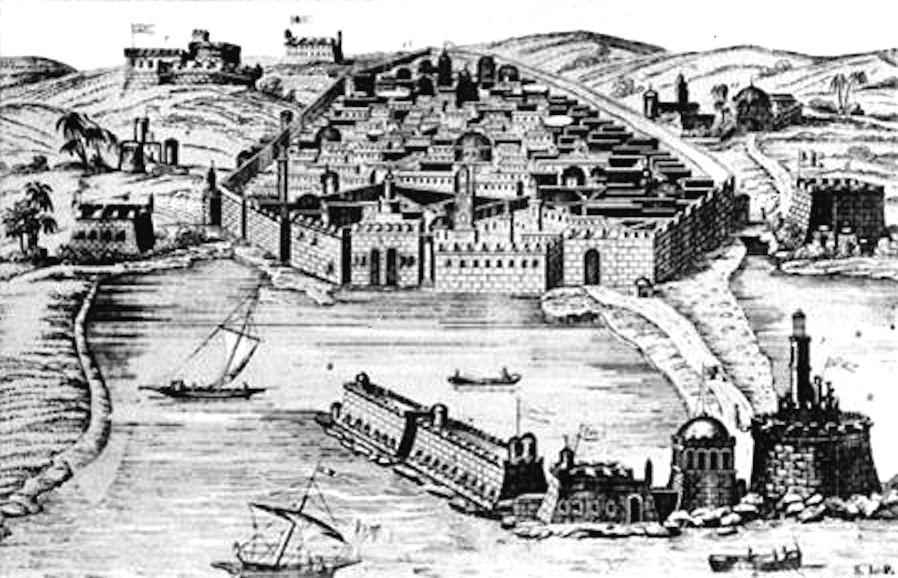
presidio

The presidio at Algiers, c. 16th century

What becomes clear in reading Braudel’s vol II about war-making is the extent to which your martial power really depends on your economic ability to supply the garrisons intended to act as your line of defence. His fascinating discussion of the presidios, fortified bases used as defensive means against Ottomans and others, absolutely points to the centrality of these logistics lines.   His brilliant research shows how such garrisons can act as massive drains on treasuries, not only through the salaries paid those garrisoned there, but also through the difficulty of efficiently, physically, logistically, supplying them with the basic things they needed.  He compares the Spanish strategies in North Africa and Mexico and writes that “Cortés on arriving in Mexico, burnt his boats; he had to triumph or die. In North Africa, there was always the supply ship with its fresh water, fish, cloth or garbanzos.”

The problem on how to man these garrisons was not easily solved though.  At some point, they even though of using Moriscos (Moors who had converted to Christianity) as settlers. But who wanted to live in this landscape defined by “its immensity and its aridity”?

How were these deportees to live? In a Spain dazzled by the lure both of the New World and the good fare of Italy, where were the men to be found? There were also plans to make these strongholds economically viable, to create some kind of link with the vast interior, off which they would live.

But even there they failed because the North African trade went through “Tajura, La Misurata, Algiers and Bône, none of which was in Christian hands.”  His description of the hardship of these frontier bases is fascinating and makes clear the centrality –again- of military logistics:

Life in the presidios must have been miserable.  So near the water, rations rotted and men died of fever. The soldiers were hungry all year round. For a long time, the only supplies came by sea. Later, but only at Oran, the surrounding countryside provided meat and grain, which had become a regular supplement by the very end of the century.  Garrison life was in many ways similar to shipboard life, not without its hazards.

Meanwhile Malaga and Cartagena acted as suppliers for the North African bases. I love his matter-of-fact enumeration of man and materiel:

The traffic passing through Málaga was very considerable. All supplies for Africa travelled from there: munitions, rations, construction materials, soldiers, convicts, labourers and prostitutes. Supply and transport posed serious problems –wheat for instance had to be bought, then transported from the interior by files of pack donkeys, which was costly for a start. To transfer it from the administration’s granaries to the port and from the port to the presidios meant more work and more delay.  The sea was infested with pirates. So it was only in winter, when pirates were few, that the risk would be taken of sending to Oran a corchapin, two or three boats, a tartane, or perhaps a Marseilles or Venetian galleon, placed under embargo, and requisitioned transport supplies or munitions. On more than one occasion, the boat was seized by the galliots from Tetouan or Algiers, and the Spanish would be lucky if they could buy it back from the corsairs when they anchored, as was their habit, off Cape Falcon.  So pirates, quite as much as negligence by the administration, were responsible for the recurrent famines in the western presidios.

Posted in 2015 Trip, militaries, political economy, readings, war | Leave a comment

Es Mejor Vivir Asir: Still in Marsaxlokk

Marsaxlokk-Jabal Ali; First impressions

4 February 2015; 10.00 Malta time

After what seemed like an interminable wait for the transport to take us (myself and three Croatian officers) from the hotel to the port, I am onboard the ship.  I am rather impressed with the officers’ massive rolling suitcases.  Climbing up that steep slightly swaying gangway with the precarious nets around the metal stairs the only gesture to safety is hard enough with a travel rucksack.  Not sure how those enormous rolling suitcases are carried up.  But there was something else impressive as well: as I fidgeted waiting for the transport which was about an hour late, the three of them were so still, so serene.  A kind of moment of respite before work begins I suppose, but it reminded me of Marcus Rediker’s wonderful account of the tedium of worklife aboard ships and the way it is relieved by storytelling.  And I suppose by learning the embodied art of tranquillity.

That climb up the gangway was glorious and terrifying and distracting (distracting, that is, from the task of observing this wondrous alien world). I so wanted to look out to port, to the cranes, to the containers, to the ship itself, so wanted to take a photograph of the ship; but there was a kind of efficiency in boarding, and the officers were so matter-of-fact I felt a bit self-conscious about this thrilling sense of wonder, at being here at last, at the sleek vastness of this enormous ship, and the dizzying smell of diesel and oil in the air (who would have thought I would find that industrial scent itself so seductive).  Everything is metallic and angled and orderly.  And the cranes, vast and swift and balletic in their graceful movement across the bodies of containers. The climb required all my concentration, not least because I had to keep myself from looking at the slick of water separating the boat from the berth, glinting under me at some great distance.

Coming through, I had to follow the officers to the ship’s office in what is called the Upper Deck, where the Croatian officers seemed to know the officer with stripes across the shoulders who met them –met us– there, with much embracing and vigorous shaking of hands and excitement in Croatian.  Later a Filipino officer (unusually, given the mapping of nautical hierarchies to geopolitical ones, he is an officer, rather than a crew member) came to get me and up a lift we went to the floor where passengers’ cabins are located.  He took my passport and my health certificate and proof of vaccination with him – and I suppose I shall next see my passport when I want to disembark (at Suez, perhaps? Or is it Khor Fakkan).  He later called me up and asked which Philadelphia it was where I was born; he seemed a bit surprised that it was the US (although I cannot think of another Philadelphia).  He also apologetically asked me some questions apparently needed upon arrival in Khor Fakkan: marital status and religion.  And I told one truth and a lie: single and Christian.  I would rather not have the government of Sharjah (or the UAE) imagine it has any say in my travel plans because they think/know someone somewhere considers me Muslim.

I was guided to my cabin and turns out I am not the only passenger, nor the only woman.  There are two other passengers, both of them Swiss women in their 70s; one of whom has done this sort of trip 4 or 5 times, and both of whom are travelling to Malaysia, having boarded in Hamburg. They have been through the storm that slowed down the ship (which apparently threw everything around and made walking around the corridors precarious) and after giving me a tour are heading out to Malta to visit Valletta. The captain’s wife is also traveling with us, and as I was getting a tour from the confident Swiss women –who seem to know their way around- we also met a young Croatian woman who seems to be a cadet.

My room is on Deck F – the decks go from A at the bottom to G on top; and U which stands for the upper deck is actually below A; and the bridge and the wheelhouse (locked when in port) are above deck G and reachable by 16 steps from there, as one of my co-travellers told me. My cabin is vast.  Certainly as a big as a hotel room with a double-bed and a sitting area.  All the drawers and cupboards have to be slightly lifted before pulling out which I suppose secures them in choppy seas.  The coffee in the passenger sitting room seems to be Nescafe and I am now really regretful that I didn’t bring my own lovely Brazilian Monmouth Street coffee (oh the problems of the bourgeoisie). The gym looks paltry and I will have to really do something for 30 or 45 minutes a day since I won’t be able to run (how I wish I could). The pool is a metal cube on one of the decks painted a desultory pool blue; empty at the moment but apparently to be filled in the Red Sea. Looks to me like a deadly hole, but my co-travellers seem to eagerly await the temperatures being warm enough for it to be filled. I haven’t brought a swimsuit (thankfully), so will not be using it (which is just as well, as the pool’s angular hardness looks like a very probable source of injury for someone as clumsy as I am).  On the other hand, I shall be taking the steep stairs from one deck to the next, in lieu of being able to run the canals and rivers and around the containers.

DSC00062

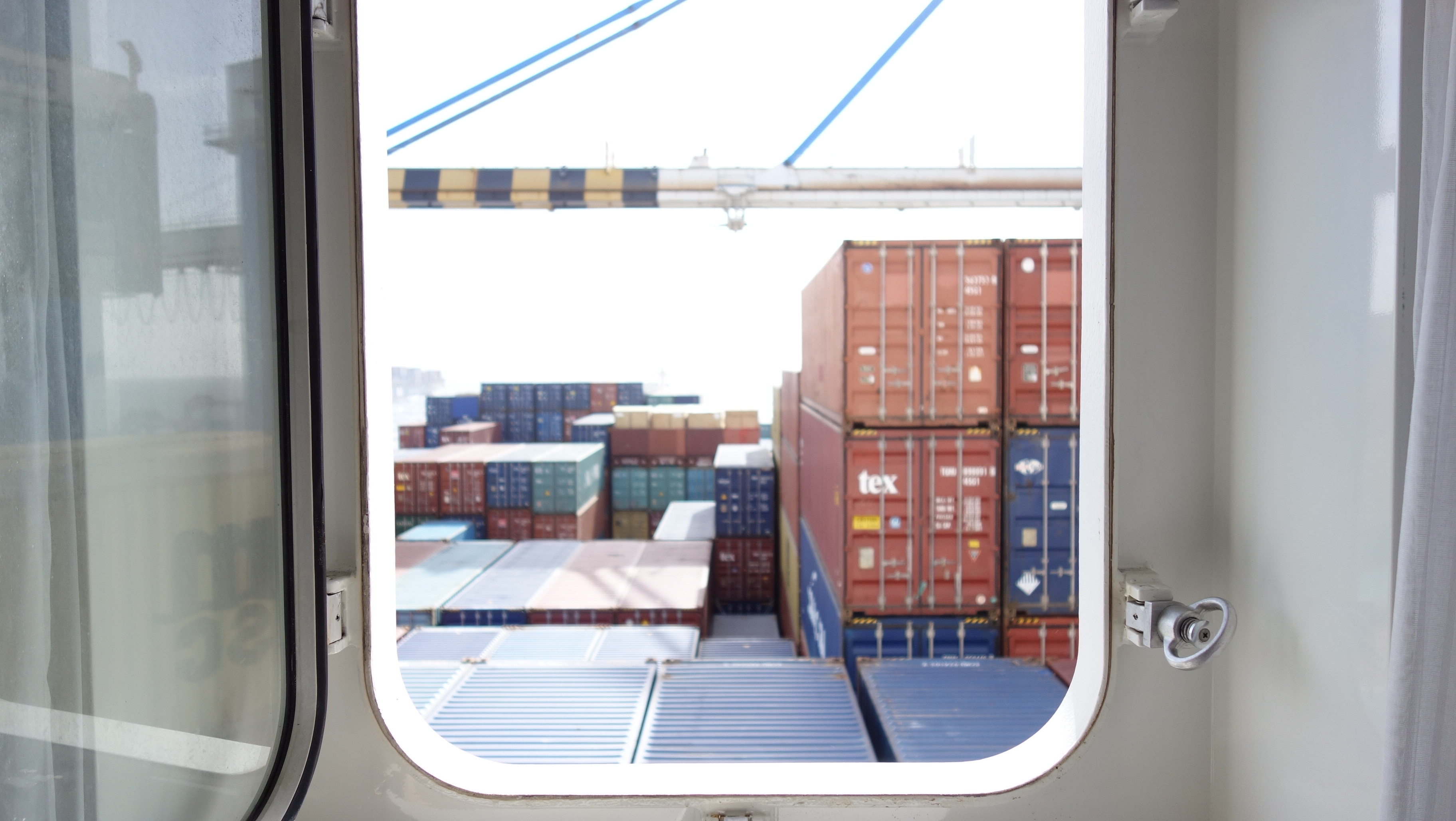
View from my cabin window before the loading is completed at Marsaxlokk

In my cabin, upon arriving I overlooked the containers as they were being moved by the cranes across my window, briefly shadowing my sun.  My windows overlook the bow (or did before the containers blocked it). Far below my cabin towers of containers begin like three-dimensional puzzle pieces.  And a few layers below my portholes is a layer of refrigerated containers, and a crew member in hardhat walking alongside them with a clipboard on a narrow gangway, checking their status, I suppose, and that they are indeed refrigerating whatever perishable cargo they may have within.


DSC00067

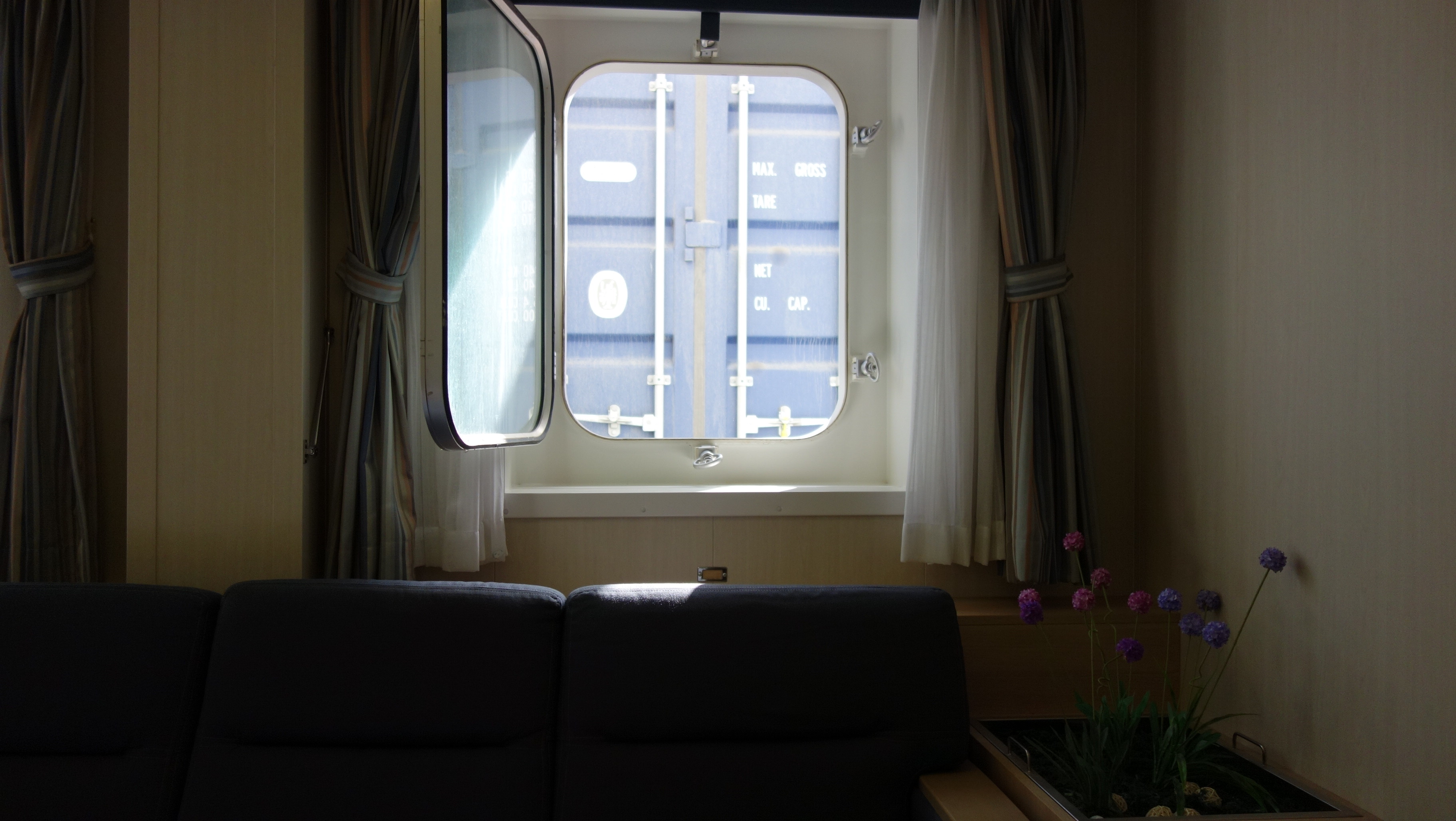
View from one of my windows

The wail and screech of the container being moved, the creaking and clanking, the sound of refrigerated containers just below, the sound of metal scraping against metal, and the swift flight of the cranes all blend very well with the music of British Sea Power which eerily echoes the sounds of the ships and containers outside. I wonder how the crane operators learn to play this distant game of placing the containers perfectly atop one another with their faultless fit as the crane balletically moves over the stack of already-fitted containers.  I feel –as the containers slowly tower in front of my porthole layer by layer- as if I am being slowly cocooned in the metallic belly of the machine leviathan, ready for my commodity circulation, dreading that the glorious sunshine shall be cut off by the layers of containers, which I suppose will go as high as they need to go.  Economies of scale.

Nor I have any sense of what is in the containers.  Their heft as the cranes moved them across the ship tells me they are not empty, but then they well could be already so heavy with the lumbering weight of the steel in their bodies, full or empty.  And there is little that tells you what can be inside.  Some have little yellow triangles saying “Super Heavy.” One, a Capital container (hah!), was cascading something liquid as it swept across the bank of containers.  DSC00066 The one immediately in front of my window, CMAU461154 8 (45G1), doesn’t seem traced beyond December, when I look for it via the website of track-trace (which takes me to the CMA CGM website).  The brilliant Charmaine Chua (commenting on Facebook) seems to think that for security reasons, the cargo manifest for containers is not posted until after delivery and unloading. Makes sense.

 

After lunch

Lunch is not quite as bad as I expected. Meat and two veg, as anticipated, but not tasteless (though overcooked). The messman in the officers’ mess on Deck B is Rico (or Enrico), a sweet and tiny Filipino guy. The soup/salad/cold cuts are laid out and the main course and desert are served by Rico.  A hot dog soup; generic cold cuts, a colourless salad of iceberg lettuce, and a chicken stuffed with something and breaded and baked and served with chips. But there is at least some fruit and veg, which is great, and tea, and I am holding out hope for some coffee rather than Nescafe in the morning.  And there is a jar of sambal oelec on the table which should make everything taste delicious, regardless of what is in it.  I wonder if I shall be able to ask to taste the crew’s food at some point.

The officers, all strapping Croatians, some with enormous arms and tattoos, most dressed in leisure suits (I guess when they are working they have overalls or uniforms on; I shall see tomorrow), sit, chat with each other, devour their food quickly and run back to work.  They are scrupulously polite, saying hello to me, but also studiously avoid speaking or looking my way.  Most accounts of why containerships would allow passengers on board say that they are there to entertain the crew and officers (we are also supposed to provide PR for the shipping company).  It seems to me that the officers see us as incomprehensible illegible nuisances and are not particularly inclined to be entertained by us.  But they also don’t hang around the mess for very long.  Apparently in the port they are very busy, and the Filipino second officer mentioned that they are doing some underwater work on the ship as well.  Which is perhaps why they are even busier than usual.

At the moment all is new for me. I feel shy meeting the officers, and the few crew members I have seen have said hello, but have maintained the courteous hierarchical distance that seems to be the order of the ship.  There were sounds coming from the crew’s dining hall, but I didn’t dare knock on their door either.  And meeting the captain in the stairwell was a bit embarrassing as he had to tell me which deck was mine as I kept climbing beyond where I was supposed to go.

I am looking forward to settling into the routine and to being cut off from communication tomorrow. I am looking forward to the ship leaving shore which shall give me a bit more freedom to wander around the decks (I hope) and the ability to go out into the sunshine at some point.  There seemed to be a little deck outside the officers’ mess but Rico cautioned me against going out there and I didn’t want to alarm him too much.


After dinner

The ship’s officers come in when they can, eat and leave.  The chief mate always has his walkie-talkie with him. I haven’t seen the Filipino second officer yet and I wonder if he eats with the crew, or if I have just missed him coming to the officer’s mess.  The cadets eat together at a small table – though not the woman cadet who eats at the main table.  We are served water, tea or coffee at meals, and wine, sometimes, apparently.  Though the crew and the officers seem to have their own supplies of wine and beer elsewhere and do not drink at meals (as they will have to return to work). The food is massively under-seasoned and over-cooked and I have been pouring salt and pepper and Tabasco or sambal oelek over every meal.

At the meals, the class and category hierarchies are firm and uncontested.  The Croatians all are comfortable chatting with one another, but this separation of tables (with the woman able to transcend the bounds between the cadet and officer) and the modes of address the messmen employ are fascinating in their upholding of orders of difference.  The captain sits at the head of the table and his wife sits to his right.  I have noticed that the officers sit at the same seats at every meal. I wonder if there is a particular order they observe even at the table, where as the distance from the captain grows, the status of the person diminishes. The hierarchy even works in which decks are populated by whom, and the higher you go in the ship, the higher the status (and shorter the distance to their workplace).  The exception to the proximity of officers to the bridge is of course the engineers – who have to descend to the bowels of the ship – but their cabins are nevertheless immediately below the passengers’ and ours are immediately below the captain’s and the chief engineer’s.  The spatial distribution of status reinforces the order onboard I suppose.  And of course it is the means by which a suppression of wages –determined geopolitically- is achieved.  Edna Bonacich long ago wrote about split labour market theory and divergent or dual wage regimes, and this applies as strongly (perhaps even more strongly) to a ship staffed by transnational crews as it does to the Los Angeles markets she was studying in the 1970s. It cannot be clearer how the ship’s crew and officers –from the global South and the fringes of the global North respectively– diverge in their wages and incomes.  And this of course means that class becomes articulated through a kind of geopolitical/racial difference; which is why the Filipino second officer disturbs these boundaries.  I hope to chat with him. He and the woman cadet are those I am most curious about.

I still have the internet connection – and Facebook– which ties me to the shore in ways I am not happy about.  I am looking forward to our departure tomorrow at 8 or noon…. And when we do, I am permitted to go to the wheelroom.  I look forward to the sense of scale and vastness that shall come with being far above the containers and the sea.  At the moment, with my view blocked by containers, and my routine one that takes me through narrow corridors to human-sized rooms, gyms, and familiar spaces, I feel a bit human-sized.  When I stepped out briefly on Deck A and looked to the sea, I found that thrilling – and the unfamiliar again: the steel, the angular objects arising from the deck; the metallic stairwells going to dark and oddly shaped spaces; the warnings painted in bright yellow and red on deck.  That is what I love about this all.  That is what I need more of.  Not the vastness of scale so much as the angularity and unfamiliarity of technology.

Posted in 2015 Trip, logistics, shipping conditions, transport, Travels | Leave a comment

all subtle and submarine

The Sea is History
By Derek Walcott

Where are your monuments, your battles, martyrs?
Where is your tribal memory? Sirs,
in that grey vault. The sea. The sea
has locked them up. The sea is History.

First, there was the heaving oil,
heavy as chaos;
then, like a light at the end of a tunnel,

the lantern of a caravel,
and that was Genesis.
Then there were the packed cries,
the shit, the moaning:

Exodus.
Bone soldered by coral to bone,
mosaics
mantled by the benediction of the shark’s shadow,

that was the Ark of the Covenant.
Then came from the plucked wires
of sunlight on the sea floor

the plangent harps of the Babylonian bondage,
as the white cowries clustered like manacles
on the drowned women,

and those were the ivory bracelets
of the Song of Solomon,
but the ocean kept turning blank pages

looking for History.
Then came the men with eyes heavy as anchors
who sank without tombs,

brigands who barbecued cattle,
leaving their charred ribs like palm leaves on the shore,
then the foaming, rabid maw

of the tidal wave swallowing Port Royal,
and that was Jonah,
but where is your Renaissance?

Sir, it is locked in them sea-sands
out there past the reef’s moiling shelf,
where the men-o’-war floated down;

strop on these goggles, I’ll guide you there myself.
It’s all subtle and submarine,
through colonnades of coral,

past the gothic windows of sea-fans
to where the crusty grouper, onyx-eyed,
blinks, weighted by its jewels, like a bald queen;

and these groined caves with barnacles
pitted like stone
are our cathedrals,

and the furnace before the hurricanes:
Gomorrah. Bones ground by windmills
into marl and cornmeal,

and that was Lamentations—
that was just Lamentations,
it was not History;

then came, like scum on the river’s drying lip,
the brown reeds of villages
mantling and congealing into towns,

and at evening, the midges’ choirs,
and above them, the spires
lancing the side of God

as His son set, and that was the New Testament.

Then came the white sisters clapping
to the waves’ progress,
and that was Emancipation—

jubilation, O jubilation—
vanishing swiftly
as the sea’s lace dries in the sun,

but that was not History,
that was only faith,
and then each rock broke into its own nation;

then came the synod of flies,
then came the secretarial heron,
then came the bullfrog bellowing for a vote,

fireflies with bright ideas
and bats like jetting ambassadors
and the mantis, like khaki police,

and the furred caterpillars of judges
examining each case closely,
and then in the dark ears of ferns

and in the salt chuckle of rocks
with their sea pools, there was the sound
like a rumour without any echo

of History, really beginning.

Posted in literature, the sea | Leave a comment

Marsaxlokk-Jabal Ali: Surmises

How will I ever be able to return to life, “circumspect life” in Melville’s words, after that, the “delirious throb” of this research adventure?

In his gorgeous opening to Moby Dick, Melville writes, “whenever it is a damp, drizzly November in my soul; […] then, I account it high time to get to sea as soon as I can.” Will I go from the balmy blue skies of the Arabian Sea –and this glorious caesura in ordinary life– to a soul enshrouded in November?

No ethnographic experience of mine has been as pleasurable as this one, perhaps because so much of what I was doing was not necessarily about the lives of the seafarers as it was about the life of the ship as it passed through Arab seas.  I didn’t feel like I was a spy in someone else’s house; didn’t feel that I had to pry to pry loose what I needed to learn.  And the experience was more about the passages, the feel of the political geography of the Arabian Peninsula (and Suez) from the shipboard, and the experience of the ports and of the security seas.  What stories I have told here about and by the seafarers have been shorn of what could get their tellers in trouble.  And I have left the other two passengers almost entirely out of the story, although they were fabulously interesting ethnographic subjects.

DSC00037

Khor Fakkan


What was extraordinary was the gradual slowing down of my life and the adjustment of my rhythms to the rhythm of the ship, and developing a routine that included hours and hours either in the wheelroom or walking around the circumference of the ship under a canopy of containers on the walkway around the upper deck.  Alongside these more sociable activities, I took a couple of hours everyday to read in the sunshine, alone, and my morning coffee was also unsociable (after a few awkward breakfasts in the officers’ mess where I really didn’t feel like talking just yet).  At night, when I finally came to bed, I would listen to music and write both the posts and in my private diary.

I listened to huge amounts of music.  When reading, when writing, and sometimes when walking on the upper deck.  It became clear after a bit that certain kinds of music lent itself much more amenably to this experience. I have named the posts after music that also acts as a mnemonic of the mood of that day.  I was already obsessed with the Brooklyn band The National which my friend Jason had suggested to me.  The obsession has only intensified. Something about the mood and cadence of the music was perfect for thinking about the things the sea and the ship and the seafarers suggested.

Of my readings, Allan Sekula (whose whatever PDF I could find I carry on my laptop) was undoubtedly the most astonishing, affecting, thought-changing. I found myself arguing with him, and more than a little in love with him.  Reading Marx’s Capital Vol II was a bit boring (yes, I know, SACRILEGE!) for reasons I will post a bit later.  It was rather wonderful reading Braudel while steaming along the southern part of the Mediterranean, and humbling even when one would vehemently disagree with one thing or another in what he argued.

MOBY-DICK

And Moby Dick.  Reading the novel again at a leisurely pace and taking note of the gorgeousness of the language was one pleasure. But then, to have his passage through the Indian Ocean coincide with our passage through the Arabian Sea was such an extraordinary flash of serendipity.  I was ever so grateful to Melville, because he seemed to sometimes agree with me and sometimes with Sekula in the round-and-round arguments I kept having with the latter, and this three-way conversation was perhaps the most wondrous intellectual memory of the trip.


What else?  Quick things I shall mention and move on.  I never felt seasick, but then the seas through which we travelled were extraordinarily calm.  Even on the windiest days (where the wind was blowing sometimes at over 40 knots and the northward current in the Red Sea was strong), the ship did not list, although it heaved a bit and you could find the movement in your body as you slept and you could find yourself swaying as you walked.  But on those very windy days when I could feel the heaving of the ship under me, I did not feel dizzy or sick.

The ship had all bourgeois amenities, including (I discovered 2 miserable days into travel) ground coffee beans and occasional wine at dinner. I and the other passengers ate at our own table in the officers’ mess.  The cadets ate at their own.  The officers ate at the captain’s table. The Filipino and Indian crew had their own mess (likely with far more delicious though less fancy food than ours). I talk about the hierarchies in one of the posts.  The food was better than I imagined (especially when heaped over with sambal oelek and salt), but it was mostly of the meat and two-veg variety (and loads of pasta or potatoes).  I never got to try the crew’s food, because although I was invited to their party one night and had friendly on-first-name-basis relations with a couple, I could not well invite myself to their meals.

DSC00061

At anchor, outside Jabal Ali

I regret that I could not speak with the crew more, although my upper deck walks afforded brief conversations (and ended up becoming the reason for taking those walks).  And I wish I could have understood the conversations in the officers’ mess (which were entirely in Serbo-Croat) because I am sure they were telling political jokes. I did become very friendly with a couple of the younger officers (one of whom in particular I adore for his openness, warm and easy conversation, and patience with my endless questions in the wheelroom) and a couple of the cadets who were wonderful and explained all sorts of things to me. They expounded on everything from the differences between Serbo-croat and Montenegrin pronunciation to how the shifts and weekends and work worked aboard the ship, to the machinery of our speed at sea and the engine, maritime measures and cultures, and arcana of reading radar, AIS, and various other technical information. They talked at length about their experiences of various ports on their routes, and compared their work on different routes and for different shipping companies if they had had this experience. They spoke about the processes of certification and the politics or heartbreaks or economic decisions or maritime memories that had driven them to the sea.  The Europeans also spoke about the Balkan Wars of the early 1990s.

One thing that is clear to me after this trip is how much geopolitics –understood as malign US power- still looms large in the thinking and lives of at least this sample of the world’s people, even if in our North Atlantic corner we think the hegemony (or decline) of the US and the age of global capital has put all that to rest.


Every day from later today or tomorrow (depending on how well I have managed to clear off my email-box), I shall post one day’s worth of posts from the beginning. I will add as many images and URLs as I can before I publish the posts, but these will be also be added on gradually, especially as I remember or track down the articles that had inspired elements in them.

Posted in 2015 Trip, Allan Sekula, logistics, Melville, political economy, the sea, transport, Travels | Leave a comment

Maritime Marriages

I have had the pleasure of reading Fernand Braudel’s The Mediterranean and the Mediterranean World in the Age of Philip II (Vol. II) while in Malta.  When I first searched for Malta in the index, I was so pleased to see that it actually said passim… So many references that the indexer didn’t even have to bother.

I shall save tidbits as I read for later. But for now, I want to post this wonderful wonderful passage:

Isabella [of Castile] had the choice between a Portuguese husband and an Aragonese, between the Atlantic and the Mediterranean… The decision finally reached in 1469 signalled the re-orientation of Castile towards the Mediterranean, an undertaking full of challenge and not without risk, in view of the traditional policies and interests of the kingdom, but which was nevertheless accomplished in the space of the generation.  Ferdinand and Isabella were married in 1469; Isabella succeeded to the crown of Castile in 1474 and Ferdinand to that of Aragon in 1479; the Portuguese threat was finally eliminated in 1483; the conquest of Grenada was accomplished in 1492; the acquisition of Spanish Navarre in 1512.  It is not possible even for a moment to compare this rapid unification with the slow and painful creation of France from its cradle in the region between the Loire and the Seine.  The difference was not one of country but of century.

I adore how matter-of-factly Braudel sees Isabella’s marriage choices as the decision to face one body of water or another.  A Mediterranean marriage or an Atlantic one, you say?

Posted in 2015 Trip, empire, imperialism & colonialism, readings, the sea | Leave a comment

Wake Up Your Saints

Travelling between worlds.  First in London, when my Thameslink train from St Pancras is cancelled and I have to jump in a last minute taxi for Victoria Station and Gatwick express. Driving through half-empty streets of London before 5 am is always glorious, the absence of traffic letting you see buildings you never see but walk past several times a week. Going from the Judt-esque temple of the modern -a Victorian era frilly-industrial redstone meringue with grand interiors and good lighting- to the dishevelled mess of construction machinery, temporary offices in shipping containers, and hideous secret stairwells to your train is an interesting exercise in thinking through where infrastructure investment is made (or not).

The Gatwick Express train goes through the unlit city and the suburbs in the early morning dark – and so much passenger silence, and arrives in the glorified mall full of exhausted people that is the generic airport terminal. These sites of transportation are themselves interesting. What a difference between a temple of consumption -the modern airport- and this town I have now arrived in, with its anaemic presence in tourist guidebooks and beautiful Borgesian name, Birżebbuġa.

DSC00043

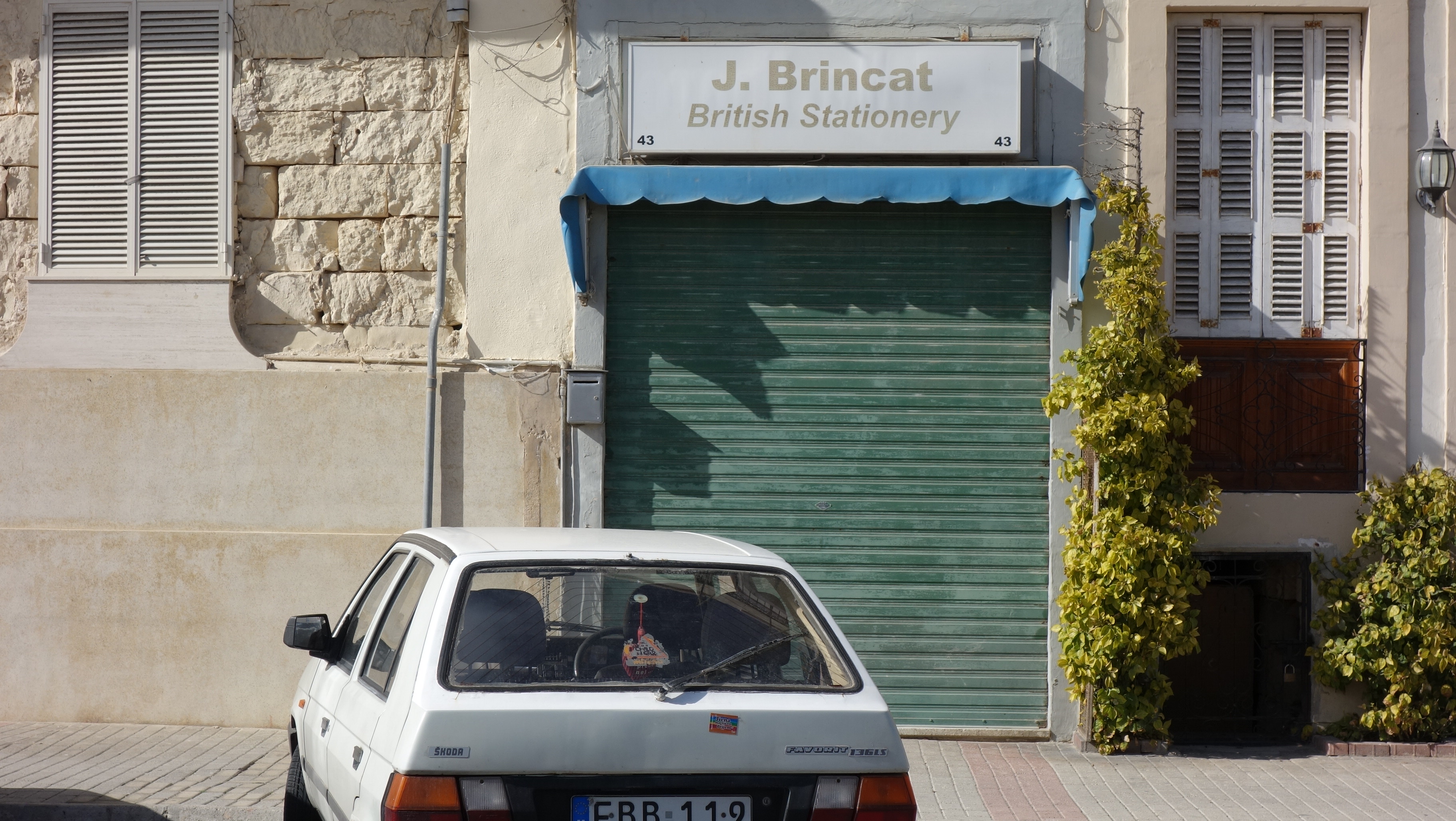
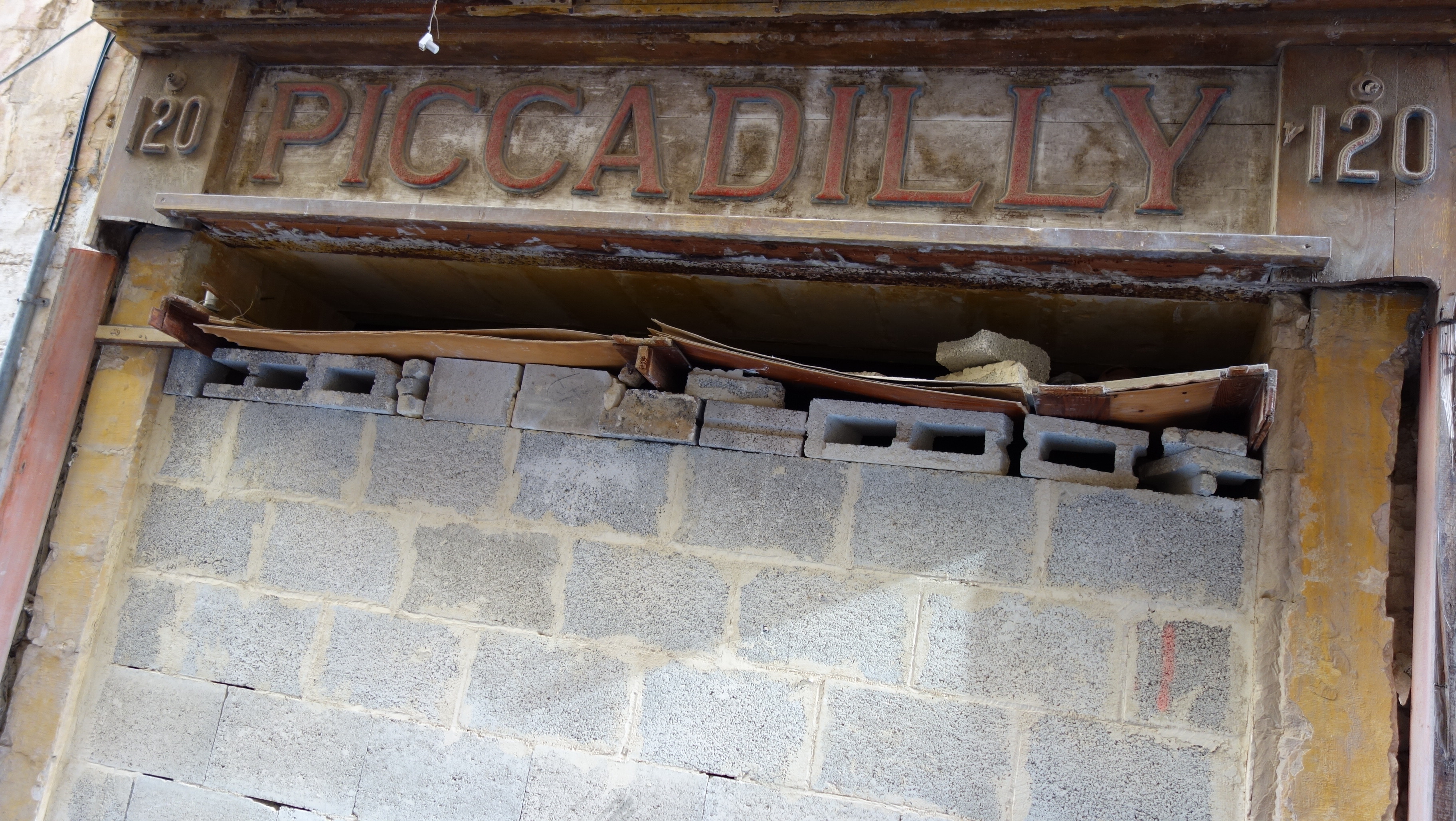
The map of Malta, the street signs, the Malti language, all make me feel as I have arrived in a strange world imagined by Borges, a kind of Mediterranean Uqbar (or its imagined mirror of Tlön).  There is the lovely Hagar Qim and the Dark Cave of Ghar Dalam (which, well, literally means dark cave in Arabic).  But it is the abundance of “Q”s in the names and the “x”s, and the Arabic absorbed into this Mediterranean soup that makes the place so familiar and unfamiliar at once. Add to that the strangely proud presence of very English-sounding shops and unmixed hot and cold taps in the hotel rooms (remember Jorge Luis Borges himself was a fanatical Anglophile).

DSC00047

DSC00050

The island -this fortified flat-top rock rising from a choppy sea- has that combination of the mythological and the mundane that makes a place fascinating: The Maltese falcons– not the film but the tribute paid by the Knights Hospitaller – and the Knights themselves and their Crusader histories; and the stories of “pirate” wars and sieges, of the Reconquista of the sea (which essentially entailed plundering North African and Ottoman ships).

And then there is the fact that Malta was used as a prison island -or a destination for forced exile- by the British during the 19th century (not to mention the first prisons built by the British on the island were modelled after Pentonville prison in London, complete with forced labour as something that improved the imprisoned natives).  Egyptian nationalist Saad Zaghlul spent some forced exile time here before being sent to Seychelles (I have written about the wide-spread colonial uses of these island prisons elsewhere).  A couple of the founders of the Khilafat movement in India had also spent some time in forced exile in Malta between 1917 and 1920, while a number of Ottoman government and military elite were transferred to Malta for two years between 1919 and 1920 from Istanbul.

But back to Birżebbuġa.  The little town is described dismissively by Lonely Planet as a “dormitory town for port-workers.”  Which is why I am here in the first place.  And listening to people speak in this beautiful language which sounds like Arabic and reads like Arabic (once you learn how to read the idiosyncratic lettering) but which also is unapologetically Italian: “buongiorno” and “ciao”, but also “aiwa” – as in “yes”- and roads called “triqs” (my favourite is the main promenade in Valletta which is called Triq ir-Repubblika… I love that irresistibly Arabic definite article “ir”).  The restaurants and cafes all seem to have multiple televisions on, and the one I had lunch at today had BBC World Service, RAI (Italian channel) and Fox Movies with Arabic subtitles showing simultaneously (with only the BBC’s sound not muted).  The town is overwhelmingly masculine, and I am not sure that my hotel -which serves the sailors about to board ships at the port- has any women guests other than me.  This adds to the surreality of the place.  You glance in the window of the restaurants and the place is full of tables of southern European (looking) men eating together and what looks like Filipino sailors eating alone.  I have been chatting with restaurant waitresses and they tell me that during the week the men arriving to go aboard ships go out drinking at bars at night, and it is true that the few bars I have walked by seem to be heaving with young(ish) men.

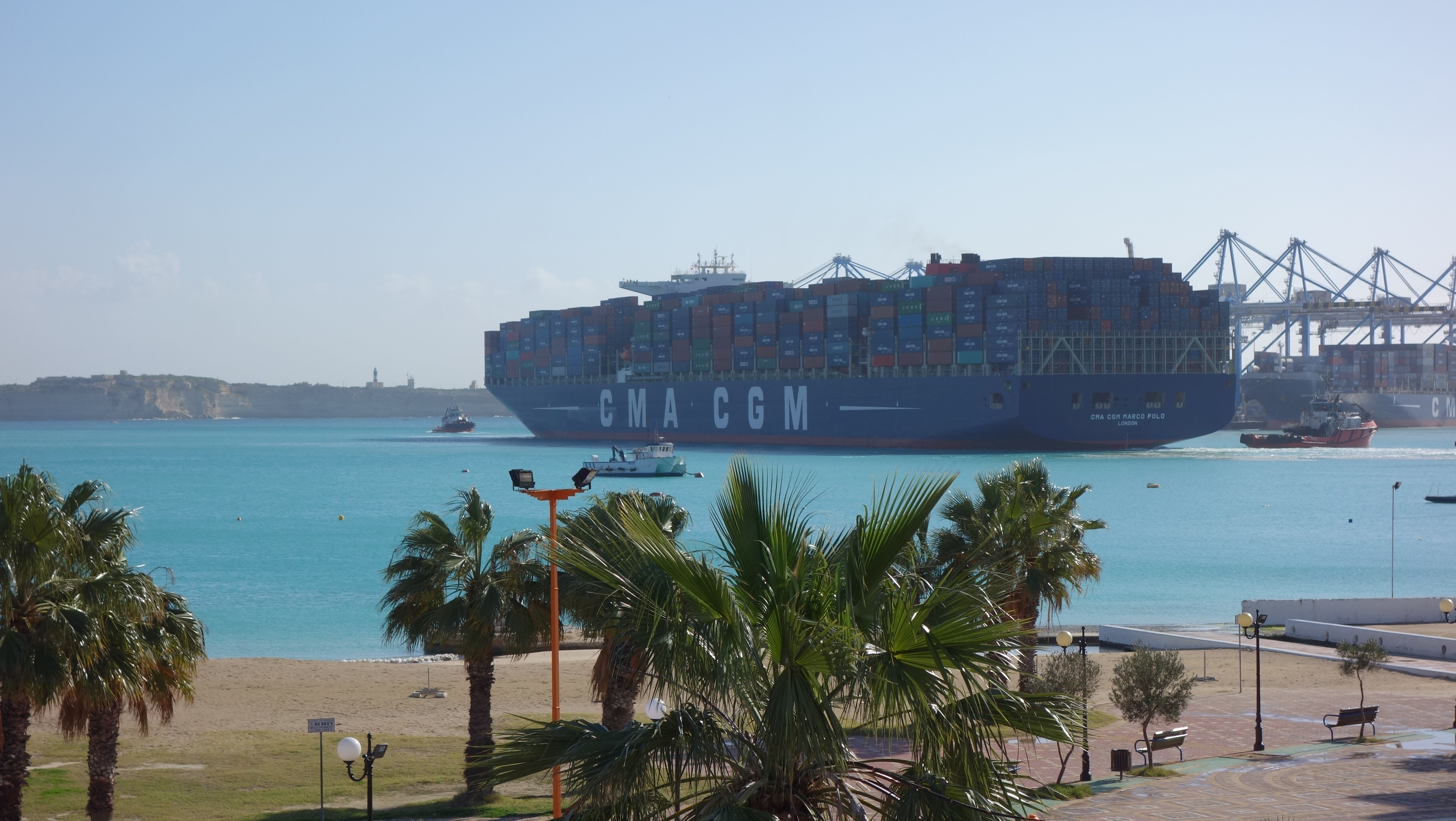
The container port itself opened up in 1988 and it is primarily a transshipment port handling nearly 3 million TEUs annually. The port is operated by CMA CGM (under a 30-year concession granted in 2004 and extended to 65 years in 2008) and in partnership with the Yildirim Group of Turkey and China Merchants Holdings. DSC00048

My ship, which was supposed to arrive at 8.00 on the morning of 3 Feb is now scheduled for 5.00 on 4 February.  So I have spent the day exploring this strange little sleepy town adjacent to the container port and going off to Valletta which is as different as one can imagine from a working port.  If this place is a living city, Valletta is a beautiful (almost too beautiful) jewel of a town with really superb restaurants and a lot more women.

I have been staring at the CMA CGM ships berthing at the port and longing for my ship to come.  I am ready -anxiously, fervently ready- to board CMA CGM Corte Real.  Apparently there is a Marseillais passenger also boarding at the same time, so I shan’t be the only passenger, but I still suspect I shall be the only woman.

P.S. I am endlessly listening to music as I wander around, so the rather random titles for these posts over the next couple of weeks are acting for me as a mnemonic aid – reminding me of the mood of the moment.  They will have very little to do with the subject of the post.

Posted in 2015 Trip, Travels | 1 Comment

the luminous beaches

A Small Invitation
By Yannis Ritsos
Translated from the Greek by Kimon Friar

Come to the luminous beaches─he murmured to himself
here where the colors are celebrating─look─
here where the royal family never once passed
with its closed carriages and its official envoys.

Come, it won’t do for you to be seen─he used to say─
I am the deserter from the night
I am the breacher of darkness
and my shirt and pockets are crammed with sun.

Come─it’s burning my hands and my chest.
Come, let me give it to you.

And I have something to tell you
which not even I must hear.

Athens, 1938

Posted in literature, the sea | Leave a comment