More on London canals

I have written lovingly of London’s canals before. I just want to briefly write out something else I have discovered which ties in nicely with the whole infrastructure thing.

regentscanal

Today I spent an hour or so in the London Canal Museum.  Not really a particularly interesting museum.  Its location is stunning, and the ice-storage space is the one interesting thing in there (it seems like the two commodities that most frequently travelled on barges on London canals were coal and ice which was shipped in from Norway).  I did pick up a little illustrated and annotated route-book about Regent’s Canal, The Regent’s Canal: An urban towpath route from Little Venice to the Olympic Park by David Fathers. The book definitely fuels my running obsession, with its details about what to watch out for in the various segments of the canal.  It also has this one very interesting passage:

Following the Second World War and the decline in canal traffic, the towpaths fell into disrepair through lack of use and poor maintenance. These paths were neither intended nor designed for public access.

Between 1968 and 1982 the towpaths were incrementally repaired and opened to the public. Two factors brought this about: action by the local councils through which the canals ran and the needs of the General Electricity Generating Board.  The City of Westminster was the first local council to restore the towpath as a thoroughfare for walkers and cyclists.  Camden and other councils followed soon after.

The then General Electricity Generating Board needed to run 400kV cables from its substation in St John’s Wood to the East End of London.  Normally this would have involved digging up major roads to lay the cables but instead they bought the towpath from Lisson Grove to the Hertford Union Canal, adjacent to Victoria Park.  This was a cheaper option; in addition, they could use water from the canal to cool the cables. The flagstones are unfixed for access and can sound like a primitive vibraphone when cycled over.

That explains the development of the towpath in some of the poorer London councils.  The book is a pleasure to follow.

Posted in infrastructure, political economy, transport | Leave a comment

Dangers of crewing an oil tanker

Associated Press reports that jets belonging to the Libyan government bombed a Greek-owned tanker, killing two crew members:

A military spokesman for Libya’s internationally recognised government says its fighter jets bombed a Greek-owned tanker ship because it had no prior clearance to enter an eastern port and acted “suspiciously”.

Spokesman Ahmed al-Mesmari said the jets struck the tanker twice on Monday in Darna before his government was informed that it was commissioned by the local power station.

Greek officials said the bombing killed two crew members and wounded two onboard the Liberian-flagged Araevo.

Al-Mesmari said: “We regret the loss of lives.”

The Araevo’s crew of 26 comprised 21 Filipinos, three Greeks and two Romanians.

Darna is a base for Islamic extremists who have pledged allegiance to the Islamic State group.

Libya, torn between rival governments, has been beset by militia violence since its 2011 civil war and the death of dictator Muammar Gaddafi.

Posted in Middle East, militaries, oil, political economy, transport, war | Leave a comment

Ghost ships

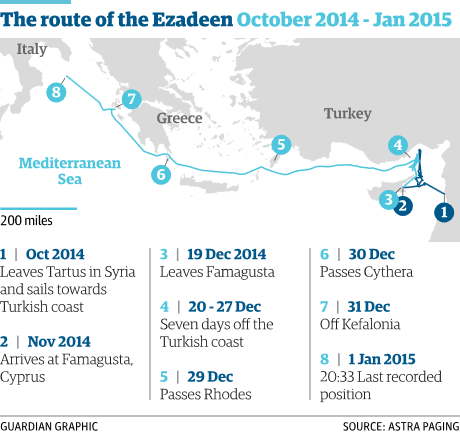
In the last two weeks, two ships filled to the brim with hundreds of Syrian refugees have been brought in to Italian ports.  The ships seem to have left Eastern Mediterranean, and sailed parallel to the Turkish coast, picking up most passengers from Mersin or other ports in Turkey, and arriving in Greek waters, heading towards the heel of Italy.  And then been abandoned by their crew.  Both ships, Blue Sky M and Ezadeen, seem to have carried middle class Syrians who paid  up to $5000 per person to be conveyed to Italy, 970 passengers in the former and 450 in the latter.
Migrant_Ship_Ezadeen_WEB030

There are three things about the story that strike me.  First is the fact that it will be nearly impossible to track down the ownership of the ship.  Or who has made the vast sums of money (the first ship’s passengers paid $4.5 million in toto!) to bring these people to fortress Europe.   As Rose George writes in her mostly excellent Deep Sea and Foreign Going,

Most ship owners operate decent ships that are safe, and pay their crews properly. But if you are unscrupulous, there is no better place to hide than behind a flag. The ITF calls flags of convenience a ‘corporate veil’. The Economist, a supporter of free markets, and so surely a supporter of this freest market of all, calls them ‘cat’s cradles of ownership structures’. I call them a back door, easy to slip through if necessary. This facility was best exposed by the oil tanker Erika, which broke up off the coast of Brittany in 1999, polluting 250 miles of French coastline. The tanker had been chartered by French oil giant Total, but its owner was unknown. As expected, French authorities immediately began an investigation to track him or her down. They first found a company named Tevere Shipping based in Malta. But Tevere Shipping had outsourced Erika’s management to a company named Panship Management and Services, based in Ravenna, Italy. Panship had chartered the ship to Selmont International, registered in the offshore haven of Nassau, which was represented by Amarship of Lugano, Switzerland. Thirty per cent of Tevere Shipping’s capital was owned by Agosta Investments Corporation of Monrovia, Liberia. It goes on and on, a dizzying Russian doll of ownership. By the end, French investigators found 12 shell companies standing between the ship and its ‘beneficial owner’. Many of the companies were a brass plate in a Maltese or Monrovian street, but that brass plate can act as a mighty drawbridge, hauled up, when flag states provide such anonymity. All the power of the French judicial investigators could go no further. When Erika’s owner finally came forward weeks later – he claimed he had been skiing and had not realized he now owned an environmental catastrophe – he was revealed as a London-based Neapolitan, Giuseppe Savarese. The BBC reporter Tom Mangold later asked Savarese why his ship’s ownership structure was so complex. I only read the transcript of the interview, but I can hear the shrug in Savarese’s voice. ‘That is normal in shipping.’

Blue Sky M flies a Moldovan flag, and Ezzadin is at the moment flying the Sierra Leonean flag, both considered by the International Transportation-workers’ Federation (ITF) to be flags of convenience.  ITF has long had a campaign against flags of convenience. While Blue Sky M is a general cargo carrier, Ezadeen was a livestock carrier before it was employed to transport migrants and asylum-seekers.  Ezadeen was built in 1966, Blue Sky M in 1976; both ancient in ship years [the average age of ocean-going ships is 22 years].  This is the second thing that struck me about the story: how unseaworthy these ships were.  And again it reminded me of a harrowing story that Rose George tells about an unsafe and ancient livestock carrier that crashed near Tripoli in Lebanon in 2009.  Forty four human lives were lost,  and 39 sailors were rescued. 10,224 sheep and 17,932 cattle also perished. Beiruti friends told me about cows washing up on the shore for weeks afterwards.  Here is Rose George’s story:

“Welfare organizations dislike livestock carriers profoundly, and with reason. (So do Somali pirates: they have captured then released a few livestock carriers without asking for ransom. Too much hassle.) The welfare groups criticize the overcrowded conditions, the lack of food and water, the inadequate bedding for the beasts. They point to countless reports of swine, sheep or cattle being crushed on their journey and think that shipping frozen meat would be more humane. […]

“Nicolás Achard describes conditions [aboard the livestock freighter Danny FII] as ‘horrible’. He was working mostly with the animals, whose pens were on decks below sea level. Although she had passed the safety inspections required by Panama, the flag state, Danny FII by many accounts was rusting, old, decrepit. The decks were in such a bad state that regularly the floor would cave in and the leg of a heifer would appear from the deck above, an inch from Nicolás’ head. He was used to working in the open with animals on Uruguayan ranches; he didn’t much like this confined, cramped, noisy, smelly ship, but he needed the money.

“The journey from Montevideo to Lebanon took three weeks with no land calls. On 16 December, the crew watched Titanic together. The following day, they prepared the ship for port. After so many days at sea, the animals had made a colossal amount of mess. Nicolás remembers that they stopped about 13 miles off Tripoli. He isn’t sure about the sequence of events, but thinks that a storm came, and that the captain thought it was a good opportunity to clean up. This seems an odd decision from such an experienced captain. Perhaps they were already cleaning and the storm came. The usual cleansing method is to tip the ship slightly and hose the muck into the sea. But all weight on ships, whether ballast water, cargo or animals, must be carefully distributed to maintain stability. […]

“On deck 2, working with a couple of colleagues, Nicolás began to hear ‘weird sounds’. It was livestock on the decks above falling over. With his crewmates, he headed up to deck 6, above the water line. There, they could see that the ship was tilting far more than it should be. It looked drunk. More crew gathered and looked worried together. Then everything got worse very quickly.[…]

“On deck 13, the Uruguayans knew they had to jump. They were in work clothes – overalls, heavy boots – and Nicolás told the non-swimmer Guillermo to remove his boots. They would only weigh him down. They ‘fell into the sea’, a three-metre descent. ‘Then we just sat and watched the thing disappear.’ Nicolás describes Danny FII as sinking ‘like the Titanic’, but that sinking had taken almost three hours. Danny FII disappeared in 20 minutes, and became the 37th ship to sink that year.

“In the water, Nicolàs saw that someone had managed to chuck a life raft into the sea and that it was 100 metres away, so he swam for it, front crawl. But he found it unexpectedly difficult to make progress. There were huge waves, and later he learned that when you are wearing a lifejacket it is easier to swim on your back. There were cattle in the water. Pounding waves, darkness, people screaming, howling and thrashing beasts everywhere: it sounds like a section of hell that Dante forgot to include. Nicolàs saw a Pakistani crewmate holding on to the tail of a heifer as a flotation device.[…]

“After eight hours, Nicolás and his companion were rescued by an Italian naval vessel that flew a UN flag. Others were picked up by Lebanese naval vessels. A Royal Navy helicopter had also arrived from Cyprus to assist. The Italians gave their guests good and immediate medical attention, thermal clothing, food and hot-water baths, then sent them by helicopter to Tripoli. There, the ship’s managers paid for a hotel, but most survivors had arrived with no possessions beyond rubber boots given to them by their Italian rescuers. Luckily the Uruguayan ambassador provided his citizens with clothes, enough for them to donate some to their Pakistani and Filipino shipmates, whose embassies gave them nothing. Only on the last day of their time ashore did Falcon Point International, the owners, provide a pair of trousers and socks and shoes for each survivor. Forty-three men returned from the foundering of Danny FII. Alan Atkinson, Gary Baker and Captain John Milloy did not.[…]”

So, this is the kind of ship that 450 Syrian migrants had boarded.    As a Guardian story recounts:

The Ezadeen is a former livestock carrier that has gone through at least seven changes of name since it first started operating as a cargo ship in 1966. Its most recent owner – officially at least – appears to have been a merchant marine company based in Lebanon, but somewhere along the way it seems people-smugglers took control of it.

Made in Germany, the 1,474-tonne vessel has been flying under the flag of Sierra Leone for the past four years and was previously under that of Syria. A sample of its docking history over the past year also reflects the disparate jurisdictions that such ships pass through. In March last year it was in the Romanian port of Midia, before later visiting Beirut, Dubai, Beirut again, Aden and the Egyptian ports of Suez and Port Said.

Blue Sky M had had its safety certificate withdrawn, BBC reported.  Who were the crew?  The people on Ezadeen reported that the crew had remained masked throughout the journey.  The passengers had no idea how to identify them. I am sure the language of communication had been an international variant of English.  The “captain” of Blue Sky M had himself been a Syrian refugee, a former ship’s captain now desperate to find refuge in Italy:

Rani said his participation in the people smuggling venture began when he left Lebanon, where he had sought refuge from the brutal war ravaging Syria, to spend time in Turkey. Once there, Rani was contacted by an acquaintance who knew the Syrian had worked as a ship captain. After the pair met in Istanbul to conclude their deal, Rani was taken with three other men aboard the Blue Sky M, which then travelled to Turkey’s Mersin port close to the Syrian border.  After waiting in Mersin two days for his “cargo”, Rani says the ship took on an initial group of 30 people the third day, followed by a succession of new arrivals that totalled nearly 800 by December 25.

In the case of Blue Sky M, neither the Turkish nor Greek customs or coast guard officials inspected the ship (see this excellent AFP story). The Italians seem to have arrested around 4 crew members of Blue Sky M.  Whether they have discovered who the crew of Ezadeen is – or where they may be- is not yet reported.

But the third thing that strikes me about the story is the idea of a ship without a crew.  From the Rime of the Ancient Mariner to Conrad’s The Shadowline a ship wandering aimlessly in vast oceans must invoke some atavistic fear – of loneliness and abandonment.  Sometimes, this fear takes on a mock horror element – as with the debunked myth-making around an abandoned Russian ship full of cannibal rats.  And sometimes, it takes on the real tinge of horror, as in Edgar Allan Poe’s very problematic The Narrative of Arthur Gordon Pym of Nantucket which, despite its myriad faults, has a terrifying scene about a Dutch ghost ship:

“The vessel in sight was a large hermaphrodite brig, of a Dutch build, and painted black, with a tawdry gilt figure-head. She had evidently seen a good deal of rough weather, and, we supposed, had suffered much in the gale which had proved so disastrous to ourselves; for her foretopmast was gone, and some of her starboard bulwarks. …

“No person was seen upon her decks until she arrived within about a quarter of a mile of us. We then saw three seamen, whom by their dress we took to be Hollanders. Two of these were lying on some old sails near the forecastle, and the third, who appeared to be looking at us with great curiosity, was leaning over the starboard bow near the bowsprit. This last was a stout and tall man, with a very dark skin. He seemed by his manner to be encouraging us to have patience, nodding to us in a cheerful although rather odd way, and smiling constantly, so as to display a set of the most brilliantly white teeth. As his vessel drew nearer, we saw a red flannel cap which he had on fall from his head into the water; but of this he took little or no notice, continuing his odd smiles and gesticulations. I relate these things and circumstances minutely, and I relate them, it must be understood, precisely as they appeared to us.

“The brig came on slowly, and now more steadily than before, and—I cannot speak calmly of this event—our hearts leaped up wildly within us, and we poured out our whole souls in shouts and thanksgiving to God for the complete, unexpected, and glorious deliverance that was so palpably at hand. Of a sudden, and all at once, there came wafted over the ocean from the strange vessel (which was now close upon us) a smell, a stench, such as the whole world has no name for—no conception of—hellish—utterly suffocating—insufferable, inconceivable. I gasped for breath, and turning to my companions, perceived that they were paler than marble. But we had now no time left for question or surmise—the brig was within fifty feet of us, and it seemed to be her intention to run under our counter, that we might board her without putting out a boat. We rushed aft, when, suddenly, a wide yaw threw her off full five or six points from the course she had been running, and, as she passed under our stern at the distance of about twenty feet, we had a full view of her decks. Shall I ever forget the triple horror of that spectacle? Twenty-five or thirty human bodies, among whom were several females, lay scattered about between the counter and the galley in the last and most loathsome state of putrefaction. We plainly saw that not a soul lived in that fated vessel! Yet we could not help shouting to the dead for help! Yes, long and loudly did we beg, in the agony of the moment, that those silent and disgusting images would stay for us, would not abandon us to become like them, would receive us among their goodly company! We were raving with horror and despair—thoroughly mad through the anguish of our grievous disappointment.

“As our first loud yell of terror broke forth, it was replied to by something, from near the bowsprit of the stranger, so closely resembling the scream of a human voice that the nicest ear might have been startled and deceived. At this instant another sudden yaw brought the region of the forecastle for a moment into view, and we beheld at once the origin of the sound. We saw the tall stout figure still leaning on the bulwark, and still nodding his head to and fro, but his face was now turned from us so that we could not behold it. His arms were extended over the rail, and the palms of his hands fell outward. His knees were lodged upon a stout rope, tightly stretched, and reaching from the heel of the bowsprit to a cathead. On his back, from which a portion of the shirt had been torn, leaving it bare, there sat a huge sea-gull, busily gorging itself with the horrible flesh, its bill and talons deep buried, and its white plumage spattered all over with blood. As the brig moved farther round so as to bring us close in view, the bird, with much apparent difficulty, drew out its crimsoned head, and, after eyeing us for a moment as if stupefied, arose lazily from the body upon which it had been feasting, and, flying directly above our deck, hovered there a while with a portion of clotted and liver-like substance in its beak. The horrid morsel dropped at length with a sullen splash immediately at the feet of Parker. May God forgive me, but now, for the first time, there flashed through my mind a thought, a thought which I will not mention, and I felt myself making a step toward the ensanguined spot. I looked upward, and the eyes of Augustus met my own with a degree of intense and eager meaning which immediately brought me to my senses. I sprang forward quickly, and, with a deep shudder, threw the frightful thing into the sea.

“The body from which it had been taken, resting as it did upon the rope, had been easily swayed to and fro by the exertions of the carnivorous bird, and it was this motion which had at first impressed us with the belief of its being alive. As the gull relieved it of its weight, it swung round and fell partially over, so that the face was fully discovered. Never, surely, was any object so terribly full of awe! The eyes were gone, and the whole flesh around the mouth, leaving the teeth utterly naked. This, then, was the smile which had cheered us on to hope! this the—but I forbear. The brig, as I have already told, passed under our stern, and made its way slowly but steadily to leeward.”

And of course the passengers of Ezadeen and Blue Sky M thankfully escaped the fate reserved for the passenger and crew of Poe’s storyship, but not so the thousands of other migrants who crash on shores and coastlines (as the two aforementioned ships would have, had there not been intervention), or drown in the sea.  The real horror of our time is not flesh-eating seagulls, the real horror of our time is the quiet, forgotten, unseen drowning of thousands of migrants in the Mediterranean.  And if Mare Nostrum, the Italian/European plan to rescue drowning migrants, is set adrift, this horror is only sure to proliferate.

Update: I think it is important to note that in the midst of this horror, ordinary Italians have shown how solidarity, how hospitality and friendship, is actually the fundamental sentiment underlying the encounter with the stranger:

“Everyone was partying, or thinking about going to a party, for the last day of the year,” says Mimma Antonacci, a Red Cross spokeswoman in the southern Italian city of Lecce. But when news came of the ship, she says, people stopped “and they asked us what they can do. And when they saw the people arriving, they started cooking.”

Monasteries and other religious buildings have opened their doors to provide shelter, she says, and locals also chipped in with lots of donations.

“Many people came with clothes, shoes, food. Everybody helped us. Socks, shoes for children, even cookies and milk,” Antonacci says. “They don’t ask for anything. They do it in silence, without any clamor or TV [coverage.] They work hard, no matter what day of the year, no matter who was partying or not. The solidarity here is wonderful.”

Posted in infrastructure, literature, logistics, Middle East, political economy, ports, shipping conditions, transport, war | Leave a comment

Pulp fictions

pulp fiction   n. fiction of a style characteristic of pulp magazines; sensational, lurid, or popular fiction.

1928   Decatur (Ill.) Herald 10 Aug. 6/5   Wood-pulp fiction commands a price of two—sometimes three—cents a word (The Oxford English Dictionary)

I sometimes think that pulp fictions touch on the zeitgeist, that they pick up on undercurrents of politics in non-pedagogical sorts of ways -in that they are free from the burden of representation good political-literary fiction is felt needs to bear.  In the unpolished presentations of a time, many pulp writers also convey something of the unvarnished prejudices and bigotries of their time without varnishing it.

Pulps

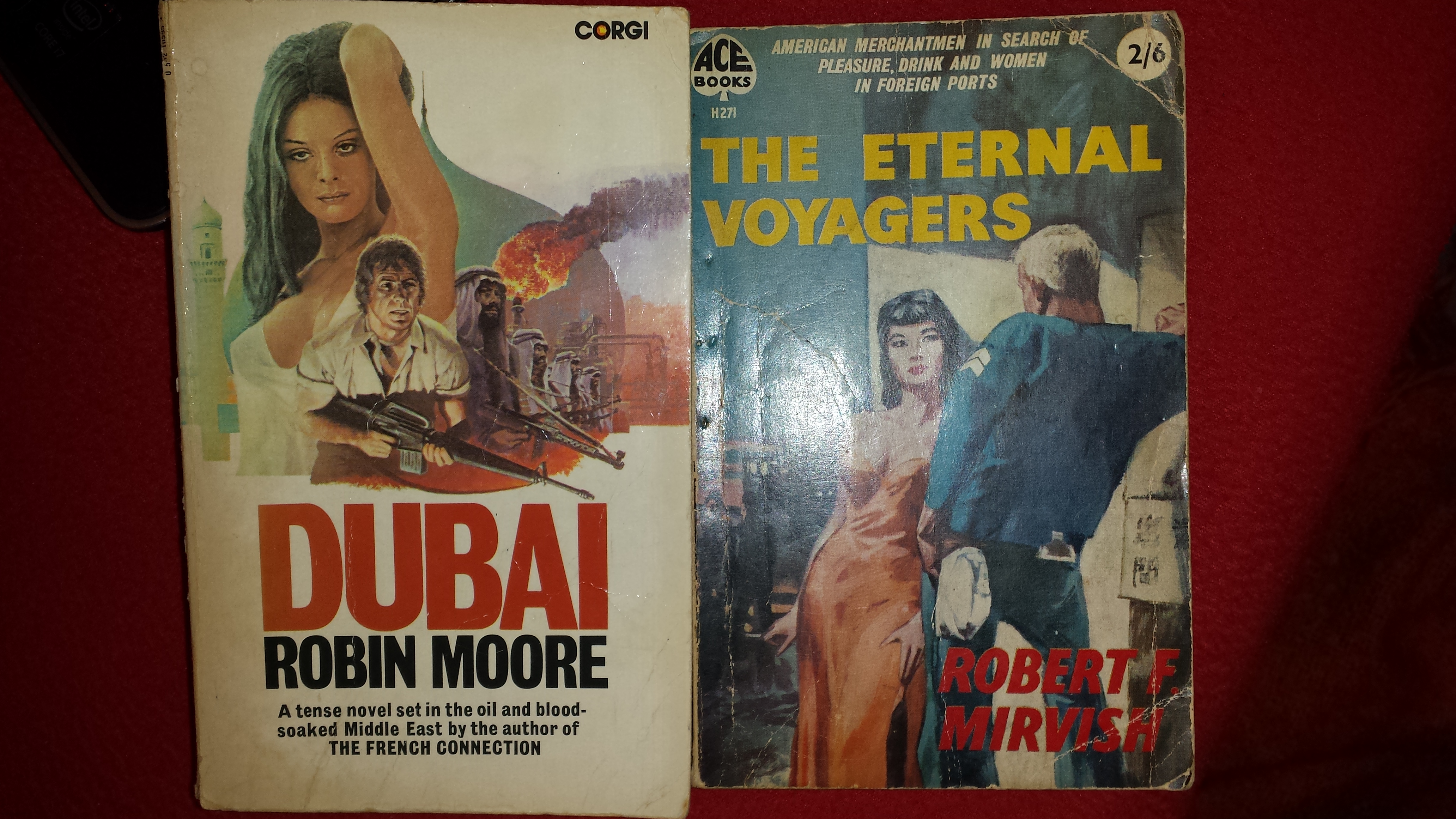
The first of pulp novels here is Robert Mirvish’s The Eternal Voyagers; the second, Robin Moore’s Dubai. The first I discovered when I was searching for something else in the historical NY Times archives and stumbled across a (fairly positive though brief) review. The second was recommended to me by a Facebook friend (thank you Yasser).  Neither is at all beautiful in their language, and Moore’s writing is especially atrocious (especially the bad sex scenes.  Lord!). Of the two, Voyagers is the better book.  Its characters are more believable, their motivations and feelings better described; the story with its own narrative force. But Dubai is more politically interesting, as it touches on events of its time that are little discussed in official histories and stories.

Voyagers is about endless maritime voyages between Kuwait and Japan on a petroleum tanker in the early 1950s.   Mirvish was himself a US merchant mariner during and after the Second World War and his sense of the life aboard a ship has a corresponding richness of details and mood. Perhaps the most affecting (because honest?) themes are of the deadliness of the work and of the bruised and strangely fragile masculinities of the sailors. Most shocking though is the unflinching rendering of how crucial alcohol is to the lives of the sailors, how complete its dominion over the ship and the story itself.

Liquor fills a place in the lives of men who go to sea that cannot be underestimated. It has a purpose as important to most merchant seamen as food and rest and recreation. To some it becomes all three, to others it is one or another. It is their consolation in their loneliness, a loneliness so acute and specialized that it is unknown among people living ashore if you dismiss the seaman’s counterpart, the men who fill jobs in the isolated commercial and industrial outposts of the world. It is a companion to merchant seamen in a sense that not every Navy man may know, for a Navy man may be stationed for long stretches of time at shore installations. (p. 38)

For the seamen of the SS Pan Nebraska, thirty days sobriety, of monotony, of work had to be obliterated before they could function as individuals again, with individual desires and tastes. And the tools of obliteration were at hand at last.  The beer was ordered so rapidly, each man throwing out his money so eagerly and quickly, that before long the table was covered with bottles, some men having three or four of them open in front of them at one time.  As the hours wore away, as the room filled with men from other ships in port, as here and there someone recognized a shipmate out of the past, as more and more people were drawn into the orbit of the big celebration, the first signs of group disintegration appeared.  Men wandered off to talk to old friends, to gather bits of information. Questions were asked.  Where could one get a woman? What was the prevailing price? What was the procedure? They all knew the answers, but they knew, too, that every country had its own idiosyncrasies. 

Strangers drifted together -men from Panamanian ships and Norwegian ships and American ships. Vows of eternal friendship were taken at that stage of the party that by nightfall would be broken by blows. (p.116).

The book’s passages on the work that needs to be done aboard a ship (and what can and cannot be done when the ship has its dangerous cargo of combustible fuel) are actually pretty fantastic.  Its emphasis on the overtime work that allows the men to earn enough money to send back home, and of the frictions between the union rep and the captain of the ship are beautifully rendered.  And for its time, its attitude towards the African-American sailors aboard the ship are relatively enlightened (and only relatively).

The vessel moved steadily through the Mediterranean, and out on deck the men worked and chipped rust and mended ladders and performed the routine workaday jobs that comprised their endlessly recurrent chores. Working from the bow aft, the men began painting the vessel. By the time they had finished with the stern, rust would be creeping back again on the bow, the pain would be fading, blistering or peeling, and the timeless monotonous round would begin anew. The pumpmen worked at renewing joints and freeing winches and reach-rods. The wipers painted below, in the ever-increasing heat of the engine room, straddling boilers and generators and turbines, each man performing his allotted function. The oilers made their rounds, the firemen tended their gauges. The twenty-four-hour round-the-clock poker game spun its everlasting way through time. Men disappeared from the card table to eat, stand their watches, turn to at special jobs, or to sleep, and their places were taken by other men who had finished eating, had stood their watches, completed their special jobs, had slept through or were willing to forego sleep to spend their time shuffling bits of cardboard while their hands rifled nervously through the money they kept stacked in front of them. (p. 33).

My interest in the book came from the fact that it happens on an oil tanker and that it specifically has (terrible, racist) passages about Kuwait.  Its account of passing through Suez is also interesting (if cringe-worthy for its descriptions of wily natives).  Tankers are particularly dangerous to sail.  They carry the fuel that can catastrophically destroy them if they are rammed and they become cauldrons of flame and fire and fumes.  After recounting one such disaster, the character -who was the only survival of such an accident: “He never forgot that if the general alarm bells had been in working order everyone might have been saved. But there had been no fire or boat drill for over three weeks, though such a drill had been entered in the ship’s log every seventh day as the law required. No one had been aware that the general alarm system was defective. No one had known until it was too late” (p. 70).

And here is the predictably orientalist description of the tanker arriving in Kuwait:

The ship passed through the narrows between the Gulf of Oman and the Persian Gulf, then moved  steadily up to Kuwait. They made landfall in the early hours of the morning, with the first rays of the sun striking the sands of the desert and the aluminium paint of the tank farms. A T-shaped dock ran into the sea, an enormous structure, newly created, modern to the last detail, the latest transformation to take place in a land that had known no change for two thousand years. (p. 93)

Once they arrive, they are engulfed in a sandstorm that lacerates the air and makes the docks opaque, covers every surface in the ship, even those behind secured doors, and “[m]onths later, when some piece of engine-room machinery broke down, opening the casings would reveal that the cause of the trouble was the sand which had sifted in during the storm in Kuwait” (p. 95).  Once the storm clears, the sailors note that

[t]here were twelve ships at anchor awaiting berth. Most of them were American-built T-2 tankers, operating under foreign flags. There were no restrictions to their activities; they could carry what they pleased, where they pleased, manned by foreign crews, and no American parent company that owned them could be censured, taxed, or held accountable for their activities. (p. 98)

And here is how the Kuwaitis appear in the story -predictably and like so much of the European and US literature of the time, as faceless étrangers, engaged in the inscrutable activities of alien natives, eternally backward amidst so much modernity:

On the docks, the Arabs bowed and knelt on their prayer rugs, their voices raised in praise to their God, their calls rising from between the narrow double lane of ships, from beside the heavy pipelines, from among the cranes and winches, the No Smoking signs displayed everywhere. The fierce sound of their cries was heavy in the night air, piercing the walls of the night like the yelp of a prisoner through the walls of a dungeon. The sailors mocked them, and they looked back in burning anger, out of desert eyes that glittered brown and black with hate, but they neither halted their devotions nor gave sign of their rage by any other mark than the changing shadow of their eyes…. 

About an hour before midnight the vessel was loaded. But the drinking session before the bos’n’s room did not come to a halt then. There was still plenty of time. The Arabs still had to disconnect the hoses. People from ashore came aboard to make up the cargo papers. The pilot still had to put in his appearance. And from the cracking plant in the distance the bright orange flame from the waste chimney licked against the desert sky. Then thousand lights winked from the stagings of the cracking plant and distillery. The tank farm lay in a solid mass, row upon row of oil tanks, far as the eye could see. (p. 100).

Of the ports to which the ship travels, they prefer the East Asian ones – for all the terrible cliched reasons one comes to expect: the available beautiful feminine petite Asian women (the characterisations are not mine), the ease of access to liquor, the fact that Japan is still really under US military and naval control and the US military police are in charge of all the policing in the Japanese ports where the ship arrives. In the end, this strange little paperback with its melancholy loneliness, alcoholic rage and stupor, and clear class frictions aboard is a document of its time. And all the more readable for conveying this sense of its own historicity.

Robin Moore’s terrible novel, tagged as a “tense novel set in the oil and blood-soaked Middle East” on its cover is a different story.  Its writing is so positively atrocious that it does not bear quoting from.  The book is both antisemitic and anti-Arab: the claim that the Jews control all US media is made again and again.  All the young Arab male characters in it have a proclivity for buggery and rape. The elite Arab men who are admired -Shaykh Zayed of Abu Dhabi, Shaykh Rashid of Dubai, and their “advisors”- are either exulted for their timeless Bedouin masculinity or for their mercantile shrewdness.  The main character of the book is an utterly implausible retired US Army lieutenant colonel in love with a half-Iranian half-American hot babe who works in the US Embassy in Tehran.  A former US hostage in Iran has claimed that Col Fitz Lodd is based on him.  Tehran is meanwhile “the capital of intrigue” in the Middle East, and apparently the most desirable ambassadorial destination in the 1970s. The book is so profoundly terrible, so absolutely horrendous, so awfully plotted, wooden, unsympathetic and offensive you won’t believe. And yet, and yet.  This utter and absolute piece of shite is a banned book in Dubai, and where there is smoke, there is fire.

Like Mirvish who used his experience as a merchant seaman to describe the work aboard the tanker of Eternal Voyages, Robin Moore’s connections to various US and local elite in Iran, the UAE and elsewhere, as well as his extensive ties to the Green Berets (he wrote an eponymous novel hat was made into a film and wrote a hit by the same name as well), enrich the political vignettes that are set amidst the macho carnage and terrible storytelling of the book. There are three vignettes of interest here: gold-smuggling; the Iranian occupation of Abu Musa island and the ensuing deal over developing offshore oil fields there; and the rebellion in Dhofar.

The details of gold smuggling operations (or “re-export” as the various operatives insist on calling it) are the most interesting by miles, perhaps because Dubai has continued to be an entrepôt economy dependent on legal or illegal “re-export” of goods to a broad range of recipient countries.  As the story goes in Dubai the novel, millions of dollars worth of ten-tola bricks of gold are stored in a high-speed dhow that has been equipped with twenty-millimetre cannons (themselves smuggled away from a shipment of arms sold by the US via the Shah too the Kurds fighting Iraq.  Yes, the dizzying deals with local proxies and allies*** -if not necessarily the actual story of the arms-smuggling here- is actually accurate).  The dhows travel through international waters blowing away possible Indian Coast Guard intervention, and arrive in the coves of Bombai where the gold, bought from London markets, are sold at ten times the price in India, where the sale of oil was controlled and rationed.  As Neha Vora recounts in her article on Indian businessmen in Dubai, Moore’s description of gold-smuggling is rumoured to be based on real events and real characters, although “Mr. Zaveri would neither confirm nor deny this connection.”  The details that are of great interest here are of course the full involvement of Shaykh Rashid, who by supporting the venture gets a 20 percent share of the deal.  A contemporaneous account of “the end of Raj” in the Gulf describes Dubai as “the biggest of the seven Trucial Shaikhdoms, with about 70,000 people, whose flourishing entrepôt and gold smuggling trade as well as a small new offshore oil field make it the commercial center of the Trucial Coast.” And of course smuggling was at the time the most important form of trade between Arabia and India (at least by dhow), as a fascinating account of dhow trade written in 1982 argues:

During the past ten years, India’s single most valuable illicit export has been silver, a lot of which has vanished from the former Portuguese colony of Daman. In the Gulf states where the silver is sold, Indian dhow captains purchase gold and consumer items, in particular radios, cassettes and wrist watches. These are brought back to the west coast of India and smuggled into towns and cities. The Gujaratis are especially important in this illegal trade and in towns such as Mandvi it is common know- ledge that some of the most successful merchants are dealing with illicit cargo imported on dhows from the Gulf states.

The second story is about the geopolitics of the Iranian occupation of Abu Musa.  Moore’s story has the British trading Abu Musa (and the Tunbs) to the Shah for Bahrain.  The deal was made with the agreement of the Amir of Sharjah (and tacit approval of Shaykh Rashid) and with the opposition of the Amir of the fictional emirate of Kajmira (presumably Ras Al-Khayma).  As a 1975 article by MERIP recounts:

This decade began with Bahrain acquiring full “independence” in August 1971, after an elaborate charade of confrontation in which the Shah of Iran renounced his claim on Bahrain in a way that paved the road for the seizure of Abu Musa and Tunb islands and helped to bolster the rather weak nationalist credentials of the al-Khalifas. British military withdrawal was followed by an agreement with the US to provide a naval station in a ten acre compound containing facilities that accommodate two destroyers, two aircraft, and a “command vessel” equipped with electronic intelligence and communications equipment for monitoring military and commercial shipping movements. This agreement was revoked at the time of the October War in 1973, but just before the withdrawal was to occur in October 1974, Bahrain agreed to a continued US military presence in return for a 600% increase in rent.

The Memorandum of Understanding between Iran and Sharja vis-a-vis Abu Musa was an interesting instance of shared sovereignty where

“neither Iran nor Sharjah will give up its claim to Abu Musa nor recognize the other’s claim,” provided or Iranian” full jurisdiction” in given areas of Abu Musa and “full jurisdiction” for Sharjah in others. It also provided for a “joint sharing” of revenues arising from the exploitation of Abu Musa’s resources. The Memorandum provided for a single company, the Butts Gas and Oil Company, to exploit the oil resources, with the revenues arising there from to be divided equally between the two states [the full text can be read here].

Meanwhile, a 1972 article from India’s Economic and Political Weekly summarises the reactions:

The Arab reaction was mild except for Iraq who instantly severed diplomatic relations both with Iran and Britain. The Parliament of Kuwait passed a resolution denouncing the occupation, the UAR media played it down and Saudi Arabia remained ambiguous.

And another of MERIP’s fab 1975 articles quotes a hilarious report from the Institute for Strategic Studies as saying about Saudi’s posture towards the event:

Saudi Arabia’s armed forces are not well placed to assert the country’s authority outside her borders [hah!]. The army is stationed mainly in the west and in Jordan; the airforce, based mainly in Dharan,..lacks experience; the National Guard, though mobile and ubiquitous, is primarily an internal security force and too lightly armed for offensive operations of any size. Saudi Arabia’s principal asset is less its military power than
King Faisal’s immense personal prestige…. His dignified restraint [hah! hah!] over the Iranian occupation of the islands [the Tunbs and Abu Musa in November 1971] contributed greatly to the defusing of a dangerous situation.

IT’S ALL CONNECTED!  In the crappy Moore book, the British/Sharja deal over Abu Musa also gives the Shah the carte blanche to explore for oil beyond the 3-mile marine territorial limit of the island.  I haven’t been able to dig up a great deal specifically that deals with this, but I am sure the 1970s deal with the oil company that went exploring in the maritime territories of Abu Musa is somewhere in some business magazine (like MEED or MEES).

Finally, I am going to leave the discussion of the Dhofar.  It is such a crappy discussion and the only things it offers is that the British were quite happy for the Dhofari rebellion to bolster their claim to presence in the region, and that the CIA was involved in black ops intercepting arms intended for the rebels.  But to find out more about Dhofar, you have to read Abed Takriti’s Monsoon Revolution.

If Mirvish’s book is full of telling detail, Moore’s is full of predictable clichés and bad sex scenes.  The only thing about the book that feels somewhat real and palpable is the neverending description of the heat of the summer in Dubai.  At a time where few places seem to have had air conditioning (or electricity for that matter), the feel of the all-encompassing hundred percent humidity wetness of 45 degrees Celsius temperatures there feels real.  And a sense of the CIA’s involvement in the region.  But we already know that.

*** From this fascinating article by Nader Entessar, this tidbit that I did not know: ” In Spring 1974, a US Army operations headquarters was established in the Iranian city of Rezayieh (now Urumiyeh), near the Iraqi border, to advise the Kurdishpeshmergas. Furthermore, a CIA station was reportedly established in the border village of Haj Umran, not far from Barzani’s headquarters.”


UPDATE: Neha Vora’s doctoral thesis has a lot more stuff on the gold trade.  She writes:

According to my informants, Dubai is a historical account about how India relied heavily on gold supplied by the Gulf. According to the novel, gold demands were constantly rising, weddings in India and Pakistan were postponed until new gold- shipments could arrive, and rich Indians were desperate to convert their American dollars and sterling into gold. Gold, which cost $35 an ounce in Dubai, could be sold for $105 in India, or traded for silver, usually at a 200% profit. Throughout the book, the characters flirt between the legality and illegality of their actions, which are out in the open in front of certain authorities and institutions, such as Sheikh Rashid and the Dubai Police, but have to be handled diplomatically with Indian officials and the press.

Posted in capital accumulation, Middle East, oil, readings, war | 1 Comment

At sea on an island as a cyclone comes

This book is neither about ports and the labour of dockers nor about shipping and transport.  But I have to write about it because it is one of the most stunning books I have stumbled into during my obsessive reading of books about ships and ports and transport.

I picked up Mutiny because of its name, and because of its Indian Ocean setting.  I thought it may have to do with ships.  But it didn’t.  Had to do with my other obsession, prisons.   I don’t want to reveal too much about the story, as it is so perfectly crafted, with such beautiful symmetry, and such slow, gorgeous, devastating unravelling of the stories of the three protagonists.  Juna, Leila, and Mama Gracienne are three women -each belonging to a different generation- who are thrown in a prison together for “crimes” that range the spectrum from murder to union-organising and attacking the police.  Mama Gracienne is from Diego Gracia – and I shall say more about her and Diego Garcia below.  There are other women in the stories, including the blue ladies, who are the guards, and especially the malevolent Blue One-One, and other women: friends, comrades, agitators, organisers, leaders, daughters, mutineers.

In the acknowledgements of Mutiny, Lindsey Collen thanks her co-prisoners: “For sharing an arrest and trial in Port Louis in 1981 with me, thanks to my seven co-accused, all women from Diego Garcia, the Chagos Islands and Mauritius Main Islands, and to our lawyer, Kader Bhayat.  For sharing an arrest and trial with me in Johannesburg in 1969, thanks to my twenty co-accused, all students from the University of Witwaterstand, and our three lawyers.”  And it is clear that her own experiences colour her writing, as the stories of the women’s lives interweave with two different other kinds of texts.  The first kind of weavings are quotations from various laws and regulations.  Many lifted directly from Mauritian law; many others fictionalised. The language of these short passages is dry, judicial, horrifying:

Sedition: Any person who by words, writing or placards holds or brings into hatred or contempt, or excites disaffection towards the Government or the administration of justice; raises discontent or disaffection amongst the citizens or promotes feelings of ill will between different classes of citizens; shall commit the offence of sedition. [Criminal Code (Amended 1993) Section 283(1)] – Pasted up in the mess.

The tedium and horror of the language of law can be contrasted to the language of food and cooking when the women talk about their food fantasies, under a regime of strict ration control and near-starvation.  The food recipes come alphabetically, and are rich with memory, flavour, loss, and women’s labour:

Dried fish, crisp-fried like in Diego Garcia in homemade tomato sauce.  

Remember when you buy dried fish, that a half a quarter pound can feed a family,’ you say.

I am comparing the grammatical structures you use for this recipe with those used in a statute. A recipe: Remember, you say, when a, that b can c. A statute might read: Note when a (a local authority is set up) then b (it) can c (govern those living in the defined area). Why do I waste my time with such thoughts?

Boil the dried fish for a while, and the drain it. This takes some of the salt out of the fish and gives it back some body. Then take the fish off the bone, break it up into flakes, almost splinters, throw away all small, silly bones, but keep big ones, especially if you get the one with the spinal cord in it.

Heat up a pan of oil for deep-frying until there’s a haze. Then put the fish in it. Water will steam off in a loud hissing sound. Deep-fry the shredded fish until it doesn’t make the hissing noise in the oil any more and until it’s light. Then pour the oil from the pan, through a metal strainer (not to melt a plastic one, Leila) into a metal container for keeping the oil, which is delicious, for later use.

Then leave the fish draining in the strainer.

Now, brown onions slowly in some of the oil you have used for the fish, add three sprigs of fresh thyme.  When the onion is nearly cooked, add crushed garlic and, if you want to, one or two chopped up green chillies.

Then you chop up tomatoes (sour tomatoes are better) into tiny, tiny bits, almost crushed, and put them into the oil and spices. The tomato then half-boils, half-fries in the spices.

Taste the fried shredded fish to see how salty it is. Then add some salt (but not too much) to the tomato, and at the last minute put the friend salt fish in it. Take off the heat and sprinkle finely with chopped fresh coriander on top.

Serve with rice and lead soup, after a glass of baka dew. 

And the recipes go on, addressed to “you”, Mama Gracienne, and to “her”, Leila.  Some of them have a lot more personal details.  Others are brief and business-like, but they sketch a life outside the prison.  A life organised around sociability and food.  And loss.

The loss that devastates the most is that of Mama Gracienne.  She is expelled from Diego Garcia when she was away from the island visiting family and when she tries to go back she is told “the islands are closed.”  She tells the story:

‘Sometimes I don’t understand.  Sometimes I don’t understand anything. For a star, I don’t know how I got missed out, or maybe it was me that missed my chance. But I wasn’t ever registered like the others  were. I was never in any movement. I never joined in any of the hunger strikes. I didn’t even know there were any. Or what one was. Or where it was held. Afterwards I have heard. I have learnt about them.  I didn’t even know the others were registered. I didn’t know anything. I never got compensation. nobody even knows I ever came from Diego Garcia. I am forgotten.’

Here again, women’s stories are foregrounded, and these stories are inseparable from their histories, memories, pasts, and the worlds they inhabit:

‘My mother came from Diego Garcia too, and her mother, my granny, and my granny’s mother, my great grandmother. Her mother, in turn, had been taken there as a slave when she was only little and had brought Africa with her. My great grandmother could move into her mother afterwards, after her mother had died. She only did that when she was empty, she told me. Into her mother from Africa.  But she wasn’t often empty. Just at night, at full moon, when there was phosphorescence on the sea, then.  Then, she said, she could move into her dead mother from Africa. Or her dead mother from Africa into her. It’s not clear.’

When many years ago, I read David Vine’s extraordinary account of the expulsions from Diego Garcia, I read it for all the wonderful research he had done about the archipelago of US bases across the world. But the book also has a shattering ethnography of the lives of those 1500 people expelled from Chagos Islands in 1971.  In 1971, when they were deported, the UK gave the run of the islands to the US, and Diego Garcia became a lilypad base for the US Navy, patrolling its protectorates on the shores of the Indian Ocean, and especially, on the Arabian Peninsula and the Persian Gulf.  And since 2001, the island has also been used to incarcerate War on Terror detainees or route rendered detainees.

300px-Hurricane_Isabel_from_ISS

The story of the expulsions runs in the background of the larger story about the prison mutiny, as a massive double-cyclone approaches:

And the sounds of the cyclone outside gain in uncontrollable restlessness, verging on the shrill now. Sudden and disconcerting gusts, rush in and press down and sideways on everything, and no sooner are the gusts in, than they begin to push and push until things start suddenly to break and to burst out. We hear them. A shutter here, a pane of glass there.

And as the pressure begins to drop, the tension in the story begins to go up. The prisoner mutiny is unexpected in its dimensions, tactics, and shape, and the trajectory it takes.  And the ending of the story comes almost too soon, and although much is resolved, Collen deliberately leaves the ending open… One of the last images is of Leila:

Then in the lintel, she dances. 

It’s so easy. Round and round, dancing revolutions.

Posted in literature, ports | Leave a comment

Train whistles and futures

I am reading two books simultaneously through both of which trains rattle and whistle and snake…  But which in some ways are as different as they can be.  Bill Cronon’s Nature’s Metropolis is a panoramic history of the making of Chicago in the 19th century; it is a work of virtuoso research and of historical imagination.  It is inspiring, thought-provoking and brilliant. Cronon does not have some technologically determinist argument about the role of trains or canals.  He argues that

The train did not create the city by itself. Stripped of the rhetoric that made it seem a mechanical deity, the railroad was simply a go-between whose chief task was to cross the boundary between city and country. Its effects had less to do with some miraculous power in the scream of a locomotive’s whistle than with opening a corridor between two worlds that would remake each other (p. 97).

Cronon tells a riveting story of how the train companies invent grain elevators:

Before the coming of the railroad, people traded grain at St. Louis. and Chicago in similar ways, although the physical circumstances of the two towns differed markedly. In both cities, the chief market for agricultural produce was along the waterfront (p. 106). The railroads changed all this. By giving rural shippers an alternative way to reach urban markets [than shipping their grain by sacks and via water crafts], they rerouted the flow of farm produce and encouraged new settlement patterns in the areas they serviced (p. 109).

The immense amounts of grain pouring into Chicago expanded the city’s markets, but quantity alone was not the whole story. Compared with other modes of transportation, railroad cars moved grain more quickly and in standardized carloads of medium size. With whole freight cars, for instance, carrying nothing but wheat, shippers and railroad managers soon came to think of grain shipments not as individual “sacks” but as
“carloads” consisting of about 325 bushels each (p. 110). Rapid turnaround was imperative if managers were to maximize
their use of capital equipment and prevent congestion.  Achieving these goals meant getting grain. out of its sacks, off the backs of individual workers, and into automatic machinery that would move it more rapidly and efficiently. The invention that made this possible was among the most important yet least acknowledged in the history 􀀁of American agriculture: the steam-powered grain elevator (p. 111)

So, the elevators end up allowing for carloads of grain to pour in. No longer distinct sacks belonging to specific producers, but flowing rivers of grain, mixing different producers’ products.  This could not happen in St Louis in the same way:

The movement of grain on the rivers had always been labor-intensive, and remained so as long as shipments continued to travel in sacks. As a result, St. Louis enjoyed few economies of scale as the trade of its levee grew; instead, it simply increased its employment of dockworkers, many of them slaves and recent immigrants. Elevator construction was discouraged by the fact that no single carrier on the river could guarantee a steady flow of grain through such a facility comparable to the golden torrent delivered by Chicago’s railroads (p. 112).

But to standardize all the grain and to liaise between producers and regulate the trade in grains, the Chicago Board of Trade is founded in 1848, although there was a great deal of internal contention within the board about the processes and extent of regulation and the Board has trouble attracting traders. And here, again, war ends up being of importance:

Not until European demand for grain expanded during the Crimean War did the fortunes of the Board begin to change. American wheat exports doubled in volume and tripled in value during 1853 and 1854, while domestic prices rose by more than.50 percent. The surge of foreign buying had impressive effects in Chicago. Between 1853 and 1856, the total amount of grain shipped from Chicago more than tripled, with 21 million bushels leaving the city in 1856 alone. As volume increased and traders found it more convenient to do their business centrally, attendance at daily Board meetings rose. Rather than argue over prices amid heaps of grain in streets and warehouses, traders-usually working on commission for real owners and purchasers-brought samples to the Board’s meeting rooms, dickered over prices, and arranged contracts among buyers and sellers (p. 115).

And here is where the alchemy that transforms commodities into capital begins:

By 1859, then, Chicago had acquired the three key institutions that defined the future of its grain trade: the elevator warehouse, the grading system [that controlled the quality of the grain and assigned prices based on quality], and, linking them, the privately regulated central market governed by the Board of Trade. Together, they constituted a revolution […]  Chicagoans began to discover that a grain elevator had much in common
with a bank-albeit a bank that paid no interest to its depositors. Farmers or shippers took their wheat or corn to an elevator operator as if they were taking gold or silver to a banker. After depositing the grain in a bin, the original owner accepted a receipt that could be redeemed for grain in much the same way that a check or banknote could be redeemed for precious metal […] The elevators effectively created a new form of money, secured not by gold but by grain. Elevator receipts, as traded on the floor of’Change, accomplished the transmutation of one of humanity’s oldest foods, obscuring its physical identity and displacing it into the symbolic world of capital (p. 120).

And once receipts for grain become the fetishised containers of value, these receipts themselves can be traded as valuable objects. And once the telegraph arrives, yet another magical transmutation occurs.  Local markets are knitted together with markets further afield.

A New Yorker could simply check telegraph quotations from the floor of ‘Change [Chicago Exchange] and wire back an order when the price seemed right, without having to examine a sample of the grain in advance. Telegraphic orders of this sort encouraged a sharp rise in what traders called “to arrive” contracts for grain. Under these contracts, a seller promised to deliver grain to its buyer by some specified date in the future.[…] “To arrive” contracts in combination with standardized elevator receipts made possible Chicago’s greatest innovation in the grain trade: the futures market. “To arrive” contracts solved a problem for grain shippers by ending their uncertainty about future price changes; at the same time, they opened up new opportunities for speculators who were willing to absorb the risk of price uncertainty themselves. If one was willing to gamble on the direction of future price movements, one could make a “to arrive” contract for grain one did not yet own, since one could always buy grain from an elevator to meet the contract just before it fell due. This is exactly what speculators did (pp. 123-124).

Et voila.  One goes from grain produced in the prairie to speculation over the fictitious commodity that is a “futures” contract.  Cronon’s account is magisterial and pellucid.  In the space of 30 (admittedly densely typeset) pages, he manages to explain the transformations that allow commodities produced by small producers being transported by trains and stored by train company elevators- and in the process being transformed from grain into not only capital but speculation over future prices.  Abstraction, fiction, magic, fetish objects.  Here, trains are the instruments for making grains into capital.  They are distant, massive, magical machines (and interestingly they really remind me of Mieville’s railways in The Iron Council, where they are motors of history).

And then there are the lives of the people affected by trains.  And here, the other book I am reading has serendipitous intersections with Cronon’s masterpiece – but is as different as it can be.

The other book I am reading is Albert Murray‘s Train Whistle Guitar, which is a gorgeous coming of age account taking place in the 1920’s Alabama.  If Cronon’s is a massive and grand sweep through the 19th century history of a city, Albert Murray’s dazzling novel is the story of an African-American kid growing up in a tiny town in 1920s Alabama. Cronon’s account is about how history moves; Murray’s novel is about the lives of ordinary people in all their everydayness.

I haven’t read another book since Joyce’s Ulysses that demands to be read aloud as Train Whistle Guitar does for the rhythms, the music, the sheer propulsive joy of its writing.  I haven’t read any of Murray’s writings about music, but I suspect that the book is written like a series of blues riffs.  It is a gorgeous gorgeous thing to read – and if one has lived in the US South, as I have- his evocation of the landscape, of the air and the feel and the smell and sound and accents of the place feels visceral, fleshed, beautifully reflecting the light of junebugs and the feel of humidity on skins.  His rendering of scenes of black folks gathering and speaking and preaching and remembering and storytelling -historytelling*- are astonishing feats of conveying the rhythms of voices and the flow of conversations, their bodily affects sketched beautifully, their mannerism and their clothing described in glorious detail.  But it is his extraordinary ability to draw characters that feel at once mythical and so real, with their specific voices and histories.  Here is Luzana Cholly, perhaps the most heroic of these mythics:

The more I think about all of that the more I realize that you never could tell which part of what you heard about something he had done had actually happened and which part somebody else had probably made up.  Nor did it ever really matter which was which. Not to anybody I knew in Gasoline Point, Alabama, in any case, to most of whom all you had to do was mention his name and they were ready to believe any claim you made for him, the more outrageously improbable the better.  All you had to do was say Luzana Cholly old Luzana Cholly old Luze.  Not to mention his voice, which was as smoke-blue sounding as the Philamayork-skyline-blue must beyond blue steel railroad bridges. Not to mention how he was forever turning guitar strings into train whistles which were not only the once-upon-a-time voices of storytellers but of all the voices saying what was being said in the stories as well.

And this is what Albert Murray does throughout: to write the words that echo “not only the once-upon-a-time voices of storytellers but of all the voices saying what was being said in the stories as well.”  But read that again and hear the sound of the trains rattling through the narrative.  The book begins with a map of Gasoline Point – which essentially orientates the small town in a web drawn by the tracks of private freight routes called by their acronyms crisscrossing the swamplands near Mobile Alabama. The boys fantasise about escaping on a train with Luzana Cholly; they explore along the tracks; they set their quotidian clocks by the scheduled sound of the train whistles (and the sound of sawmills).  Voices and skins and auras are compared to the gunmetal blue steel of trains.

But Scooter, the fabulous protagonist of this novel (and three others, The Spyglass Tree (1991), The Seven League Boots (1996), The Magic Keys (2005)) lives near Chickasaw river which is a tributary of Mobile River (look up the river on a map; and look for Magazine Point, which Gasoline Point is autobiographically modelled after).  The map of the place shows a convergence of waterways and railroad tracks (which is so very similar to the story Cronon tells about Chicago). And so the economy is inevitably both riverine and tracked:

The next traffic out in the channel was another launch going downstream with a log raft which was even longer than the first, and not far behind was a tug with a string of empty Tennessee Coal Iron Company barges.  We padded softly on having a good time just being where we wanted to be and doing what we wanted to do with Chicasaw still to come. Then the first tug heading upstream came into sight behind us, and the barges behind it were loaded with rosin and tar, and turpentine.

There was a blueness which went with the odor of caulking tar and turpentine and which was to twine and tarpaulin what steel blue was to rawhide; and it went with Mobile because it was seaport blue, which was that infinite color of horizons beyond harbors and salt foam, that compass and spyglass blue again which gulls circled and roared above red clanging buoys, and against which international deck flags fluttered and flapped during Mardi Gras while bilge green anchorage water lapped dully at the barnacles and pilings along the piers.

There is a particular pleasure in reading two books simultaneously, one of which speaks about the historical magic through which material things are transformed into fictions and the other writes magical music through which memories and imaginaries are transformed into something as real as Scooter’s language and the sound of Luzanal Cholly’s voice and the colour of his smell and sound:

But the shade of blue and blueness you always remember whenever and for whatever reason you remember Luzana Cholly is steel blue, which is also the clean, oil-smelling color of gunmetal and the gray-purple patina of freight train engines and railroad slag.  Because in those days, that was a man’s color (even as tobacco plus black coffee was a man’s smell), and Luzana Cholly also carried a blue steel .32-20 on a .44 frame in his underarm holster. His face and hands were leather brown like dark rawhide. But blue steel is the color you always remember when you remember how his guitar used to sound. Sometimes he used to smell like coffee plus Prince Albert cigarettes, which he rolled himself, and sometimes it was a White Owl Cigar, and sometimes it was Brown Mule Chewing Tobacco.


*********************

*history-telling is the terminology Alessandro Portelli uses to explain the telling of those personal stories and memories which in their telling also sketch histories.

Posted in capital accumulation, construction, environment, finance and insurance, infrastructure, labour, literature, political economy, transport | Leave a comment

From detention to logistics

As I wrote earlier, one of the most amazing sections of Deb Cowen’s amazing book is about how after its closure, Camp Bucca was transformed into Basra Logistics City.  Today, yet another article has come out about how Camp Bucca was the incubator for ISIS/Da’ish:

Baghdadi also seemed to have a way with his captors. According to Abu Ahmed, and two other men who were jailed at Bucca in 2004, the Americans saw him as a fixer who could solve fractious disputes between competing factions and keep the camp quiet.

“But as time went on, every time there was a problem in the camp, he was at the centre of it,” Abu Ahmed recalled. “He wanted to be the head of the prison – and when I look back now, he was using a policy of conquer and divide to get what he wanted, which was status. And it worked.” By December 2004, Baghdadi was deemed by his jailers to pose no further risk and his release was authorised.

“He was respected very much by the US army,” Abu Ahmed said. “If he wanted to visit people in another camp he could, but we couldn’t. And all the while, a new strategy, which he was leading, was rising under their noses, and that was to build the Islamic State. If there was no American prison in Iraq, there would be no IS now. Bucca was a factory. It made us all. It built our ideology.”

I wrote about this process of managing the prisoners in my earlier book:

Statistics indicate that after the surge had begun in 2007, the number of detainees held in US custody in Camps Bucca and Cropper rose to 25,600, of whom only 10–15 percent were ever brought to trial. By then the average duration of detention was 333 days, and around 1,500 (5 percent of all detainees) had been held without charge for more than three years.

The emergence of programs of improvement or “counterinsurgency inside the wire” in Iraq was marked by the appointment of General Doug Stone […], to reform US detention processes. All the adulatory narratives describing Stone mention his graduate degree from the Stanford Graduate School of Business and his success as a businessman. […] His agenda of reform included segregation of “hard cases” from “moderate prisoners,” provision of vocational training, and, most important, its “true center of gravity, a moderate exegesis of the Qur’an to encourage debate and refute extremist arguments.” Stone hired sixty imams for the “religious enlightenment courses” vetted for the tilt of their political and religious opinion, some two hundred teachers and trainers to teach literacy and vocations, and psychiatrists and counselors to monitor the “progress” of the detainees. Therapeutic approaches were advanced. Short courses were offered on “how you control anger, the oath of peace, the sacredness of life and property.” 

In addition to training, Stone set out to make use of “traditional” disciplinary structures such as tribes and families. The ostensibly tribal “Iraqi cultural operating codes, such as shame and honor and patronage” were activated to encourage detainees to improve themselves. This attachment was concretized further through the exchange of money and obligation. To be released, a detainee had to “secure a guarantor, often a tribal leader, to assume responsibility for their post-release conduct.” The program was lauded by its proponents for “capitalizing” on family bonds by encouraging family visitations to constrain possible radicalism in detainees. Stone himself described the other side of paternalistically encouraging family bonds: reforming detainees meant that not only the detainees themselves but also “the detainees’ web of relatives, friends, and tribesmen who were directly affected by their internment and who, by some estimates, included a half-million Iraqis” could also  be transformed. Detention became a means of disciplining vast numbers through the familial conduit. What was not mentioned is that the tribe was a concept reinvented in the process of occupation, or even more astonishingly, “prior to detention, more than 70 percent of detainees were not fastidious mosque-goers; in fact, 36 percent had never even set foot in one.”* Thus, religion and tribe were introduced in places where they were not prominent, as a means of control and discipline. [for citation and references, see pages 160-167 of the book; * comes from Azarva, Jeffrey. 2009. “Is U.S. Detention Policy in Iraq Working?” Middle East Quarterly (Winter): 5–14.].

Posted in logistics, Middle East, militaries, war | 1 Comment

How Railways Changed Time

I am reading Bill Cronon’s extraordinary Nature’s Metropolis.   For obvious reasons, the chapters on credit, on canals and water transport, and on the railways are most interesting to me.  This, however, came as a surprise:

Before the invention of standard time, clocks were set according to the rules of astronomy: noon was the moment when the sun stood highest in the midday sky. By this strict astronomical definition every locale had a different noon, depending on the line of longitude it occupied. When clocks read noon in Chicago, it was 11:50 A.M. in St. Louis, 11:38 A.M. in St. Paul, 11:27 A.M. in Omaha, and 12:18 P.M. in Detroit, with every possible variation in between. For companies trying to operate trains between these various points, the different local times were a scheduling nightmare. Railroads around the country set their clocks by no fewer than fifty-three different standards-and thereby created a deadly risk for everyone who rode them. Two trains running on the same tracks at the same moment but with clocks showing different times could well find themselves unexpectedly occupying the same space, with disastrous consequences.

And so, on November 18, 1883, the railroad companies carved up the continent into four time zones, in each of which all clocks would be set to 􀀁exactly the same time. At noon, Chicago jewelers moved their clocks back by nine minutes and thirty-three seconds in order to match the local time of the ninetieth meridian. The Chicago Tribune likened the event to Joshua’s having made the sun stand still, and announced, “The railroads of this country demonstrated yesterday that the hand of time can be moved backward about as easily as Columbus demonstrated that an egg can be made to stand on end.” Although the U.S. government would not officially acknowledge the change until 1918, everyone else quickly abandoned local sun time and set clocks by railroad time instead. Railroad schedules thus redefined the hours of the day: sunrise over Chicago would henceforth come ten minutes sooner, and the noonday sun would hang a little lower in the sky.

Posted in capital accumulation, infrastructure, transport | Leave a comment

From Tegart forts to shipping containers

Christian Science Monitor reports that the British are building watchtowers along the Lebanese-Syrian border:

“A lonely fortified watchtower built from stacked metal shipping containers, topped by a bullet-proofed observation booth, and protected from shrapnel and assaults by 18-foot-high walls of rock-filled Hesco barricades, marks the western edge of the regional campaign to check the expansion of the extremist Islamic State organization.

[…]

The fortified watchtowers are part of a British-funded project to enhance Lebanon’s border security. The project arose in late 2011 when the early peaceful demonstrations against the regime of Syrian President Bashar al-Assad were evolving into civil war.

[…]

The first watchtower went up along Lebanon’s northern border with Syria nearly two years ago. Since then 11 more have been erected, four of them along Lebanon’s volatile northeast frontier, which the Syrian militants use as a sanctuary from attack by the Syrian army.”

You can see a video of these watchtowers on the Telegraph website.

I am of course very interested because on the one hand the watchtowers are built from shipping containers.  But perhaps more so because they immediately made me think of Tegart Forts built by the British in the 1930s Palestine, in their war of pacification against the Palestinian revolt.  In an article I have written about British (and Israeli) counterinsurgency tactics in Palestine, I wrote

Charles Tegart, previously of the Calcutta Police, had borrowed the idea of fences and blockhouses from the British counterinsurgency against the Boers some thirty years before and hired Histadrut’s construction firm to build a security fence with imported barbed wire from Mussolini’s Italy [fn65]. Tegart’s wall was considered an innovation, as Time magazine reported on 20 June 1938 that “Britain’s most ingenious solution for handling terrorism in Palestine was revealed in Geneva last week to the League of Nations Permanent Mandates Commission.” In Palestine, although the security fence impeded movement for ordinary civilians and limited access to farmlands, when it came to forestalling rebels, it “proved useless. The Arabs dragged it apart with camels.”[fn 66]

The Tegart Forts, used as watchtowers and garrisons, continue to dot the landscape throughout Israel/Palestine and many continue to be used as police buildings or as detention sites (like the infamous Camp 1391).  They are obviously far more permanent structure than shipping containers topped by an observation booth.  And their conjugation with walls, police action, house demolitions, curfews, mass detentions, and all manner of brutality means that their effect was more far-reaching in transforming Palestinian lives than a few watchtowers on the border will have.

And finally, there is something rather interesting about having gone from concrete and stone garrisons built to fit a site and to last to pre-fabricated and all-purpose shipping containers that are mobile, flexibly used, and easy to throw up: war in our lifetime is fought everywhere and there is no longer a “front” along which garrisons can be built.  And the shipping container, that extraordinary embodiment of mobility, flexibility, and automation, perhaps assumes a disguise it was always meant to have.

Posted in construction, infrastructure, militaries, war | Leave a comment

The pirate republics of North Africa

Just check out this incredibly fabulous painting of Hayreddin Barbarossa and Sinan Reis, 16th century pirates extraordinaire… (thanks Orit).

Posted in piracy, the sea | Leave a comment