Here and there and now and then, a stance.

The Aerodrome
By Seamus Heaney

First it went back to grass, then after that
To warehouses and brickfields (designated
The Creagh Meadows Industrial Estate),
Its wartime grey control tower blanched and glazed

Into a hard-edged CEO style villa:
Toome Aerodrome had turned to local history.
Hangars, bomb stores, nissen huts, the line
Of perimeter barbed wire, forgotten and gone.

But not the smell of daisies and hot tar
On a newly surfaced cart-road, Easter Monday,
1944. And not, two miles away,
The annual bright booths of the fair at Toome,

All the brighter for having been denied.
No catchpenny stalls for us, no
Awnings, bonnets, or beribboned gauds:
Wherever the world was, we were somewhere else,

Had been and would be. Sparrows might fall,
Β -26 Marauders not return, but the sky above
That land usurped by a compulsory order
Watched and waited – like me and her that day

Watching and waiting by the perimeter,
A fear crossed over then came like the fly-by-night
And sun-repellent wing that flies by day
Invisibly above: would she rise and go

With the pilot calling from his Thunderbolt?
But for her part, in response, only the slightest
Back-stiffening and standing of her ground
As her hand reached down and tightened round mine.

If self is a location, so is love:
Bearings taken, markings, cardinal points,
Options, obstinacies, dug heels and distance,
Here and there and now and then, a stance.

Posted in literature, transport, war | Leave a comment

Confusion of land

[Untitled]
By Octavio Paz, Trans. Muriel Rukeyser

At daybreak go looking for your newborn name
Over the thrones of sleep glittering the light
Gallops across all mountains to the sea
The sun with his spurs on is entering the waves
Stony attack breaking the clarities
The sea resists rearing to the horizon
Confusion of land approaching the state of sculpture
The naked forehead of the world is raised
Rock smoothed and polished to cut a poem on
Display of light that opens its fan of names
Here is the seed of a singing like a tree
Here are the wind and names beautiful in the wind

Posted in literature, the sea | Leave a comment

nothing was what they said: not safety, not the sea.

Children, the Sandbar, That Summer
By Muriel Rukeyser

Sunlight the tall women may never have seen.
Men, perhaps, going headfirst into the breakers,
but certainly the children at the sandbar.
Shallow glints in the wave suspended
we knew at the breaker line, running that shore
at low tide, when it was safe. The grasses whipped
and nothing was what they said: not safety, not the sea.
And the sand was not what they said, but various,
lion-grained, beard-gold, grey. And blue. And green.
And each grain casting its shadow down before
childhood in tide-pools where all things are food.
Behind us the shores emerged and fed on tide.
We fed on summer, the round flowers in our hands
from the snowball bush entered us, and prisoner wings,
and shells in spirals, all food.
All keys to unlock
some world, glinting as strong as noon on the sandbar,
where men and women give each other children.

Posted in literature, the sea, the sublime | Leave a comment

Malta to Dubai on a freighter

CMA CGM Corte Real

It all started off with this FT piece by Horatio Clare, whose book (a meditative reflection on ships and travel on the sea) was about to come out.  I had just finished reading Rose George’s amazing book on her travels on a Maersk ship.  And was about to read about historian Maya Jassanof’s travels on a freighter – from China to Southampton.  Not too long thereafter the New Yorker published probably the least interesting of all such travelogues on Patricia Marx’s freighter travels.  And when I started my “read-everything-maritime-and-port-related” kick (which led to starting this blog), I read John McPhee’s luminous Looking for a Ship, which though written nearly 25 years ago, is still the most gorgeous meditation not just on travelling on a freighter, but also on shipboard labour and the lives of seafarers on shore.  And now there is the blogposts of doctoral student Charmaine Chua which I am not reading just yet, lest they colour my own writing later on (what Paul Kirby has called only half-jokingly “ethnographic purdah”!).

Anyway, back to that December 2013 FT piece.  There, at the very bottom, were those magical words:

Book early, as popular routes get booked up a year or more in advance. Agents include Strand Travel (strandtravelltd.co.uk), which has an excellent website, and The Cruise People (cruisepeople.co.uk)

I checked out the routes on both websites, and there, in words, were these sinuous oceanic roads, named ports I knew and didn’t, destinations near and far and very far.  The fantasy of the adventure was born then.  I had grown up in a landlocked place but have always loved and so very often lived in port cities.  I have always loved visiting ports and railway stations. I am not the only one.  One of the late Tony Judt’s last pieces for the New York Review of Books was a moving love letter to train stations and trains:

I love trains, and they have always loved me back. What does it mean to be loved by a train? Love, it seems to me, is that condition in which one is most contentedly oneself. If this sounds paradoxical, remember Rilke’s admonition: love consists in leaving the loved one space to be themselves while providing the security within which that self may flourish. As a child, I always felt uneasy and a little constrained around people, my family in particular. Solitude was bliss, but not easily obtained. Being always felt stressful—wherever I was there was something to do, someone to please, a duty to be completed, a role inadequately fulfilled: something amiss. Becoming, on the other hand, was relief. I was never so happy as when I was going somewhere on my own, and the longer it took to get there, the better. Walking was pleasurable, cycling enjoyable, bus journeys fun. But the train was very heaven.  

Perhaps the most dispiriting consequence of my present disease—more depressing even than its practical, daily manifestations—is the awareness that I shall never again ride the rails. This knowledge weighs on me like a leaden blanket, pressing me ever deeper into that gloom-laden sense of an ending that marks the truly terminal disease: the understanding that some things will never be.

When melancholy, I have never thought of death, but of escape – on a train or on a ship. Living so close to Kings Cross with its travel routes to near and far destinations was always a seduction, a temptation. The fantasy of running away was always just under my skin, this subcutaneous flow of desire and dreaming in my capillaries.   When visiting Istanbul what wowed me was the crush of ships waiting to cross through Bosphorus– beyond the architecture that was meant to seduce me.  In every visit to Barcelona, I have hauled my children on tours of the port before they ever went to see Gaudi’s Sagrada Familia or Parc Güell (incidentally, the kids found the port tours far more interesting than the usual tourist sight-seeing.  Nature or nurture?).  When going for runs in new cities, I love the early morning run towards the grand brightly coloured cranes of container ports – backlit if in the east,
20140625_062728

gloriously illuminated if in the west…

20140913_115032

The technological sublime has always thrilled me.  Those modernist temples of construction and technology.  I once saw a Concord take flight in Heathrow and was moved to tears.  I am still in awe of the fantastical, unbelievable, lumbering takeoff of Jumbo Jets or A380s.  Something of the engineer in me remains still; and something of my modernist father’s love of the rational linear voluptuousness of science and technology, the “development” it promised.  Like so many other anticolonial, anti-imperial lefties of the 1960s and 1970s, he thought that the salvation of the global South lay in acquiring science and technological sovereignty: in dams, roads, railroads, bridges, airlines, ports, steelworks, refineries.

So the chance to go on a ship invoked in me at once the love of the sea – as that metaphysical space of the sublime, and, perhaps more important, of that material space of both labour and of the technological sublime.

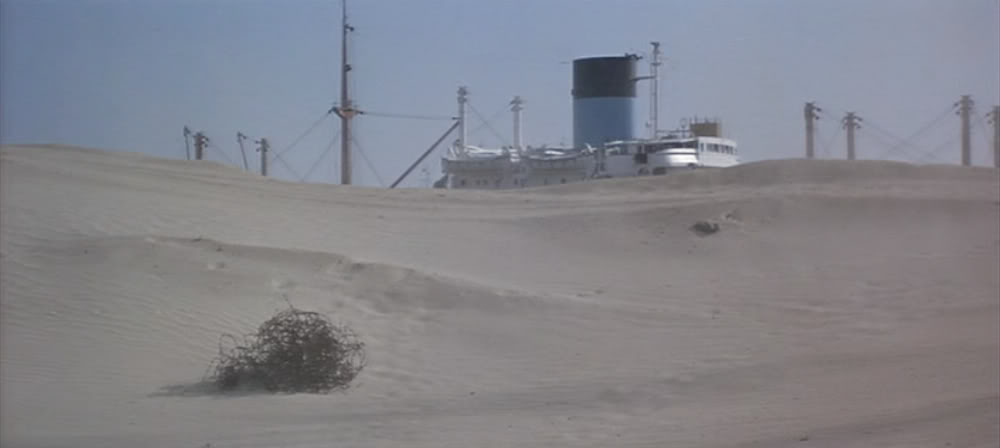
Imagine travelling on a freighter weighed down with colourful containers; imagine crossing the Mediterranean, the Red Sea, the Gulf of Aden, the Indian Ocean, the Gulf of Oman, the Persian/Arabian Gulf.  Imagine the ship going through the desert through the Suez Canal (incidentally, one of the most memorable images of the politically terrible but aesthetically wonderful Lawrence of Arabia was of a ship traversing the Suez Canal):

Lawrence

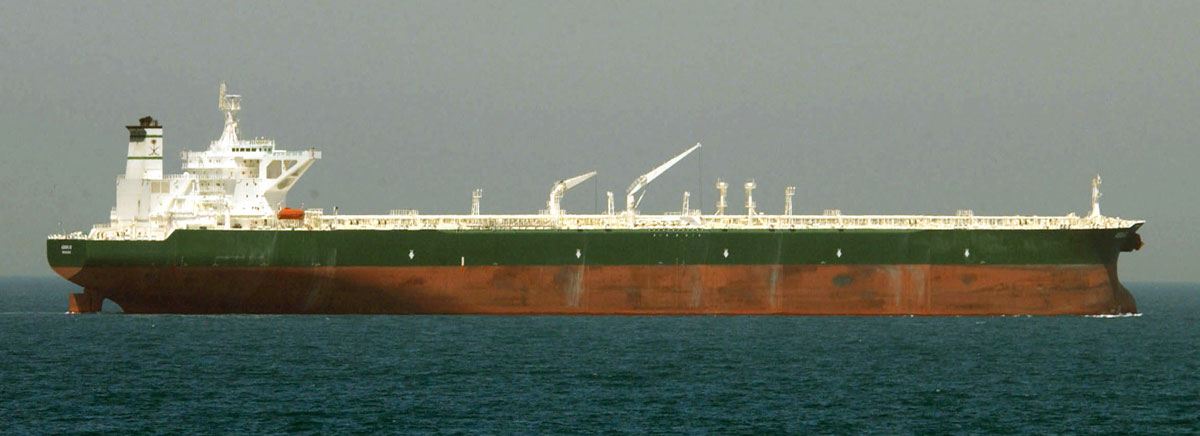
Imagine crossing Hormuz Strait, passing Very Large Super-Tankers travelling in both directions.

I shall be doing exactly this starting next week.  I fly to Malta where I board CMA CGM Corte Real and sail for Jabal Ali in Dubai.  I will only have internet access when in port (in Malta, Suez, Khor Fakkan and then Jabal Ali) if even that.  So I will post my reflections upon arrival – or maybe after I am back in the UK.  You can track the ship on www.marinetraffic.com.  And for those coming to my inaugural lecture, I will be incorporating images and films taken during the trip in my lecture.

Posted in Middle East, ports, ships | 1 Comment

Sha’bi cosmopolitanisms

There is very little that is original in this post, but I want to put it down anyway, because the affects of this moment are lovely; something that I want to remember when I think about so much that is functional, or dry, or frustrating, or riven with anger, power asymmetries and exploitation.

What strikes me again and again is the sha’bi (or popular; or from-below) cosmopolitanism of port cities in the global South.  This cosmopolitanism occurs because of longstanding ties across the sea (including the trade in humans and in indentured labour). But it also occurs because of mercantile relations that long predate stories of modern capitalist “globalisation” (I put that term inside scare quotes because I find it such an inadequate term for the kinds of transformations we see in the world; now or historically).

I have a profound awareness of the ways in which cosmopolitanism is problematic.  David Harvey’s book on the subject has a thoughtful recapitulation of the critiques of cosmopolitanism, including the most devastating postcolonial critiques.  But the kind of cosmopolitanism I want to celebrate is not cosmopolitanism as an ethics or ethos. Nor is it some sort of liberal Kantian ideal that demands global structures of power.  It is not even a universal or universally recogniseable value.  This kind of cosmopolitanism just is. It is neither an injunction nor something that can be created or reproduced on command.  It is not global and doesn’t look the same everywhere.  It is something grounded and specific.  Something that even in its rootlessness has a geography, a history.

This cosmopolitanism is an everyday cosmopolitanism or conviviality of a port city.  This is of course classed, and always already taut with tensions of history, memory, power. But there is also a port city’s openness.  Its proximity, accessibility, to those who escape or arrive.  It is the survival of languages, of pidgin forms of communication, or hybrid or mixed foods, hybrid or mixed styles of life.  It is walking through Souq Mubarakiyya in Kuwait and hearing a distinctly Kuwaiti-accented Farsi in the mouth of people whose ancestors migrated to Kuwait several generations back.  It is to see meyveh (dried fish mixed with herbs and spices) being sold not as an Iranian condiment, but as the thing eaten by Kuwaitis, spelling it in distinct ways, preparing it differently than Iranians do.

Again, I don’t want to romanticise this kind of cosmopolitanism. If Dubai has neighbourhoods where one can speak to Filipino and Filipina people on city squares it is because global structures of labour have pushed these people to abandon their homes and come there to support their children’s lives and education.  If there are Iranian merchants selling a distinctly Kuwaiti version of Iranian foods it is because they were pushed out of their towns on the Iranian coast by rapacious or venal state powers consolidating their forces of coercion on the backs of marginal people of Khuzestan.  If sailors and their worldliness are features (one would say almost clichéd) of ports, the thing that makes ports ports all over the world, it is so because of a life of graft and loneliness and tedium aboard ships, released or erased momentarily when on shore.  I recognise all of this.

And yet. And yet.

Ports are worldly places.  They have convivial histories, ways of muddling through.  Of looking to the sea and seeing in it not just the metaphysics of being, or a source of income, but also a route of escape, a place of arrival.

I find it interesting that of all the port cities on the Arabian Peninsula, it is Kuwait that has invoked this kind of strange and perhaps sentimental reaction in me to the worldliness of sh’abi cosmopolitanism.  But it is perhaps not surprising.  Every nation-state tells its citizens a kind of mythology about its origins.  I find it interesting that Kuwait’s myth of origin is so bound up with seas, with ships, with water being brought over in water boums from Basra.  That the city seems to longingly look to the sea that is this strange fluorescent blue here. That the bread that is broken, the unctuous dates covered in sesame seeds, the flavours of the fish and of the citrus borrows as much from across the sea as it does from the forbiddingly arid hinterland.  And that in the squares at night the convivial voices speak in the languages and dialects of this region, tightly bound by histories of trade.

I also wonder how much this sha’bi cosmopolitanism has left its grooves as a kind of ghostly permanence of route-making in the sea itself. I suppose part of my project is to discover how much these grooves determine the subsequent geography of the ports of arrival and departure.  How much does the spectral echoes of history shape the structures of today’s stories.  And how much of the worldiness and conviviality of these sha’bi cosmopolitanisms survives the onslaught of war and capital.

Posted in capital accumulation, labour, Middle East, ports, the sea | 2 Comments

Benjamin’s grim writing on Marseille

Marseilles

Walter Benjamin
The street . . . the only valid field of experience.
– Andre Breton

Marseilles-the yellow-studded maw of a seal with salt water running out between the teeth. When this gullet opens to catch the black and brown proletarian bodies thrown to it by ship’s companies according to their timetables, it exhales a stink of oil, urine, and printer’s ink. This comes from the tartar baking hard on the massive jaws : newspaper kiosks, lavatories, and oyster stalls. The harbour people are a bacillus culture, the porters and whores products of decomposition with a resemblance to human beings. But the palate itself is pink, which is the colour of shame here, of poverty. Hunchbacks wear it, and beggarwomen. And the discoloured women of rue Bouterie are given their only tint by the sole pieces of clothing they wear: pink shifts.

Posted in literature, ports, readings | 4 Comments

Confidence

Confidence
By Marsden Hartley (1877-1943)

‘We’ll have the sun now,’
the quaking sea gulls said
‘We’ve run the gamut of the thundering sea,
one by one one by one,
and though the wave is full of bread
a wing is often tendon-weary
of a thing so varied-vast;
we do our geodetic surveillance,
for herring are a shining thing,
a shape of sleek imagining,
a pretty circumstance.
The shiver of an ash leaf and of pine
makes other music for a day’s determining,
even sea gulls love the shape of roses
ere day closes.’

Posted in literature, the sea | Leave a comment

The Logistics of War

The indispensable National Security Archives has released a memo by Rumsfeld (dated 6 October 2001) that has loads on the logistics of war.  The memo covers Rumsfeld’s visit to Saudi Arabia, Oman, Egypt and Central Asia, in preparation for the invasion of Afghanistan.  The memo has loads of fascinating tidbits including, for example, this:

Mubarak offered much advice on the war on terrorism: The U.S. should use intelligence operations as·an alternative to “too much bombing.” “Don’t be in a hurry, take it easy.” Bombing of caves by the U.S. in Afghanistan will be ineffective, like Egypt’s bombing of caves in Yemen in the 1960s. “Put your money into buying allies on the ground in
Afghanistan.”

And this bit:

Karimov [of Uzbekistan] opened by listing what he has agreed to allow US forces to do and what he has not agreed to. The latter category includes land operations and air strikes from Uzbek territory, all of which he said were “not quite ripe, not quite ready.” […]

Echoing Mubarak’s advice, Karimov said: “You can buy and sell anything in Afghanistan.”· Humanitarian aid will do a lot of good and will produce results more effectively than weaponry will.  “You can buy any warlord and neutralize him. You don’t need to persuade him to join the Northern Alliance, just neutralize him.” He pressed his point: “In Afghanistan, only Afghans should fight.”

As for cooperation in the War effort, I said that we are content to continue to work on the written agreement now under negotiation. “We’ve indicated what would be helpful to us but what you do is clearly your choice. If greater cooperation ripens (to use your word), it could be helpful to us. If not, we’ll go about our task as best we can.’

As the NSA analysis indicates, Saudi Arabia “refused to allow strikes on Afghanistan being launched from its bases… Securing Egyptian support was key for the Afghanistan campaign, Rumsfeld knew, because Egypt controlled the Suez Canal, which could provide U.S. aircraft carriers passage from southwest Asia to the Mediterranean.” And finally,

While the short trip highlighted a host of logistical problems for air strikes against Afghanistan, the U.S. war with Afghanistan went ahead on October 7, two days after Rumsfeld’s return to Washington. The first strikes were launched from submarines based in the Arabian Sea, U.S. aircraft carriers USS Carl Vinson and USS Enterprise, and USAF bombers launched from Diego Garcia.

Thanks to Carmi for pointing me to this memo.

Posted in empire, imperialism & colonialism, logistics, Middle East, militaries, war | Leave a comment

Stand-Up Beer Hall

Stand-Up Beer Hall

Walter Benjamin

Sailors seldom come ashore ; service on the high seas is a holiday by comparison with the labour in harbours, where loading and unloading must often be done day and night. When a gang is then given a few hours’ shore-leave it is already dark. At best the cathedral looms like a dark promontory on the way to the tavern. The ale-house is the key to every town; to know where German beer can be drunk is geography and ethnology enough. The German seamen’s bar unrolls the nocturnal plan of the city: to find the way from there to the brothel, to the other bars is not difficult. Their names have criss-crossed the mealtime conversations for days. For when a harbour has been left behind, one sailor after another hoists like little pennants the nicknames of bars and dance-halls, beautiful women and national dishes from the next. But who knows whether he will go ashore this time? For this reason, no sooner is the ship declared and moored than tradesmen come aboard with souvenirs: chains and picture-postcards, oil-paintings, knives and little marble figures. The city sights are not seen but bought. In the sailors’ chests the leather belt from Hong Kong is juxtaposed to a panorama of Palermo and a girl’s photo from Stettin. And their real habitat is exactly the same. They know nothing of the hazy distances in which, for the bourgeois, foreign lands are enshrouded. What first asserts itself in every city is, first, service on board, and then German beer, English shaving-soap and Dutch tobacco. Imbued to the marrow with the international norm of industry, they are not the dupes of palms and icebergs. The seaman is sated with close-ups, and only the most exact nuances speak to him. He can distinguish countries better by the preparation of their fish than by their building-styles or landscapes. He is so much at home in detail that the ocean routes where he cuts close to other ships (greeting those of his own firm with howls from the siren) become noisy thoroughfares where you have to give way to traffic. He lives on the open sea in a city where, on the Marseilles Cannebiere, a Port Said bar stands diagonally opposite a Hamburg brothel, and the Neapolitan Castel del Ovo is to be found on Barcelona’s Plaza Catalunia. For officers their native town still holds pride of place. But for the ordinary sailor, or the stoker, the people whose transported labour-power maintains contact with the commodities in the hull of the ship, the interlaced harbours are no longer even a homeland, but a cradle. And listening to them one realizes what mendacity resides in tourism.


With many thanks to Alireza who brought this wondrous piece of ethnography to my attention.  It also reminds me of Foucault’s Hetertopia (about which I wrote here) and The Death Ship which keeps growing on me the more I think of it.

Posted in capital accumulation, labour, political economy, ports, readings, seafaring, shipping conditions, the sea | Leave a comment

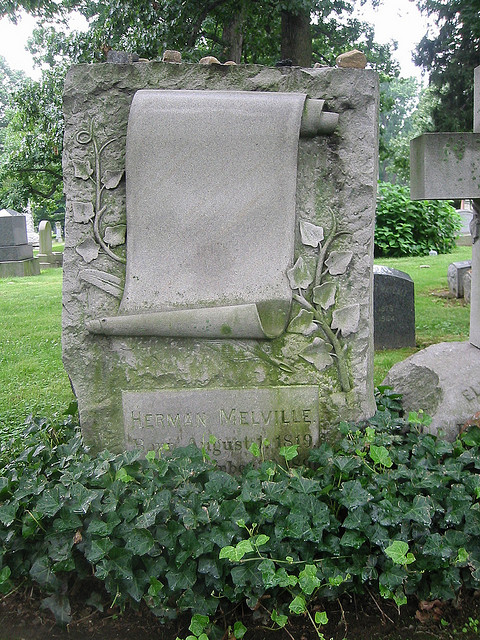
At Melville’s Tomb

At Melville’s Tomb

By Hart Crane

Melville's tomb

Often beneath the wave, wide from this ledge
The dice of drowned men’s bones he saw bequeath
An embassy. Their numbers as he watched,
Beat on the dusty shore and were obscured.

And wrecks passed without sound of bells,
The calyx of death’s bounty giving back
A scattered chapter, livid hieroglyph,
The portent wound in corridors of shells.

Then in the circuit calm of one vast coil,
Its lashings charmed and malice reconciled,
Frosted eyes there were that lifted altars;
And silent answers crept across the stars.

Compass, quadrant and sextant contrive
No farther tides . . . High in the azure steeps
Monody shall not wake the mariner.
This fabulous shadow only the sea keeps.

Posted in literature, Melville, the sea | Leave a comment