Pirate Jenny: Labour and capital in Khor Fakkan

14 February 2015

in Khor Fakkan port
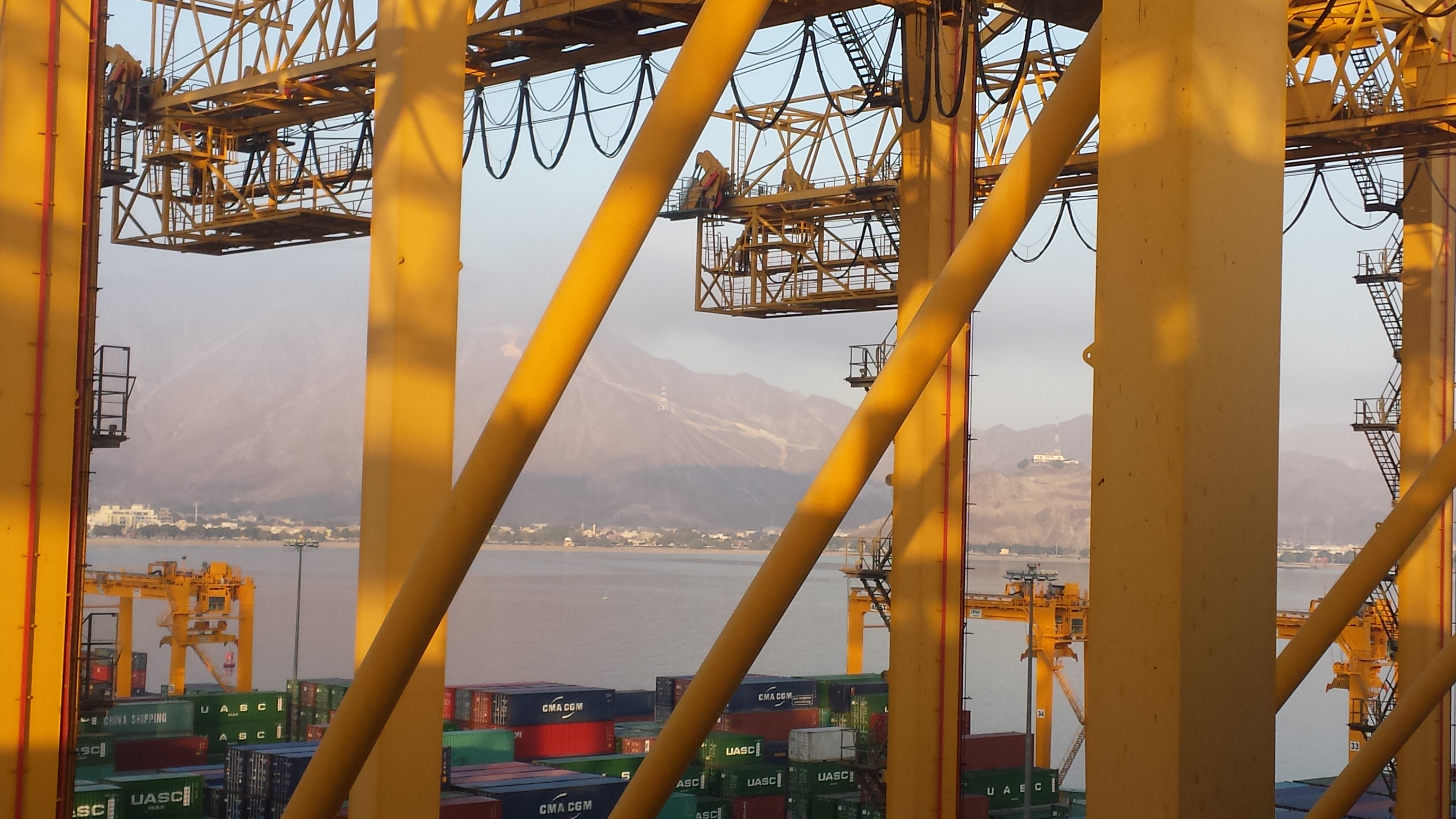
20150214_072630

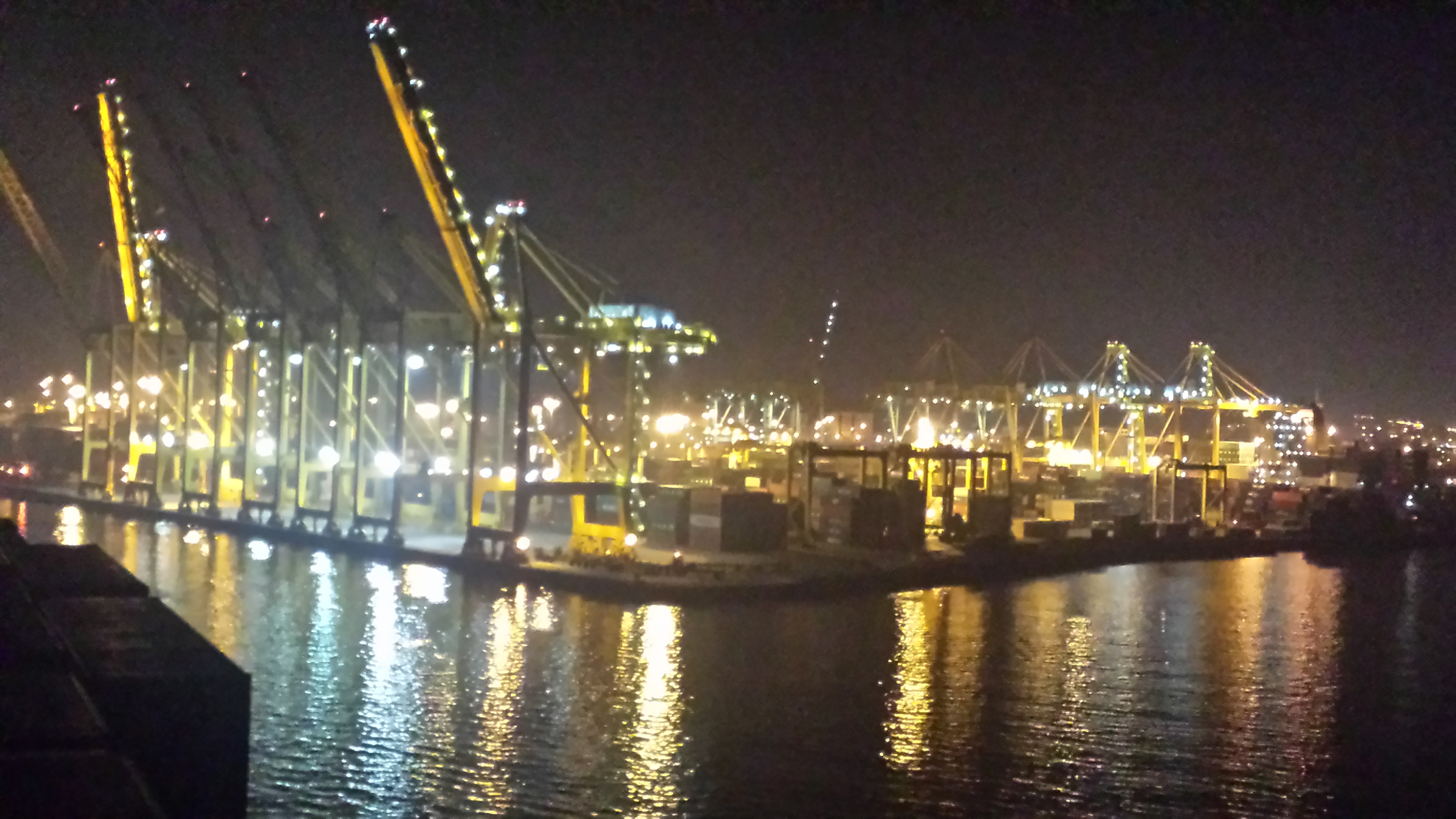
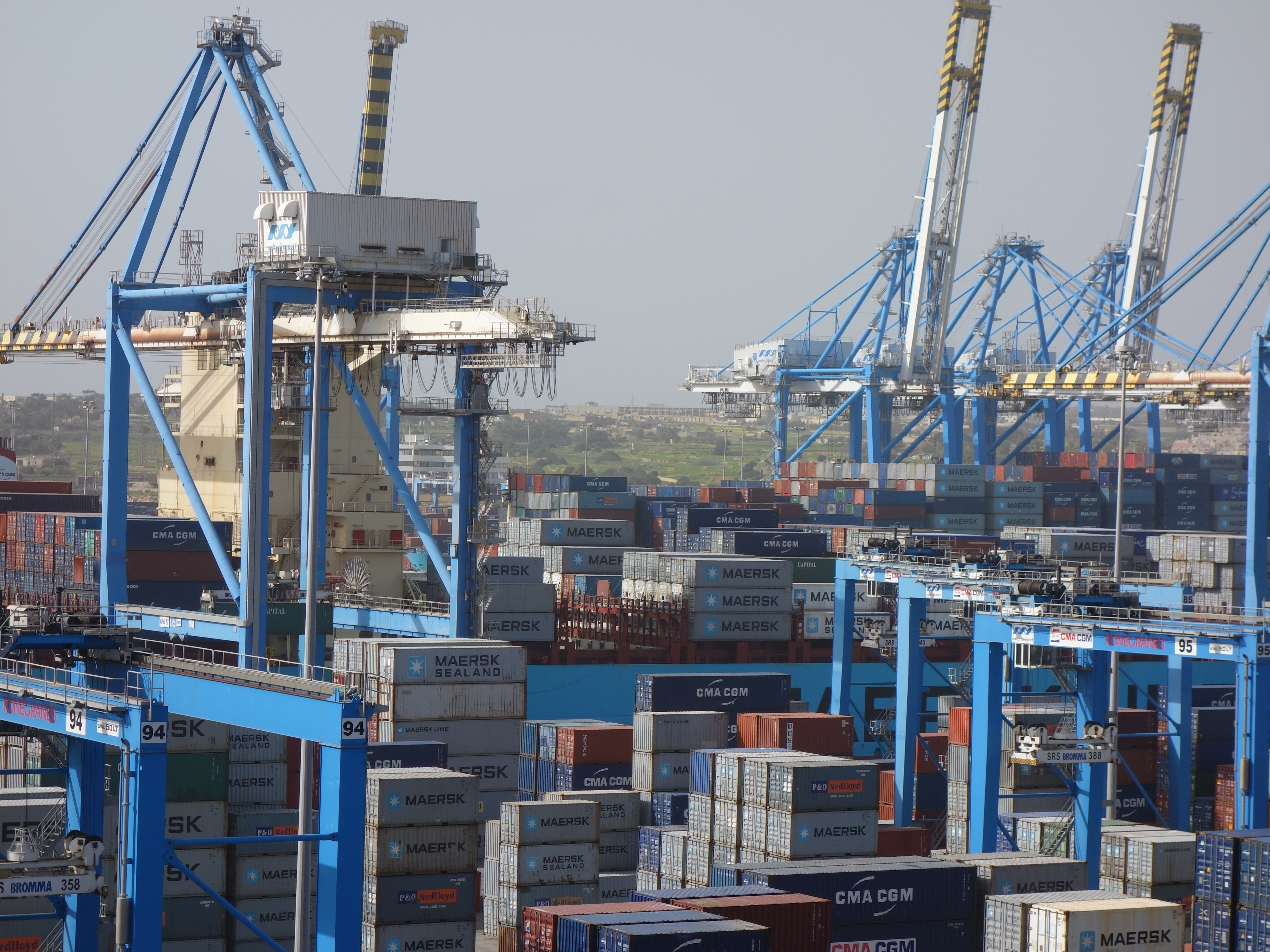
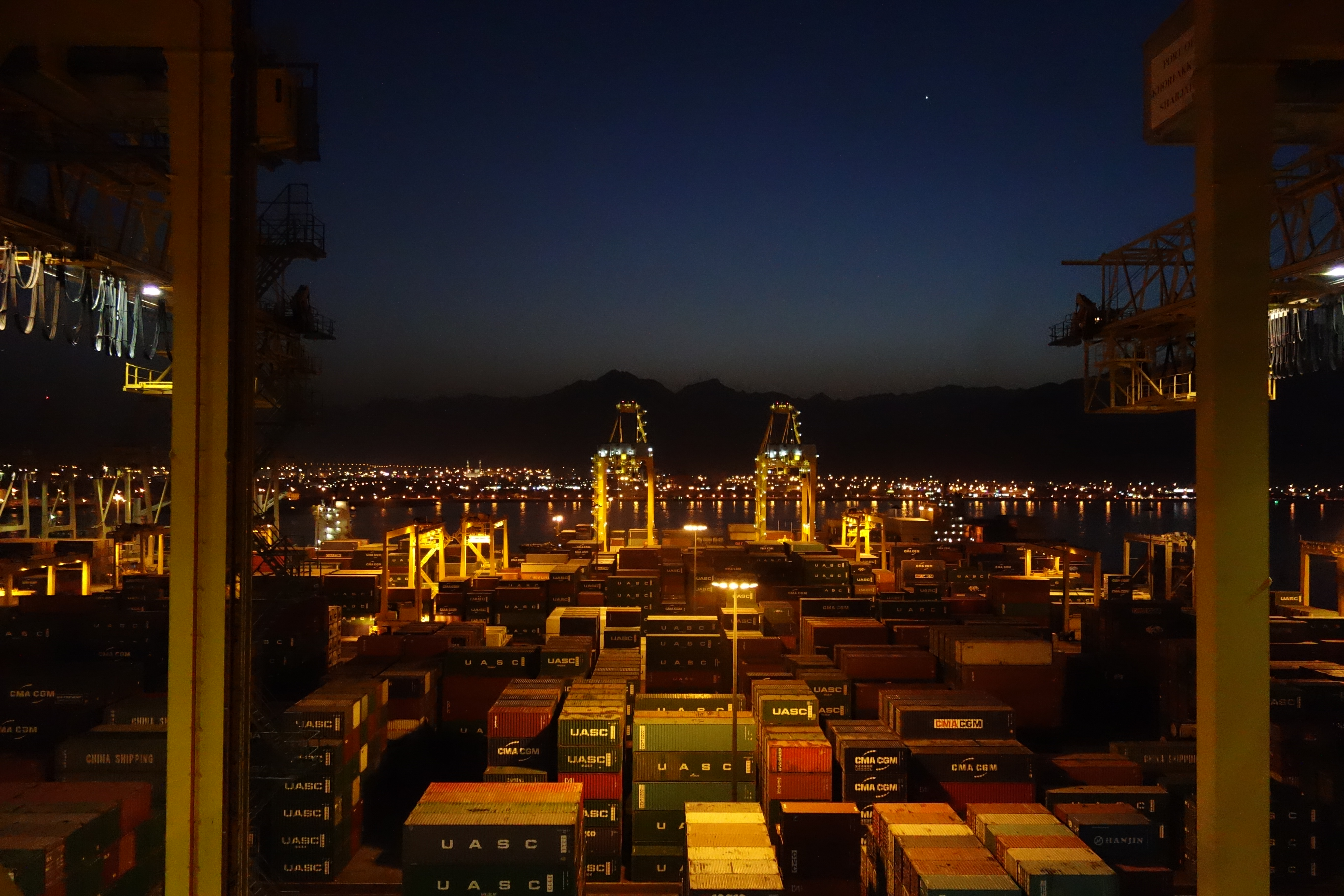
Gantry cranes in Khor Fakkan

After several hours of watching the unloading of the ship, and after walking on the port to go to the duty-free shop (to buy a new memory card for my camera), it is rather interesting to see that my “fresh” ethnographic eyes have become more accustomed to the sights, and the sense of wonder has been replaced by a more reflexive, perhaps even sceptical, view of the work of men and machines in the port.

I suppose I can now see the incomprehension in the more experienced officers about my thrill at this experience (although the engineers themselves were not really all that surprised by my awe at the engine.  Maybe something of the wonder remains when the machinery you work with is so utterly awesome).  And although the epic ballet of the machinery still thrills me, I now see not the machinery first, but the workers below.

20150214_100537

In Khor Fakkan port

This might be because so much more cheap labour is employed to do so much more dangerous things here, and so the humans at works are so much more visible.  This might also be that having wrestled with my seduction by the technological sublime, I may have laid my apprehension to rest.  I see in the romance something of my history, and I am, I suppose, at peace with it.  And besides I am not so dismissive of romance as so many other academics seem to be.   We may deny it – and it may be denied us as the university becomes ever more an enterprise– but it is there: in all sorts of small things: the archival documents marked by human hand and acerbic humour; in the ethnographic moment of arrival (which has become a cliché) and the terror of unfamiliarity becoming the comfort of knowing people; in the sense of wonder of being a student all over again, having to unlearn and learn in equal measures.  There is romance in all of this. And I suppose I have no trouble admitting that I see in my teaching and research a vocation not a job, however much there is pressure to think of it as a job both from the university-as-enterprise crowd and from those who oppose that.
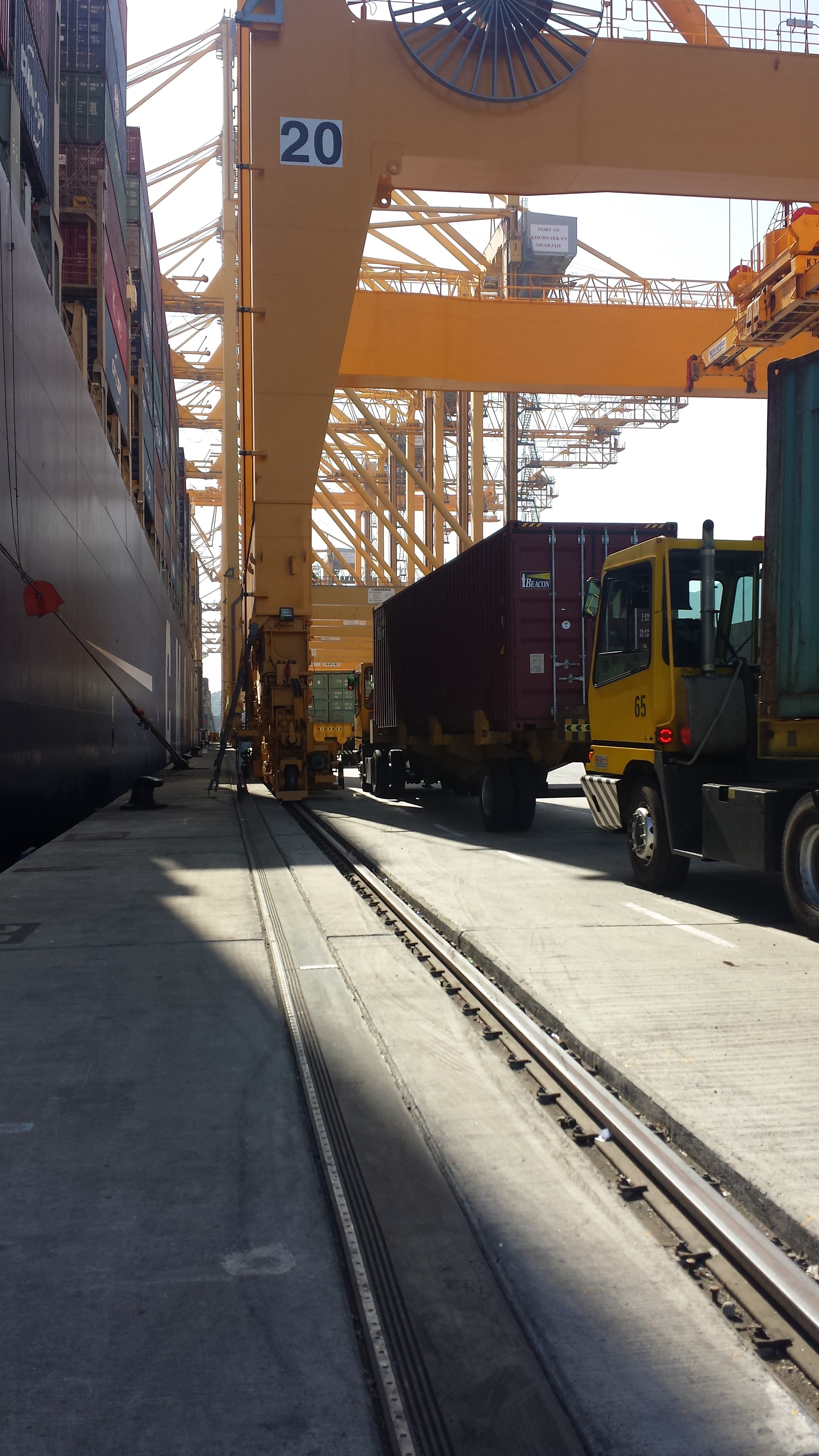
20150214_103931

Trucks carrying away containers

But in any case, what I noticed today was the speed of loading and unloading which was entirely incomparable with Marsaxlokk.  Things move here at breakneck speed.  The cranes’ spreaders were already down on the ship before it had even stopped moving last night and there were empty flatbeds gathering there.  Today, I watched as multiple containers were being moved at a time, which can’t possibly be safe.  I only saw two stacked 40TEU containers at a time being moved but the chief mentioned that on a previous occasion he had seen them move six empty containers stacked on top of one another at one time, which sounds insane.  The chief was mentioning how unsafe China was though, and as an example talked about a guy who gets on the crane’s spreader and gets on top of the containers with his pole to unlock the containers.  I mentioned that this was happening last night, which surprised him a bit.  The chief seems to think things are superlative in China: everything is more unsafe; rules are more often disobeyed; the tugboats are more powerful there; and arrival in the ports are far more terrifying because of all the fishing boats crowding the shipping lanes (on this point, absolutely everyone else seemed to be in consensus).
Walking around in the port, I was struck by how much this was an international of workers.  Crane operators who look like they are Indonesian or Chinese; flatbed drivers who are Sikhs or venerable-looking southern Indians, or moustachioed south Asians of a sort, lithe Bangladeshis with their moustache-less white beards, lean Nepalese men.  This transnationalism of course makes for non-nationalist sentiments, but also brings up the question that for mobilising, what are the common languages, common ways of knowing and moving, common grievances and stories told to redress those grievances? Common repertoires of rage and sabotage?  Common breaking points for strikes or walkouts or machine-breaking?
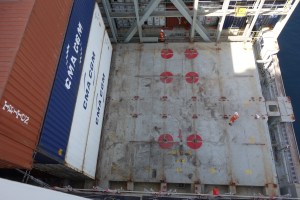
DSC00021

Port-workers locking in the hatch cover onboard the ship

The walk in the port was certainly a good remedy for the seduction of the epic and the steel aesthetics of technology.  Work here is material and real and embodied.  And certainly the South Asian guy made to stand in the heat and unlash containers from trucks or drive them in the heat is not seduced by the technological sublime.  Work seems to cease only for an hour at lunch when the humid heat is already beating down at 30 degrees in February.  I caught (but pretended not to) a crane-operator climbing out of his box and pissing in a corner behind his aerie high above the ship’s containers.  No time I suppose to climb all the way down and go for a piss in a loo somewhere in the outer reaches of the port.

All day today, and after the encounters with the port-workers (mostly of the hello and wave variety), I have been thinking a lot about a story Sekula tells about Trotsky.  For Trotsky the Potemkin sailors at the heart of the 1905 Russian revolution represented the proletarian heroes of the revolution. Sekula quotes him as writing: “Who raised the red banner on the battleship?  The technicians, the engine men. These industrial workers in sailor’s uniforms who form a minority among the crew nevertheless dominate the crew because they control the engine, the heart off the battleship.  Friction between the proletarian minority and the peasant majority in the armed forces is characteristic of all our military risings, and it paralyzes them and robs them of power.”

There is something quite horrifying then to think that the same Trotsky that writes a hagiography of the skilled workers aboard a ship in 1905 would go on to so viciously crush the Kronstadt Revolt of 1921.  In justification, years later in his Mexican exile, he blamed the rebellion on the “muzhik-soldier,” the “petty bourgeois reactionary extremes” and “the numerous middle peasant layer” at Kronstadt.  So, not the aristocracy of labour, but the dregs; the peasants; the petty bourgeoisie, the always culpable pharmakos so readily available to the revolutionary as the locus of blame for failure.  Sekula then goes on to add without emotion that “historian Paul Avrich has demonstrated that the leaders of [Kronstadt] were actually drawn from that very heart: machinists, electricians, clerks and navigators, many of them veterans of the October Revolution.”

There is something really disturbing at work here.  If you are a peasant and always a peasant even if you board a ship and your work is the work of a sailor or “an industrial worker”, then where exactly are the social relations based on the modes of production, rather than some primordial or atavistic and unchanging stratification?  How is this eternal peasant “identity” that cannot be shed no matter what habits and environments of work you adopt different than those identities embedded in the “identity politics” so many Marxists are ready to decry for the failures of the left?  And if it is your work that makes you the aristocracy of labour and the repository of revolutionary intent, what of the billions of unskilled, deskilled, menial workers which in this post/hyper-Taylorist, just-in-time, hyper-automated world of work form the vast majority of the human cogs in the engine?  In this port, there are probably around 20 cranes at work and around 40 container-shifting cranes.  Let’s say that makes 100 highly-skilled crane operators who fit the proletarian mould.  What about the hundreds of other workers (maybe thousands if you count the cooks and cleaners and janitors and tea-men who inevitably populate these places) at work here? Are they, having arrived from their south Asian –or Nepalese- backwaters a bunch of peasants and petty bourgeoisie, ready to betray heady goals of the revolution?

20150214_072847

Will the little island hill survive the inexorable port expansion?

But I have also been thinking about another thing at work here in a port such as this: what are the constraints on the growth of these ports?  Not land.  When I last visited Khor Fakkan in September last year, the port manager was mentioning that he is running out of space for storing containers.  He pointed to the dramatic hill rising in the background of the port and said, “If I have to move a mountain, I will.” In the age of land reclamations, where sand becomes a desirable commodity needed for making work-ground where there was sea before, land is literally Polanyi’s fictive commodity.  Or maybe it is not so much fictive as fabled: you wish it upon a magic lamp (fuelled by oil that can now be extracted from sand and shale and god knows what) and it appears.
DSC00043

Pulling away from the port

Labour is certainly not a constraint.  Here are limitless workers supplied from countries whose primary export to the Gulf (and the world at large) seems to be humans. And they come in their millions, this international of workers, and one wonders how we can overcome the stubborn fissures that separate them from one another along the lines of language and custom and memory.  This is where Deb Cowen’s brilliant book is so good, by reminding us of the obstacles that striking bodies can provide; and yet, Chief was telling me today about the ghost port of Rotterdam with its automated trucks driving around, increasing safety, but also removing the necessity for humans, those cogs in the machine that can also become spanners in the gears.

Capital may be another constraint.  Who provides the endless capital for the endless expansion?  For these ports need to be constantly dredged for ships with ever deeper and deeper draughts, and cranes have to be replaced with those with longer and longer arm spans and height as the ships become longer and wider and taller (I was gobsmacked by how BIG Corte Real is in comparison with another CMA ship moored here, Balzac). And who finances this?  Is that where the constraints are?  The debt restructuring Dubai World had to undergo would have to be something to study.

DSC00056

The lights to the right are of Khor Fakkan; the necklace of lights on the left are ships at anchor

And finally, why here, on this sun-baked corner of Arabia, just north of Fujairah?  Why Fujairah in fact?


Posted in 2015 Trip, Allan Sekula, capital accumulation, environment, labour, logistics, Middle East, readings, transport, Travels | Leave a comment

Fouq El-Nakhl: Masaculinities aboard the ship

“and in everything imposingly beautiful, strength has much to do with the magic.” Herman Melville, Moby Dick


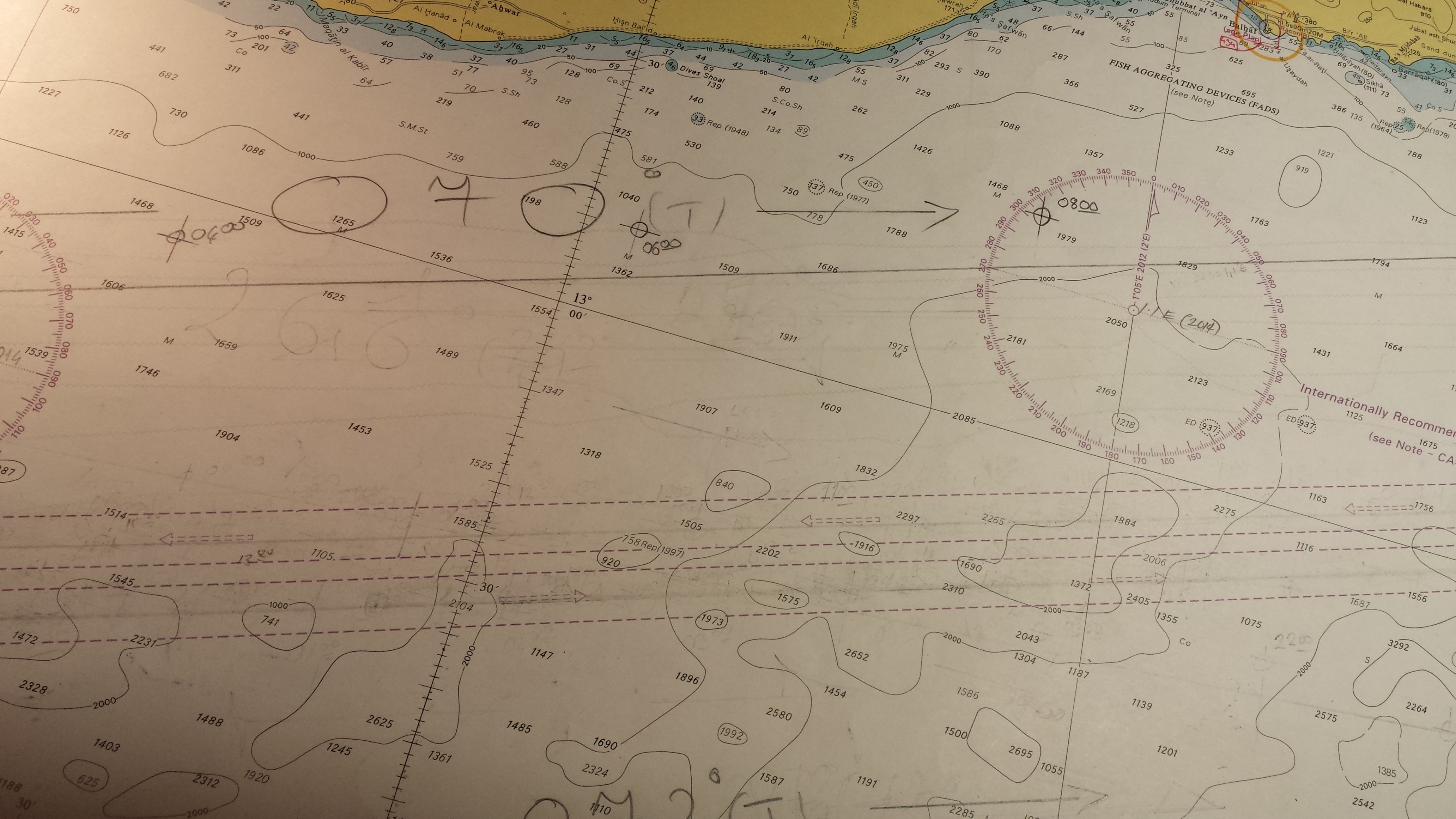
The first incident of its kind happened last night.  Hopefully, also the last.  I was in the wheelroom in the dark, keeping easy company with my favourite ship’s officer and favourite cadet. One of the below-deck officers who had winked at me earlier at lunch when I had smiled at him came up to the wheelroom.  I discreetly stayed away so that they can all converse in SerboCroat, and instead went to the charts area behind the curtains to look at our location on the Admiralty charts.  The below-deck officer came to the back, and walking past me, his hand brushed my ass.  It was one of those groan-inducing moments: “Really?  Just fucking really?”  I mean, the act is done so casually as to be plausibly deniable, but honestly, are we doing this shit now? So, I swiftly left the charts area, went back to the safety of the dark in the wheelroom-proper, and then shortly thereafter went downstairs.  It all came as a bit of a surprise, since the guys have uniformly been brilliant and respectful.

The shipboard masculinities are fascinating to me, although I am sure a more laddish web of interactions aboard has been attenuated by the presence not only of a woman cadet and the captain’s wife, but also by three women passengers, two of them grandmotherly.  But still, there are jokey moments about the soft porn images of half-naked women along the edge of the auto magazine, and the half-hearted attempt by the below-deck officer last night and that of one of the crew members on my first day telling me “So you are working out so you can be sexy?”

It is unsurprising that shipboard life would be masculine, even if relieved slightly in our case by women passengers and cadets.  Moby Dick seems to be not only about intensely homosocial love between sailors at sea together for years, but its very central obsession seems to be that of Ahab, who is not only “dismasted” but also unmanned by the whale. But these masculinities are obviously not consistent across time, however much the solidarities of life aboard may echo those of Melville’s time.
Last night’s ambiguous bodily contact also gave me an occasion to reflect on the peculiar masculinities and forms of embodiment that exist shipboard, and the differences between how it is performed among the deck officers; the engineers; and the Asian crew members.  There was not too long ago a fascinating piece about the making of metrosexuality and spornosexuality in the Northeast of England, and its emergence in the aftermath of the devastation left by Thatcher.  The guy who came up with the term had this fascinating thing to say about it:

“It’s fitting,” says Simpson, “that in a post-industrial landscape, the lads in these programmes work on their own bodies in the gym instead of someone else’s property/product down the gym or the shipyard. The ‘structured’ reality is their own hyper-real bodies.”

Simpson goes further, providing a socio-historic explanation for the Geordie attraction to sporno. “The North East was carpet-bombed by Thatcherism in the Eighties,” says Simpson. “Coal and shipbuilding disappeared and were replaced by shopping, service industries, gyms and tanning salons. Metrosexuality and then spornosexuality both took root in the North East because a new generation of young men had to adapt to the wreckage around them, while their fathers’ traditional ideas about masculinity were as redundant now as they were themselves. The post- industrial North East ended up being on the ‘coalface’ of metrosexuality and then spornosexuality.”

In some ways, the muscled (especially around arms) physique of the former Yugoslav deck officers says something about this.  It also probably has an element of inducing command and respect (a bit like birds that expand their bodies through puffing their feathers in order to look bigger and more intimidating).  Even the woman cadet does body-building (although she follows the new-fangled Crossfit dicta, she mostly seems to do the body-building reps rather than the cardio kinds).  Even the lovely ship’s officer who used to be a football player and has the lean elegant body of a football player is now building his arm muscles.  Meanwhile, not a single one of the engineers, not even the cadets, builds their bodies, and in fact they all have puny arms and proper bellies.  And of course the Asian crew members (and officers) are all lean and wiry and their muscles have the taut strength that comes from work rather than the skin-bursting bulk that weight-lifting creates.

I wonder how typical this spectrum of corporeal self-making is on other ships. I will have to ask the others who have taken freighters.


11.00

Had a chat with the captain today who showed me quite a bit about what they are carrying and the way the cargo is organised (including the yachts they are taking to China whose masts I had seen by the engine casing on the upper deck).  He did mention a few things that were fascinating to me.  First that this ship –his first 13,000 TEU ship- is far too quiet for him.  He liked the accommodations being aft, on top of the engine, in his previous ship, and his body being able to read the vibrations of the engine.  He said “even when the engine changed by a few rpms, I could tell.” The quietness of the engine on Corte Real now alarms him, because he says he can’t tell if the ship is running or not.  He mentioned how when the wheelroom was on top of the engine, everything vibrated so much that the metal ceiling panels would go “drrrrrrrr” and had to have crumpled paper stuck in  the interstices of the metal ceiling panels to stop them from shuddering so much.  Some nights, the captain said, the engine vibrated so much you couldn’t sleep, and there was one cabin in particular that had to be left unoccupied because the vibration was particularly intense therein.

And yet, he misses the vibrations.  I suppose if you have acquired a skill in your bones, a way of reading objects and material things that has accumulated in your body in subconscious ways, then the discomfort of vibration is compensated by the knowledge it imparts to your muscles and sinews.  It is a way of making your body learn: a bit like how the able seamen can perceive disturbances on the surface of the sea with their naked eyes that using binoculars, I could only just distinguish from the regular churning of the billows.

The second thing he mentioned is that he feels that the ships are lot less safe than they were in 1978, when he started as a seafarer.  He feels that the dependence on machinery and computers, and the requirement of speed in unloading and loading cargo –which sometimes forces a ship into a berth at a port at zero visibility as he felt had happened in Rotterdam a couple of years back– makes it really difficult to actually manage the ship and amplifies both the danger and the responsibility for the captain.

***

Meanwhile, as we go through the Gulf of Oman, the radio is constantly crackling with the sound of the Iranian Navy asserting its sovereignty every five seconds and with every passing ship.

20150213_145724

Ribbons of pollution

And I briefly saw a pod of dolphins.  They were swimming aft and we were steaming at speed so I didn’t have time to photograph them, but their gleaming sleek body jumping out of the water was glorious, perhaps precisely because of its ephemerality.  This is, however, a hazy polluted sea.  With the horizons obscured by a humidity that has been painted with the gorgeous orange of air pollution, and beautiful ghastly yellow and green ribbons of waste and effluence stripe the sea, where yesterday, in the Arabian Sea, it was the silvery currents. The ship cuts through this contaminated flow and the backwash –where it was aquamarine yesterday- is a kind of sludge green today.

22.00

Khor Fakkan port

I have spent most of the afternoon in the wheelroom, talking to various officers, but also to the Captain’s wife.  She was telling me that the when they married the captain was a seafarer, and just before they had their daughter, the captain decided to quit the sea and work in the port.  This obviously made their domestic arrangements much more amenable for all.  But then, ten years later, when the Yugoslav War broke out the port of Rijeka was closed, and the city itself became a refuge for others escaping from other parts of Croatia (the woman cadet was mentioning that her family sans her father were refugees for a time in Sweden).  At that point, desperate for a livelihood, the Captain (who was not yet a captain) had to go back to sea.  They thought this might last a scant few years, but she said, “It has been twenty years now.”  The Captain this morning also was speaking longingly of retirement in about eight years’ time.

We are now at port in Khor Fakkan.

20150213_162659

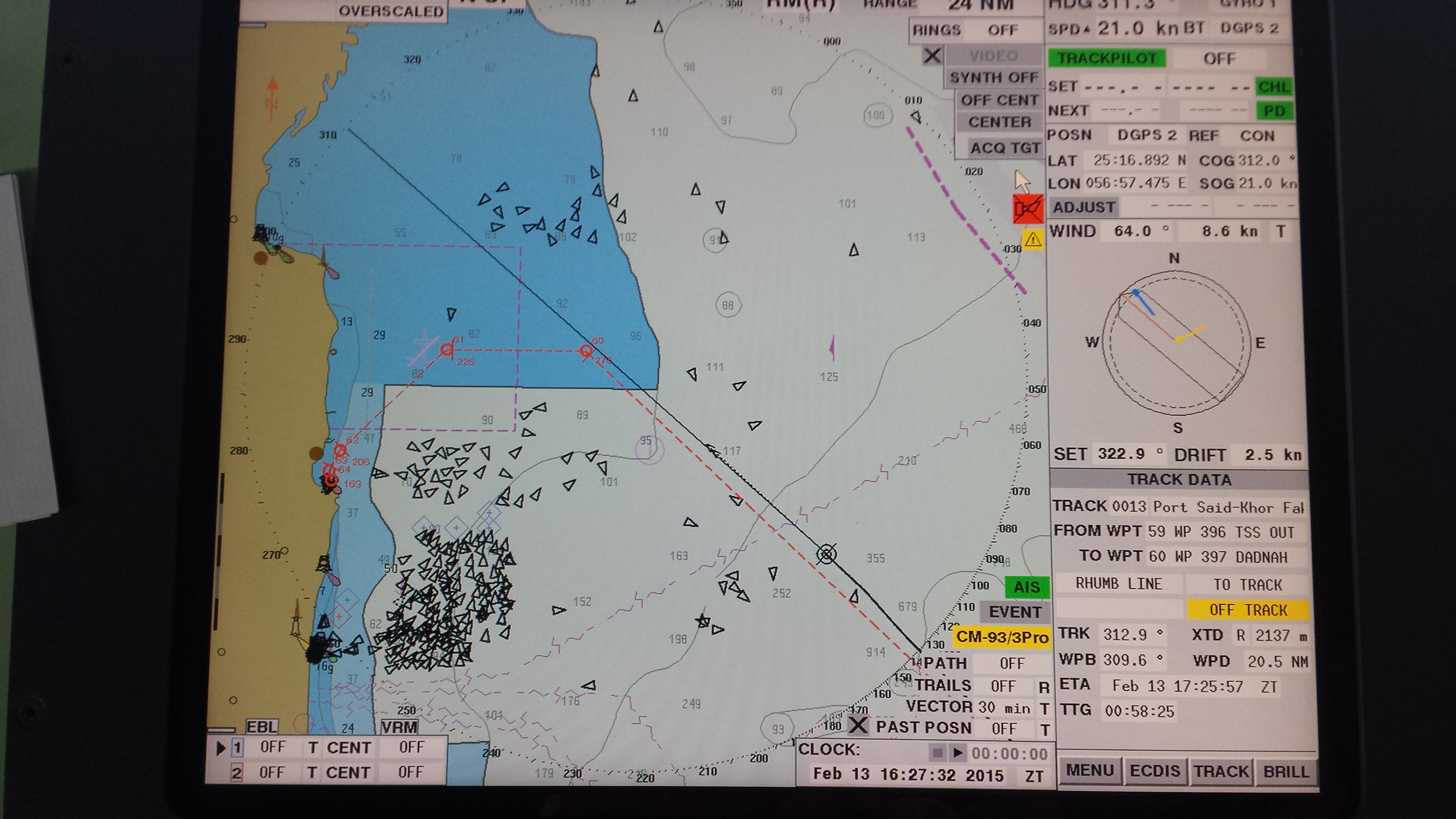
The clump of black triangles in the bottom left corner are tankers and chemical carriers at anchor just outside Fujayrah Port (which is one of the biggest oil terminals in the Middle East).

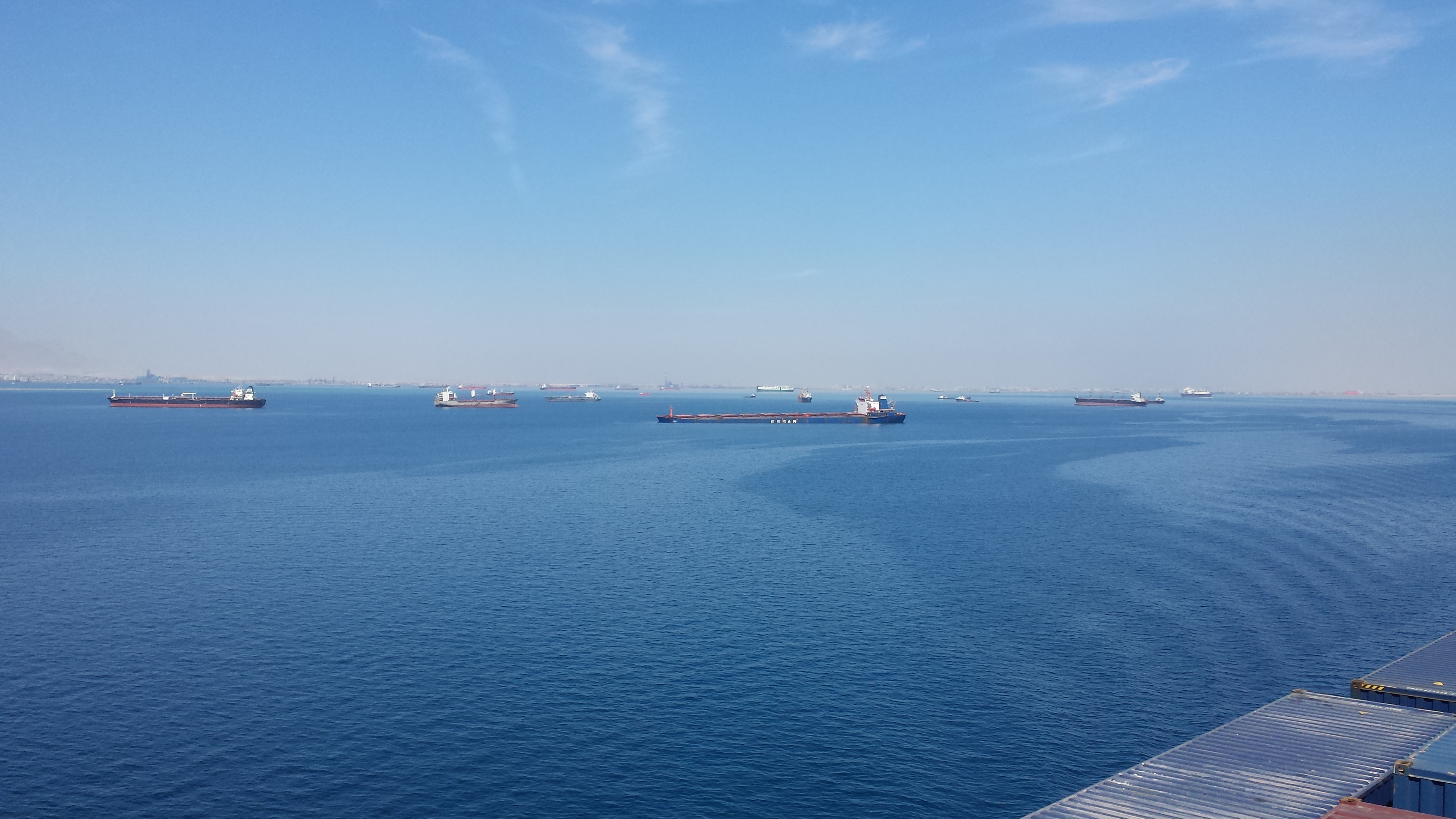
As we approached Khor Fakkan, most of the afternoon, over the radio I could hear voices and languages and conversations that made me melt with memory.  Iranians with bandari accent (saying “chenge de chennell” as if it should be followed by “bachcheh”), some calling to each other in Farsi, some speaking to other boats or ships in English.  But mostly strange, momentary, transient conversations between people conducting their day to day routines of work. “Hamid Hamid Hamid, kojayi?  Nemibinament!” Or men speaking in a language that was either a form of Urdu partially intelligible to me, or some deliciously mixed littoral dialect of Farsi.   The sea was dense with tankers at anchor, and the radar screens showed ridiculous numbers of ships awaiting loading at the Fujairah port just south of Khor Fakkan. The sheer number of tankers –and the varieties of accents of their crews- was astonishing. The Croatian officers were telling me that many of the tanker crews were Indian. Where we had steamed through empty seas next to Yemen, and where we had seen maybe two dozen ships on the AIS next in the northern part of the Arabian Sea, here, there are hundreds of ships –and that is even not mentioning dhows and fishing boats and an occasional “sailing vessel” (as identified by the AIS)- and perhaps the very many anonymous numerous military ships that work the security seas veiled from the AIS.

20150213_182717

Coming into port at Khor Fakkan

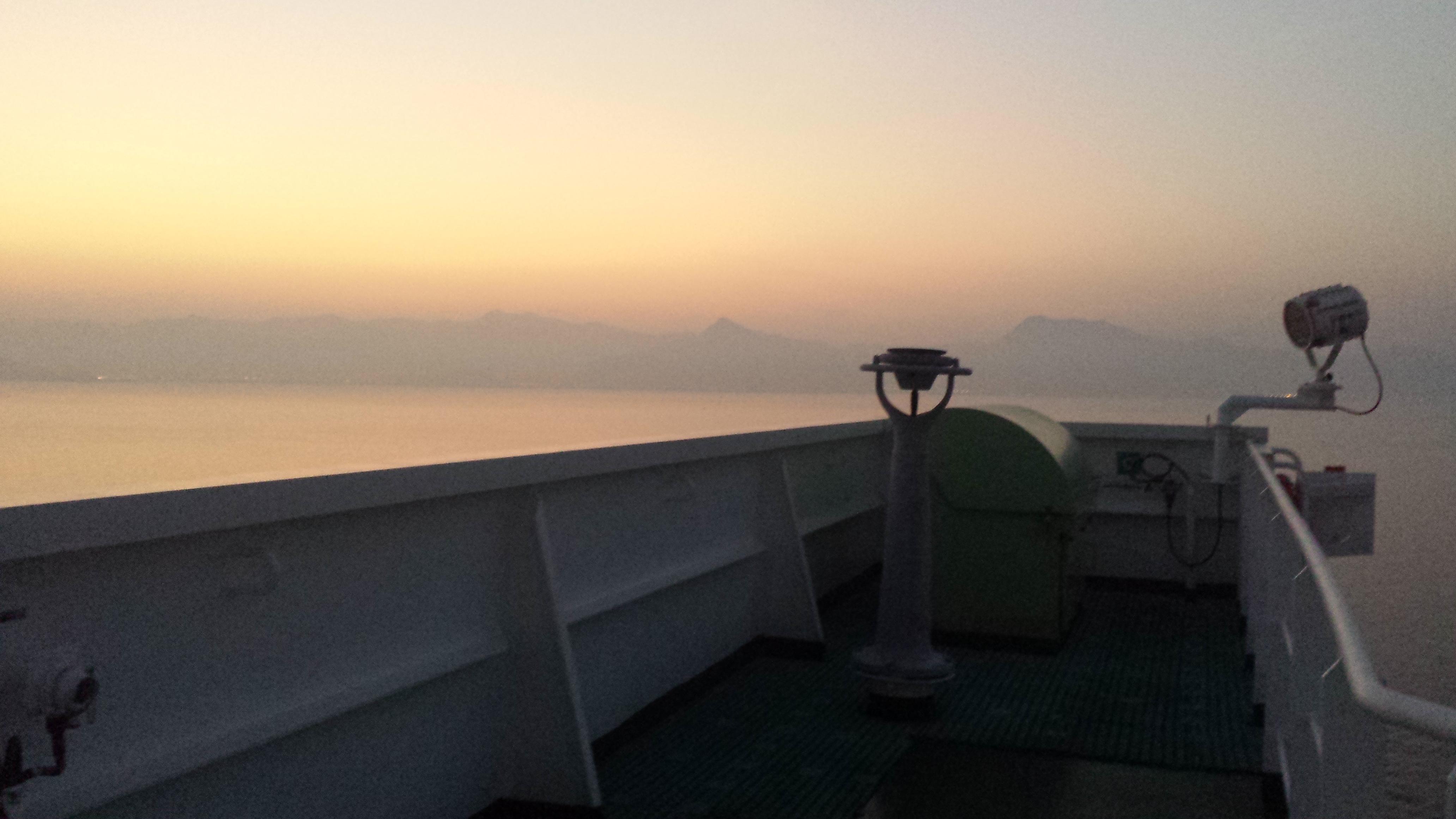
We had to circle around the anchorage zones for Fujairah in order to come to the Khor Fakkan harbour.  Close to the town of Khor Fakkan, and starting just north of it, the mountains that I think stretch to the majestic Musandam Peninsula begin looming jagged behind the lights of the coast.

20150213_193152

Khor Fakkan

By 19.00, the pilot had boarded the ship.  He was a man of girth and loud exclamations and authority, and I think he may have been Sudanese or Egyptian.  It took about an hour and the help of a whole series of beautiful new green and red tugboats with names like Mudaifi and Muhaibi and Al-Khan to push us into our berth at the port.  We were there by 20.10; and by 20.20 the cranes were already moving, and the armies of flatbeds were lining up underneath us on landside to move the cargo we (well, the cranes) were offloading. I will have to write down the exact number of containers being offloaded and loaded back on; but the captain seemed to think that our draught will be 80cm shallower than what it was before which means many of the containers we are loading will be empty ones headed for Southeast Asia and China.  This shallower draft is also necessary because I am not certain that Jabal Ali can handle a draught of more than 16 metres.

The loading shall go on throughout the night.

20150213_213424

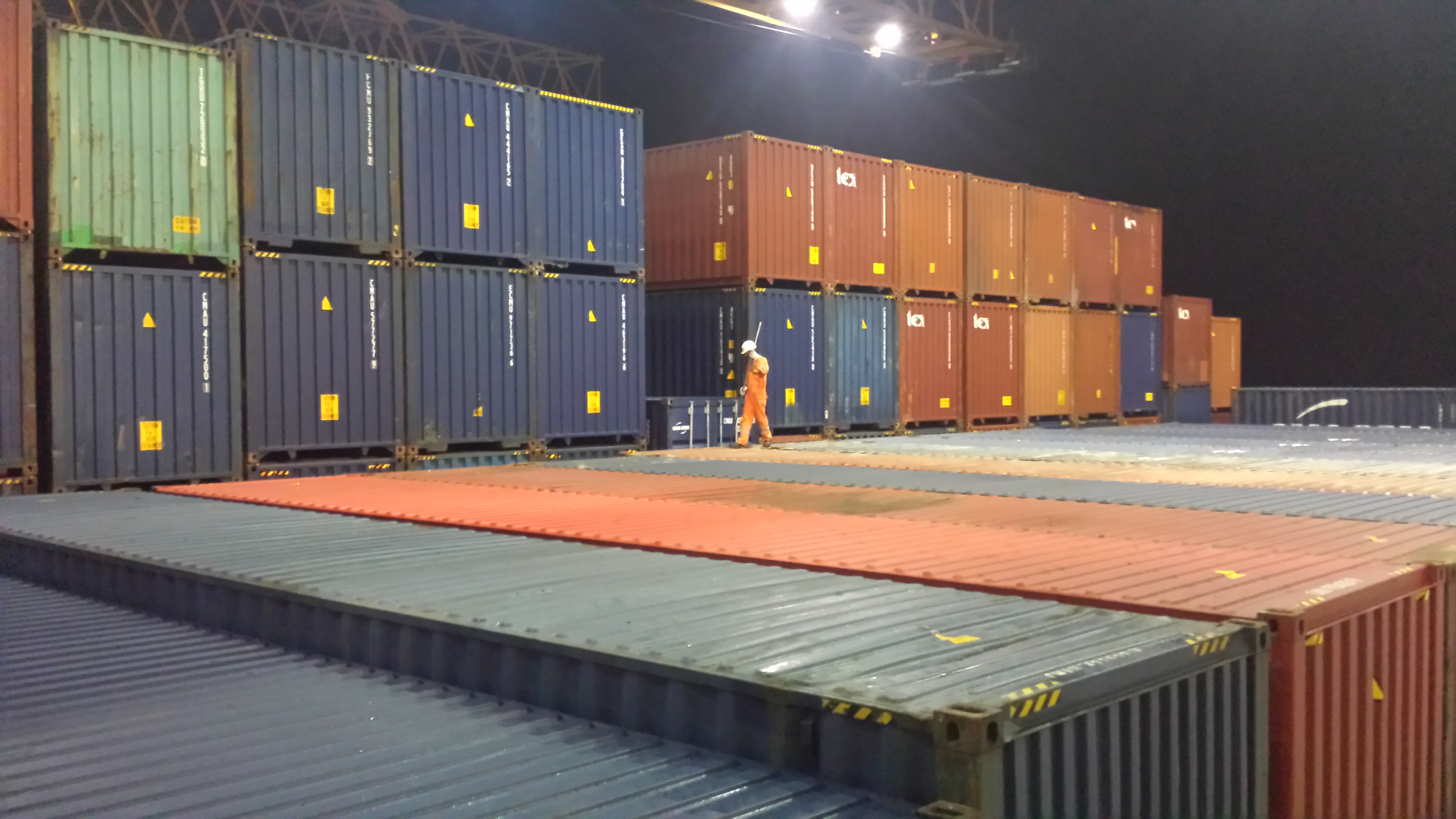
Port-worker unlocking twist locks on a stack of containers 6 high aboard the ship

The one thing I had not quite anticipated, as I watched the early stages of the port-work- was that beautiful slender young port-workers climb the cranes’ spreaders and fly down to the top of the mesa mountain that are loaded containers on the deck.  They jump down with long poles in their hands (being in the midst of Moby Dick I was thinking of harpoons) and walk along the containers, coming to their very edge hundreds of feet off any surface (and what surface!), and using the hook attached to the end of their very long pole to unlock the little nodules that lock the containers together.  And meanwhile the enormous crane spreaders bearing filled containers moves back and forth over their head, lifting containers to be unloaded (even empty, these containers weight 3600-3900 kgs).  It is the most terrifying spectacle I have yet seen: such literal precarity, walking alongside steel precipices that would give you vertigo even if you had none before, and having enormous containers (superfluously labelled “Super Heavy”) flying overhead, attached by only 4 little corners to a machine that one hopes does not suffer from metal fatigue or frayed cables.

Posted in 2015 Trip, infrastructure, labour, Middle East, political economy, ports, seafaring, shipping conditions, transport | 1 Comment

Anyone’s Ghost: Fishing grounds of the Arabian Sea

12 February 2015

Morning

We passed Salalah in the night, and the sea is not as lonely as it was yesterday, with the AIS showing at least 5 or 6 ships at a time (when it was sometimes entirely bereft of ships yesterday). Now, as we pass Khuriya Muriya islands, the captain says that when he was a cadet on a general bulk carrier, sometime at the end of the 1970s, early 1980s, whenever they passed these islands they would anchor and would put fishing lines down all the way around the ship and catch fish.  Apparently the waters here are rich with all sorts of delicious fish, including some that were 25 kilos.  He said that the crew would go from one line to the next and at each line they would pull up a fish, so that in one session, they could catch as much as two tonnes of fish.  He said that years later when they tried to do the same, the Omani Navy moved them along.  And of course now, it is unimaginable to be able to catch fish off these fast moving containerships.

20150212_112632

Whales in Masirah Bay

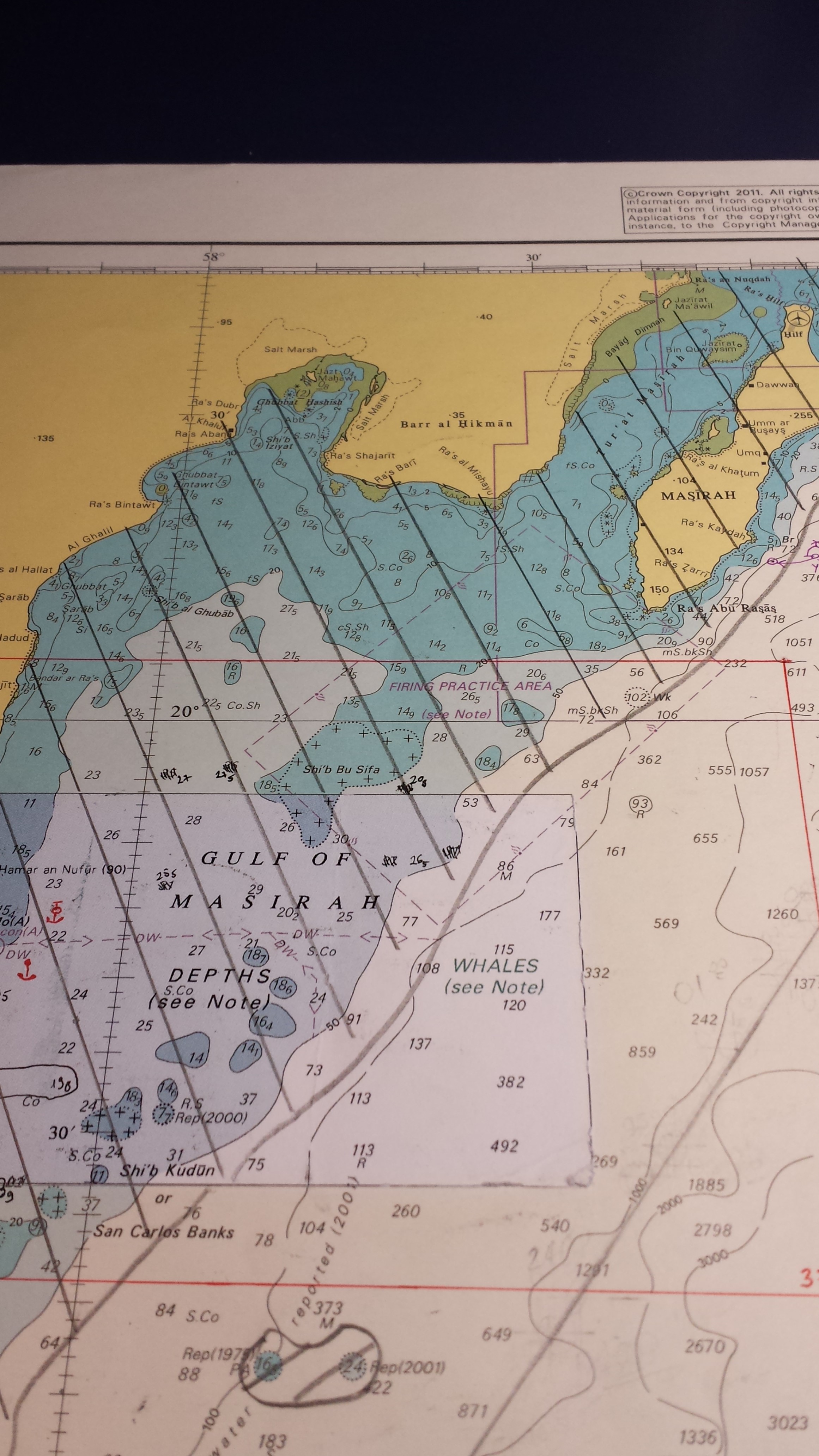
Meanwhile the Admiralty charts mention that near the Bay of Masirah (which we will reach in the evening today), there is a chance to see humpback whales.  The Filipino ship’s officer says that the sea here often has a covering of plankton and so it is rich feeding ground for whales and other kinds of fish.

Walking on the upper deck today, I kept company with a sleek black and white seagull who was skimming the sequined surface of the water in swoops.  The Arabian Sea is beautiful here; glimmering coruscating shimmering under the sun, with ribbons of current striping its surface and necklaces of small white birds flying in formations.  But it is the solitary black and white gulls that have my attention, so beautiful in flight.  There are also dhows in these waters, on our portside, in their beautiful wooden gait slowly making their way to their destination, closer to the coast than even us.  Apparently the French Naval ship Charles de Gaulle was in the area yesterday as part of a “deconfliction” (?) mission of the Naval Cooperation And Guidance for Shipping.  The letter they sent to the master warned him of the possibly of overflight by naval aircrafts, but none did fly over.  So, another ghostly warship wandering the security seas.

One of the other things I want to note today before I forget is the extent to which the work onboard seems to be paperwork.  The Filipino ship’s officer seems to be tasked with updating of charts and navigation books and other such things, so most of his time is spent cutting out bits of paper and pasting them on top of maps, chart catalogues, and navigation books.  The recording of locations, latitudes and longitudes, temperature and pressure, and a million other details –on paper and online also keeps going on, and most of the equipment is constantly tested, so there are logs kept of the endless tests.  Yesterday, the woman cadet spent at least two hours labelling and marking a massive binder that seemed to have every certification and inspection the ship had undergone.  From the ITF certificate, to stuff about lifts and oil and fuel tanks and a million other things.  So, this kind of paper task seems to take up as much time as the actual job of navigation.   On the decks, painting and repair and maintenance seems to be the most frequent activity.  So, pens and paintbrushes as the commonplace tools of navigation.


Posted in 2015 Trip, environment, labour, Middle East, Travels | Leave a comment

Machineries of Joy: Wrestling with the technological sublime

This one is for my friends Rachel Shabi and Waleed Hazbun, who might recognise something of the pathos of our common paternal utopias in it…

11 February 2015

“Hyperbole is the main stock in trade of publicists, boosters and even anti-boosters in some artists. Yet redemptive hyperbole and apocalyptic hyperbole amount to the same thing. We should be alert to the way to booster discourse circles back into apocalyptic foreboding and vice versa. The prosaic and often boring reality of the grimy present moment is always excused either by imagining a better future or an even worse one.” Allan Sekula, interviewed by Edward Dimendberg

About the sea as the sublime, as the metaphysical fantasy of the romantics, the great Allan Sekula writes, “when proto-romanticism is … confronted with [the sea’s] uncommodifiable excess [or what cannot be reduced to property], it transforms it into the sublime, taking it initially as proof of divinity; only later is the category naturalized and psychologized.”  But what about the technological sublime?

gagarin

Yuri Gagarin

I am still grappling with this seduction by technology. On the one hand, I resist the seduction just as strongly as I feel it because of some Oedipal apprehension about the way in which my father and his generation loved technology (about which more below).  On the other hand, I resist it because of the primacy of the American technological sublime as the species of the sentiment par excellence.

Part of this is what I can attribute to my own puppy-like enthusiasm for things whose machine workings, their engineering, the sophistication and usefulness of their operation, still inspire in me awe and wonder: something elegant and effective and ingenious; something that bespeaks of inventive thinking and of the absorption of histories of thinking and invention into an object which simply works [all of this of course clashes titanically with my utter revulsion at purity; authenticity; homogeneity; sterility; theoretical vigour/rigour/sparseness].  I was earlier reading an essay by John Law on the technological advances in medieval Portuguese navigation by astronomy, much of which must have been absorbed from the Arabs and then transformed into workable knowledge by sailors and masters who were not astronomers or scientists.  The story he tells is problematic in that it also bears the markings of the seduction by the workings of science to the point that sometimes the politics of the thing ends up getting forgotten or relegated to the margins of the essay (Law is a Latourian).  But despite this shortcoming, the story Law tells of how these then-new forms of navigation were naturalised and absorbed by the seafarers and sailors is perhaps the most absorbing part of an essay which in the whole feels a bit unpersuasive and not entirely worked-through (I suspect it is part of a larger project, of which I only see a bit; as I write this without the benefit of a search engine at hand).

Treshkova

Valentina Treshkova

But there is another part of my relationship with technology which I am trying to understand or explain (or justify?) as something different than the US version which is about romanticising an era of capitalism in which robber barons made grand infrastructures on which the foundations of the US liberal empire were built. This American technological sublime was another kind of thinking about “frontiers,” but now the frontier was no longer the territories of the indigenous peoples being dispossessed, but frontiers of science, innovation and technology (most US people think that most technology was invented in the US; and that generally, efficiency, good design, good engineering etc can best be found in the US – which of course if you are living in Europe after having lived in the US you realise what an uproarious joke it is). This discourse of US scientific “frontier” often celebrates vaccines or the CDC or the Hoover Dam or the Hubble Space Telescope (all admittedly things I am besotted with) or whatever else – but often ignores other “innovations” and “inventions” in this wasteland of scientific frontier: like nuclear weapons, or remote control assassination machines, or fracking, or – indeed viruses that can kill pandemically and genetically modified foods that can exterminate entire ranks of species and ecologies.  This is not my technological sublime (though I don’t deny I am fascinated by the inner workings of these things too).

nuke

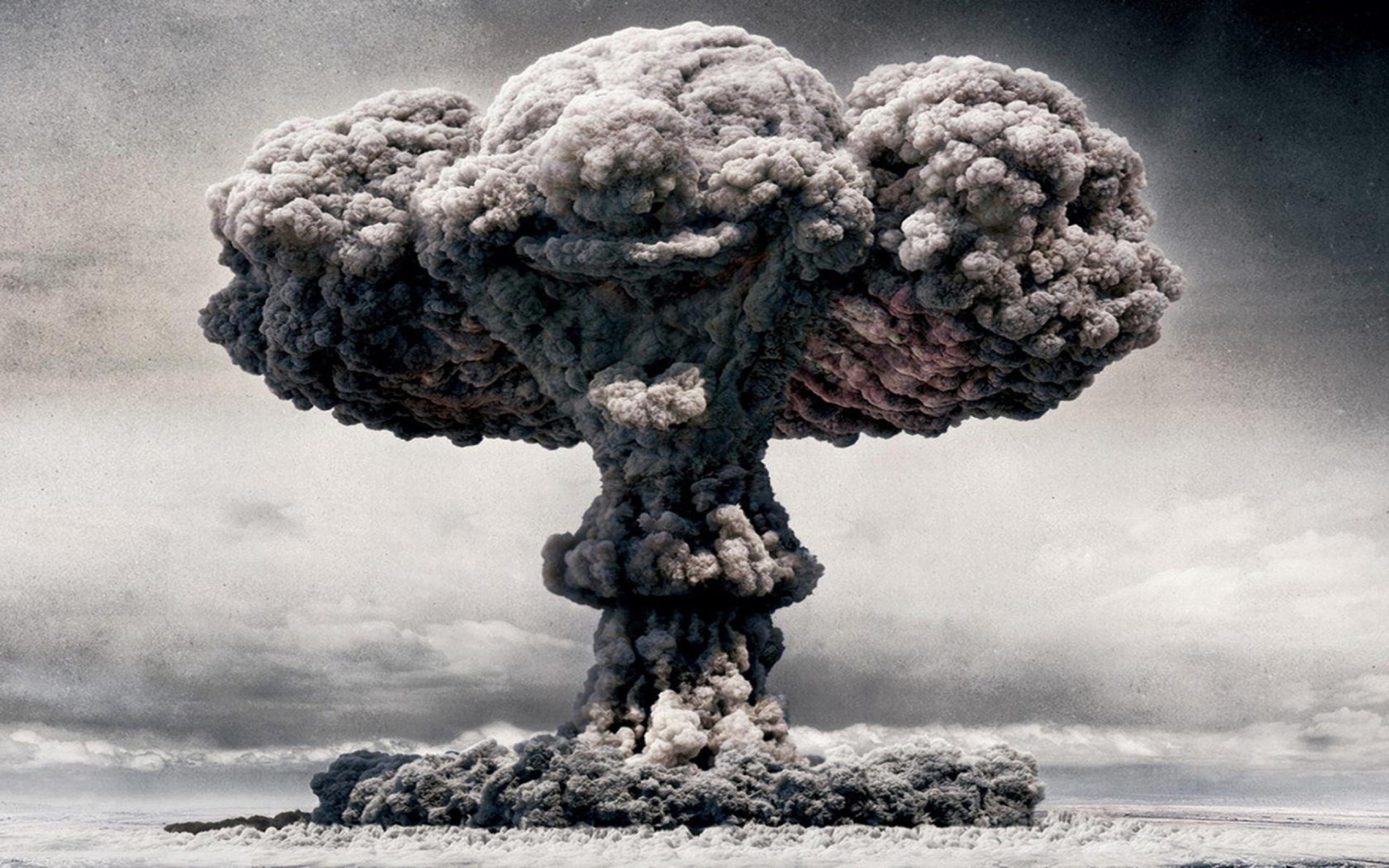
Nuclear test

So, let me try and excavate the lineage of my own personal seduction by technology.  Inevitably this will have to go through the early Soviet love of the modern (from electrification by way of Stalin all the way to Yuri Gagarin and Valentina Treshkova); but also the whole history of modernist art and literature in Europe which has by-and-large a left lineage or connection as well; and then through the post-colonial states’ fantasies of political economies independent from colonial masters, or at least on course to development. So some of it is aesthetic; some of it political; and some of it comes from that primordial soup of memory and affect and affection into which goes your early childhood stories and readings and loves and what you learned and what you drew and wrote and studied and all that.

First the Soviets.  It is now a cliché (though of course all too horrifyingly true) that Stalin killed millions so he can bring electricity to those vast territories. But certainly electrification and rapid industrialisation through the destruction of the peasantry and a form of state accumulation by dispossession certainly led to the USSR fast becoming a power with which Europe and the US had to reckon.  There is a great deal in there about the fascination of Lenin with Fordism, and in early Soviet Union, the state managers wanted to overlay some version of Taylor’s “scientific management” unto the processes of production.  So much of this of course had to do with the ways in which the Soviet version of Marxism (starting with Lenin himself) had themselves this odd affective relationship with industry and technology, a proto-technological sublime of a sort which then became a full-blown thing in the early 1920s.

Gramsci articulates something of this Marxist fascination with the rationalising force of Fordism and scientific management.  For him, the American version of Fordism is worthy of study because it is distinguished from the European version.  European capitalism is saddled with “a heap of passive sedimentations produced by the phenomenon of the saturation and fossilisation of civil service personnel and intellectuals, of clergy and landowners, piratical commerce and the professional (and later conscript, but for the officers always professional) army.”  Gramsci writes that by contrast

In America rationalisation has determined the need to elaborate a new type of man suited to the new type of work and productive process. This elaboration is still only in its initial phase and therefore (apparently) still idyllic. It is still at the stage of psycho-physical adaptation to the new industrial structure, aimed for through high wages.

This making of a “new man” seems to be a fantasy also echoed in Fanon.  If Gramsci’s version the capitalist new man of the US is created through the rationalisation of Fordism (which can only recall Charlie Chaplin’s version), for Fanon, the violence that matches colonial savagery with anticolonial apocalypse is what makes a “new man.”

What is striking is that Gramsci sketches his fascination with Fordism through a contrast with Neapolitan economies; and Lenin and Stalin’s fascination with this industrialising, rationalising modernism also came from their understanding of their living in a kind of “backward” agricultural environment.  As does both the Third Worldist Marxist and nationalist fascination with industry. Sudipta Karviraj’s fascinating reading of Indian Marxism (in “Marx in Translation”) also echoes this problem of Marxists reconciling their theory with an agricultural (and therefore pre-industrial and pre-proletarian environment) clearly shows the problems associated with having to map indigenous social formations to a “universal” Marxist schema – and thus the universalisation of the category of “feudalism,” where local formations could only be seen as a replica of the European feudal regime of production,  as backwards formations to be discarded on the inevitable speeding along towards the salvation of socialism.

This universalising schema also looked to Soviet Union for that revolutionary leap over the (un)necessary stage of capitalism directly into socialism. And the leap could only happen through technology.  Thus, not just the early Soviets, but also the Third Worldist Marxists saw in the emergence of industry, of steelworks, of transport infrastructure, of oil derricks and coal mines routes to discarding this “backward” past and leaping into a future which guarantees higher incomes, and better hygiene, and less superstition, and perhaps by necessity, fewer conservative forces associated with rural “feudal” forces (as well as those peasants described by Marx as potatoes in a sack) or urban petty bourgeoisie.  Speeding along the Marxist stages of development from one station to the next ended up becoming a sine qua non of belief in progress towards socialism.  And “progress” itself became associated with all those things that Europeans seemed to have on their way towards an inevitable socialism: hygiene, clean streets, public transport, industry, infrastructure, public health, good schooling, engineers and doctors and architects (but of the functional and practical kind not the fancy type that did frivolous buildings).

And some of my father’s generation’s fascination with technology, science and progress also came not from this epistemic diagnosis or ontological or historic desire, but also from very practical sets of relations and transformations: all those sons and daughters of the petty bourgeoisie rebelling Oedpically against their fathers and going off to Berlin and Paris and London and New York (or more likely technical colleges and polytechnics in Kansas and Sheffield and Leeds and Texas) to be educated in the ways of making the modern.  This was a serious venture, as it is obvious from chauvinistic higher education universities banning “the enemy” youth from acquiring the mystical knowledge now embedded in science.

What was learned, at home and abroad, was not just the necessary skills to operate modern technologies (though interestingly, not modern economies, except in so far as it was the scientific statistical methods and the like).  What was also learnt in that era was also an affection for, an awe of, the human majesty that could transform the world around us in the way it was doing, a kind of humanism familiar to the Marxists of early to mid-20th century. A fascination with the human ability to invent, to carve out the new, the massive, the epic history. A rejection of god, and gods, and fate, and religion. This was the new man of Gramsci and Fordism and Fanon. This Marxist form of humanism left its traces and residues (and its repressed opposite) in the modernist arts, architecture and literature produced by so many communist and socialist and leftist artists of the early to mid-twentieth century, of course in Europe, but especially elsewhere in the world.  These modernists were the people who remade our poetry and our arts and our literature.  They stopped using the old forms and the old vocabularies and spoke of shovels and of machinery and of the unspoken and unspeakable.  They wrote novels that in their jagged experimentalism was meant to echo the jagged technological rebirth we were supposed to go through.

But there were other things at work as well:

The nationalists well remembered how their former colonial masters brought with them industries that exploited them –the coal and gold and silver and copper and diamond mines into which they descended, the rubber plantations which were essentially factories in jungles, the roads and railroads (and sometimes ships) that carried away the fruits of their labour. I serendipitously stumbled upon a reference to Manu Goswami’s wonderful book in which recounted this colonial infrastructure was called “memorials of British rule” by a British chief consulting engineer.  And having, owning, mastering, these same industries and infrastructures ended up becoming a way you measured your independence against the domination of your former masters.  So, if you were an independent state, you went to Soviet Union to give you the steelworks that would allow you to make your own steel for your own railroads.  And the Soviets could also provide electricity plants and the massive dams that could produce that electricity.  And coalworks.  And railroads.  And oil refineries. As could the French or the Germans.  And later the Japanese and Koreans.

But at work was another thing too, which worked in those hybrid economies of the non-aligned countries: import-substitution industrialisation.  Which was seen as another route to progress.  There, we made our own things instead of importing them, and that allowed us to industrialise.  I remember my father’s disdain though for our auto assembly plants.  He would spit out his revulsion, “but they control the technology; we only assemble the parts they have made.”  And he was not wrong.  So, controlling the technology, knowing it, mastering it was another way in which we could catch up with them, maybe even surpass them, the way the fantasy had the Soviets surpassing “the West.” And in some regards, the fantasy was not all wrong either: after all Gagarin was the first man in space; and it took so many decades after Treshkova had gone to space that the US would send its first woman there.

This comfortable convergence between what was essentially a liberal-nationalist plan for industrialisation and the epistemic diagnosis of committed Marxists usually happened along the vector of technology.  So technology became our true north, the thing we sought, needed, desired.  I still remember the days of my engineering undergraduate degree not as just this degree I had to get to “help my country” but as a thrilling initiation into how things worked.  The things that made our lives richer (in the very vulgar sense of more materially comfortable). The things that raised our standard of living and our national income, and our sense of national pride at having caught up a little.

Of course I don’t deny that this fascination with technology and a desire to make the world new and whole also made the rule of the technocracies (although the technocrats were more often economists and statisticians rather than engineers); or that the dams displaced people and destroyed entire ecologies; or that thousands, nay millions, died in the making of the national roads and railroads and edifices of the modern; or that the organic fabric of cities like Beirut or Tehran were completely rent asunder; or that some of those engineers then went on to become the most enthusiastic adherents and recruits of a transnational Islamism whose intents were not those of the left or the liberal nationalists; or that all those factories and steelworks inaugurated a rapacious form of capitalism which owed as much to colonial structures of exploitation as to the free wage ideal types sketched in Capital I. But I still argue that unless we understand how we came to love technology, we are missing something about how the greater schema of transformation (the rule of experts; or neoliberalism; or hegemony of capital) came to be implanted not just in our bureaucracies and relations of production but in our souls.

This affective landscape is what is often missed in the so frequently arid debates over modernity (thankfully now dead and dusted; hopefully for good). DSC00074What is missed is that when I look at those cranes moving massive boxes, when I look at ships that look like floating cities and indeed produce enough water and electricity and process enough sewage as a small landside town, I don’t just see the instruments of capitalist exploitation (although of course I see those too every minute).  Nor any longer do I see the salvation to our degraded, exploited and dark predicaments.  What I feel, often viscerally and unconsciously, is the thrill of invention; that humanist love of remaking and rebirth; that epistemic shift that came with that glorious moment in time in the era of decolonisation when everything seemed possible.  I was not alive then –I was born at the tailend of it- but I still carry it in my memory, as if implanted there through so many stories my father told, so many conversations we had.

In 1955, Ahmad Shamlu, one of those great Marxist humanists and modernist poet who industrialised Persian poetry (in the good sense of “industrialisation”, when industrialisation was still the desiderata of so many of his contemporaries), wrote a utopian poem about a day into the future when “each man/is a brother/to each man.” The poem ends:

I will await that day
even on a day
when I
n
o longer
am.

I wonder if my visceral love of technology is my father still awaiting that utopian day even on a day he no longer is.

Posted in 2015 Trip, Allan Sekula, capital accumulation, empire, imperialism & colonialism, infrastructure, logistics, Middle East, political economy, readings, the sublime, transport, Travels | Leave a comment

About Today: Steaming the security seas

10 February 2015

20150210_114945

“Coalition Warship”…

20150210_115143

F571

Everything anticipated our entry into what I can only call security seas. There are ships that do not send signals: they turn out to be warships of a sort, small, compact, going only at 7 knots with a marking of F571 their only distinguishing feature off the coast of Yemen. There is another ship that appears on the control room monitors; its name only “Coalition Warship” and it seems to be coming at us at high speed; again off the coast of Yemen; this one much closer to the coast and obviously showing its AIS (unlike F571) but even then, which coalition?  Which country?

Our fire drill today took us to the lifeboats, and climbing into it was a bit like climbing into a tomb.  Our lifeboat is far smaller than the one in Captain Philips and looks a bit more rudimentary.  Tomorrow as we pass into the Gulf of Aden, we will be closing and locking all of our deck entries, and will not be allowed to go outside.  Which is a bit of shame really, given that the 30 knot winds of today make it nearly impossible to be outside.  When I tried to go for my walk along the upper deck, at the bow, the wind was so strong that I had to hold on to metallic objects so that I would not be pushed hither and tither, and there was vast amounts of seawater washing on the deck, and even the windshields in the wheelroom are covered in sea-salt as the spray splashes up in momentary rainbows.

20150210_093851

Wind and sunshine in southern Red Sea

As we go further south and closer to the Bab Al-Mandab, stories about piracy end up increasing.  A Filipino able seaman on watch on the bridge talks about how in 2010, they frequently heard the distress calls of ships calling “under pirate attack.”  The targets were often tankers which have a lower frame and slower speed; some going as slow as only 12 knots, where pirate skiffs were going at 18 knots. When I mentioned Maersk Alabama, they said it was a smaller ship that only went as fast as 16 knots.  So, in strange ways, what I was reading in Sekula about the enforced slowness of travel on the sea is in some ways negated by the ever more powerful engines that can go as fast as 25 knots.  But back then, a lot of commercial ships would also travel in “shadow mode”: all navigation lights off; no AIS data even; and they would only be visible on the radar screens.  One of the ship’s officers said it was mostly MSC ships that followed this protocol.  Nowadays it seems to be the warships –of how many different nations? – that follow this strange routine: no flags; no AIS signals; just there, a ghostly presence, grey and anonymous on the radar screens, and then eventually visible to the eye, during the day anyway.

There are other things about piracy: the notice printed on a dot-matrix printer from the IMB Piracy Reporting Centre contains this bit:

Masters are reminded that fishermen in this region may try to protect their nets by attempting to aggressively approach merchant vessels. Some of the fishermen may be armed to protect their catch and they should not be confused with pirates.

The area is apparently patrolled on some sort of rota by naval ships of many nations, including India and China, and there is the Djibouti Navy (which I can only believe in with some difficulty) which calls upon different ships and asks them about their specifics.  Another ship’s officer seems to think that the US just blows the pirates away.  He asks (with some justification), “Have you ever heard of US capturing pirates?”  One of the Balkan officers thinks that the whole thing is a conspiracy between insurance companies and governments: “If NATO can bomb our entire country so nothing is left how can they not deal with a bunch of pirates with Kalashnikovs and RPGs?”  I didn’t much feel like giving a lesson on guerrilla or asymmetric warfare and the ability of small stealth fighters to get away with it.  Perhaps if there is no strange conspiracy between insurance companies, nevertheless shipping companies give directions to the ships about the routes they can choose which saves the shipping companies money by saving them the cost of fuel they would have spent on longer and safer routes.  The shorter routes also buythem delivery time – while also exposing their seafarers further to piracy by being too close to coasts.  In fact, my 14 day trip is going to be 13 or even 12 days long despite the delay in arrival in Malta because we have been steaming down the Red Sea at unbelievable speeds and despite the 30 knot headwinds and strong currents which slow us down a bit (by about 2.5 hours in a day, I would say based on yesterday’s estimate of when we would arrive in Bab al-Mandab and when we actually arrived today) [in the end because of anchoring at sea outside Jabal Ali and slowing down, this turned out not to be true].

20150210_161214

Evacuated rocky islands off the coast of Yemen on the way to Bab al-Mandab

As we move forward through the narrows towards the Gulf of Aden, we listen to the conversations between the Djibouti Navy and the passing ships (as between Port Said Port Control and later Jeddah Port Control and passing ships); one’s imagination can weave so many stories about the people passing through the night.  One particular conversation took place between a woman chief officer on a container-ship flagged to Liberia and with 22 crew members going to the Isthmus in Turkey. I couldn’t tell where her accent was from; or which ship she was officering. But she was there in the darkness steaming away from us. I could have sat in that control room and listened to these conversations endlessly (some conducted in variously accented Arabic) and have imagined the lives passing by on enormous steel vessels in the darkness.


11 February 2015, Along Yemeni coast

20150211_090031

Very few ships on the AIS screen.. only to grow even sparser as the day goes on

It is an incredibly lonely sea today, especially in contrast with yesterday’s crossing through Bab al-Mandab and the intensity of that traffic, both visible and in range of the AIS all the way beyond 300 nautical miles.  Today, at most 3 or 4 ships show up on the AIS monitor (2 of them P&O ships, one of them called after Balqis the Yemeni queen Suleiman loved in love fables with which I grew up), none beyond the range of a few dozen miles.

20150211_090510

Our route close to the Yemeni coast marked on the Admiralty charts

Instead, we are hugging close to the Yemen coast, which is visible by sight and without binoculars.  We have passed Ra’s al-Kalb and are approaching Mukallah, A rather beautiful barren sight, sand dunes and black hills rising out of the dunes and the sea, and an occasional crag of a mountain rising behind them.

20150211_102515

Yemeni sand dunes in the distance

The captain has just permitted me to go outside in the sun, though it looks still too windy to go for a walk on the upper deck, but at least now, I can go out and sit in the sun, once the deck cleaning above us –and the flood of dirty water being washed off- has subsided.


Evening

20150211_173248

Looking towards Djibouti

20150211_173632

A very lonely sea

A little bit of excitement at just before 18.00 and sunset, when the very sharp eyes of the Filipino able seaman on watch catches a bit of white on the surface of the sea on the port side.  We look and when the radar is made more sensitive to notice it, sure enough, it is a little white skiff going at about the same speed as us, but speeding towards the coast.  At the same moment we see two other skiffs on our starboard, again speeding towards us.  Of course, they turned out to be nothing but perhaps fishing boats.  The experience was interesting in two ways though: first, that the seafarers have learned to see in in ways that I am obviously not skilled at all.  That the able seaman could pick up the skiffs from the waves and without the aid of the radar shows ways of seeing which only develop through long experience.  These embodied or corporeal skills are rather fabulously interesting because it is training eyes for example to do things that ordinary eyes cannot do.  Must be like trackers who can smell, hear, see things other people’s senses are not attuned to.

The second interesting tidbit was what my cadet friend mentioned: that often these fishing boats know that the big ships are apprehensive about pirates and so the fishing boats “play” with them, play on their fears.  It seems like a rather dangerous game, given that some shipping companies (apparently Russians and Israelis especially) have armed guards on board, but it also says something about relations on the sea and the ways in which the tedium on work on the water is relieved.

Posted in 2015 Trip, empire, imperialism & colonialism, militaries, piracy, seafaring, transport, Travels, war | Leave a comment

A Bunch of Lonesome Heroes: The factory at sea

9 February 2015

20.00

“Going forward and glancing over the weather bow, [… the] prospect was unlimited, but exceedingly monotonous and forbidding; not the slightest variety that I could see.” Herman Melville, Moby Dick

For the next few days, we shall be traveling on the sea in a monotony of sunshine, humidity, warmth, and reading pleasure.  Only near Bab al-Mandab will the monotony be relieved, whether by the sights of nearing mountains lowering over the strait or by raised security level (from 1 to 2) as we cross through the pirate alley.  It is already quite warm outside, and we are properly in the Red Sea, beyond where we can see the traffic of other ships or the coasts. In the afternoons, I quite like my circumnavigation of the upper deck again and again.  It is a kind of tawaf; a kind of pilgrimage in which at last I have a chance to say hello to the crew, however briefly.  They are so hard at work, welding, sanding, high-pressure cleaning of the deck, painting rust spots, sweeping away the mud that the massive anchors brought up with them from the Mediterranean as we waited for permission to cross into Suez. I march around the deck again and again – around 6.5 times makes an hour, saying hello to the smiling Filipino crew members, the electrician who is sometimes wandering about, and others that pass through. And occasionally cheat and stop at the bow, as close to the front as I can, and stare out to the sea.  There are fewer (or no?) refrigerated boxes towards the front of the ship, and there, the sound of the sea drowns out even the massive engine’s thrumming.

20150209_094101

The lower deck

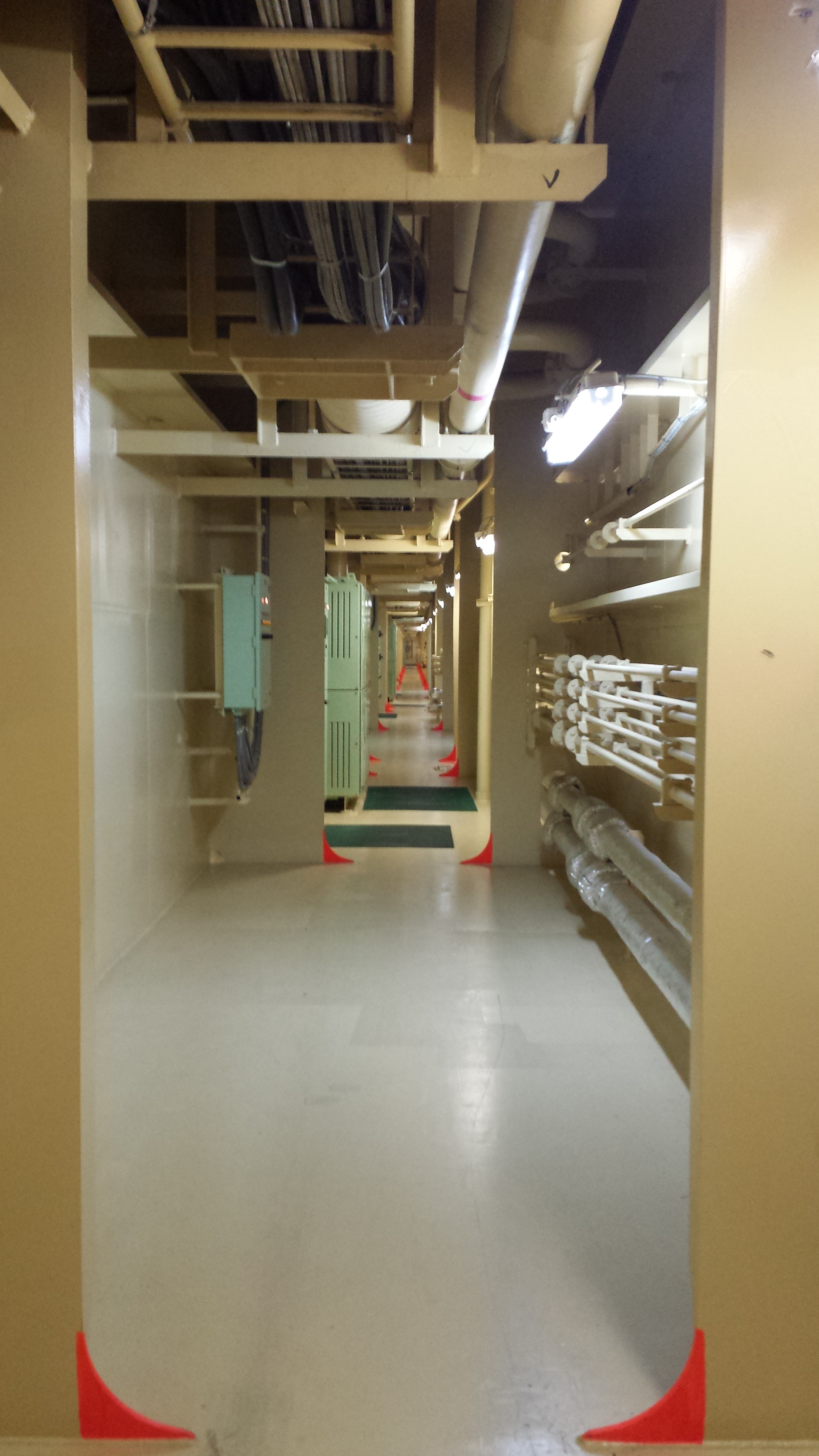
This morning, we passengers were shown around the engine room by one of the crew members.  Getting there through the corridors in the lower deck with the low hum of the engine and the heat running through feels a bit like a horror film, especially as we passed one light that kept blinking.  It is the sterility of the space down there, all surfaces painted beige, the sameness relieved only by the silver insulation of the pipes that run the length and little painted red triangles on the edges of the ribs of ship.  There are manholes down to the ballast tanks, which we have to watch out for, as sometimes they can be open. I was told when we visited the citadel the other day that in the winter in northern Europe, the lower deck can be covered in frost, and in the summer, passing through tropical zones, it can be hot as hell.  Literally.

20150209_091236

The 14 cynlinders

20150209_092920

I am not certain which direction this photograph is supposed to be in

The engine room visit was rather amazing.  We had to wear noise-cancelling headphones and were given a tour by one of the Filipino engine room crew. There is that enormous engine with its 14 cylinders producing 107,000 horsepower.  With the colossal crankshaft whose rotation drives the ship forward.  And the deep pulsation of the engine which you can feel in your bones at 90 rpm, it beats beats beats in some visceral infra-hearing sort of way, traveling through your muscles, magnetising the rhythm of your heart to its own. I recorded the sound, but the recording is all a kind of barely thrumming static. But being there, inside the ventricles of the heart of the engine, with what felt like the valves opening and closing and the aorta of the ship throbbing, the rhythms and vibrations travel through the walls, floors, through the air into your bones and body. At this speed, the engine consumes around 200 tonnes of fuel a day, fuel that is bunkered only in Europe apparently and which has to last all the way to China and back.

This vast engine is most affected by humidity apparently.  The second engineer told me that at Bab al-Mandab, sometimes it is so humid that the engine produces something like 200,000 litres of water a day, absorbed from the air and transformed into a cataract pissed into the sea. There are other things about the ship that reminds me of a body. Tonight, we have been sailing into a head-wind of 15-20 knots under a star-drunk sky (we seem to be following the trail of the Milky Way as we speed south closer to the Sudanese coast than to the Saudi one). 20150209_103238The wind blows through the gaps of the containers and the strange groaning squally sound it produces reminds me of the ultrasound thrum of a pulsating wash going round and round inside one’s womb, like the whoosh of blood boiling through the bigger veins and arteries of a body.

20150209_093213

Chains; not sure what they are used for

But back to our morning adventure: Of all the shipboard spaces, the engine-room is most like a factory (which if Capital Vol II is right, the ship carrying this cargo to a market where it can be sold for higher value is indeed part of the production cycle, and therefore, a kind of factory).  Enormous tools everywhere and enormous skill required to work with all of that.  No sight of the sea, no feeling of the wind, or the infinite (I hang my head in shame), and if there is a movement visible, it is not of the ship cutting through water, but of machineries’ inner parts moving one another in a kind of methamphetamined tango.  Down there, in the workshops and on the floor of the engine-room, cadets and engineers and oilers and fitters are at work in the heat, and objects are oily and heavy and hot and the air smells like diesel and metal.  This is the ship sans the romance, and labour that is not just about tedium or exhaustion of erratic shifts, but about lifting massive objects, affixing things to one another, or to chains, welding, digging through oil and grime. The danger of electrocution or chemical burns, or heat burns, or heat exhaustion, or falling and cracking your skull or spine on these massive angular sharp edges and ledges.

20150209_091211

Tools

There are rooms within rooms and spaces within the larger spaces where tools are arranged in orderly arrays, gleaming in the heat. Somehow this reminds me of a ship on which the great Allan Sekula travelled and the story he tells about it.  The ship was the first ship built in South Korea by Daewoo (incidentally the same company that has built CMA CGM Corte Real) for the now-defunct US shipping company, Sea-Land (also notable for having been the shipping company set up by Malcom (sic) McLean, the inventor of the container as a form of intermodal transport). Sekula writes

When an American crew picked up the first of these ships from the Daewoo dockyard, completed the sea trials, and began the voyage back across the Pacific, they discovered in the nooks and crannies of the new ship a curious inventory of discarded tools used in the building of the vessel: crude hammers made by welding a heavy bolt onto the end of a length of pipe, wrenches cut roughly by torch from scraps of deck plate. Awed by this evidence of an improvisatory iron-age approach to ship building, which corresponded to their earlier impression of the often-lethal brutality of Korean industrial methods, they gathered the tools into a small display in the crew’s lounge, christening it “The Korean Workers’ Museum.”

I am fairly certain that now, some decades later, Daewoo, through probably still brutally exploiting its workers, is no longer in that iron-age stage of ship manufacture: looking at that crankshaft below as it turns at 90 revolutions per minute, around 1.5 turns every second, inside the ribcage of the engine –that metallic leviathan’s skeleton- I am fairly sure that they have surpassed our age in their construction methods.

In some ways, thinking about us descending level by level by level into the bowels of the ship where physical, embodied work is being done reminds me a bit of the chapter in Moby Dick where captured whales are processed in the bowels of Pequod. Here he is:

And thus the work proceeds; the two tackles hoisting and lowering simultaneously; both whale and windlass heaving, the heavers singing, the blubber-room gentlemen coiling, the mates scarfing, the ship straining, and all hands swearing occasionally, by way of assuaging general friction.

Not much singing in the engine room of Corte Real, but there is a sense of the choreography of work, of its perfect fit together that somehow corresponds to the fleshy labour of Melville’s whalers, “every sailor a butcher.” In his stubbornly materialist reading of Moby Dick, CLR James pauses on the Try-works chapter and those proximate to it most carefully, prises their mechanics loose, and describes the choreography of the works involved in stripping the whale as the basis of a kind of solidarity, “a world-federation of modern industrial workers [who] owe allegiance to no nationality… They owe no allegiance to anybody or anything except the work they have to do and the relations with one another on which that work depends.”  Perhaps because our ship has fewer nationalities on it than I have read about in other instances, the national languages (Tagalog and Serbo-Croat and probably one of the southern Indian languages too) seem to make islands of groups of workers, bridged by English. That contraction in the number of nationalities is a surprising difference between Corte Real and Melville’s ships in his very many gorgeous maritime stories.


Later:

On Allan Sekula’s Fish Story

Every time I read the late Allan Sekula’s gorgeous prose while looking at his photographs I fall in love with him a bit more, if it is possible to be besotted with a dead man. That picture of his included in “Between the Net and the Deep Blue Sea,” winking as he dives up from the sea outside Bill Gates’ house, of all places, just takes my breath away.  How could you not fall for him?  Such a vast store of erudition about the inner machinery of maritime commerce and nautical wars; such a beautiful weaving of cinematic stories, breathtakingly illuminating  imagery with the words of Walter Benjamin and Proust; Mumford Melville and Manet; such an insightful reflection on forgotten spaces and places – and even as he cuttingly critiques “humanism,” the seriality of his images constantly introduce humans into the shabby or epic machine spectacles he photographs initially without a person in them (if one doesn’t count the congealed labour of making all the machinery he photographs).

And then there is this:

The weird origins of Korean shipbuilding in the 1970s can be traced in part to the purchase of plans from bankrupt Scottish yards on the River Clyde.  With the second Industrial Revolution repeating itself on the shores of Mipo Bay, a number of unemployed Glasgow shipwrights migrated to Ulsan…

The greater Hyundai empire began as a fledgling construction firm building bases for the Americans. First during the Korean War, then later in Vietnam. … In the film version of White Badge, Vietnamese peasants are massacred by Koreans within sight of a busy superhighway that could not have existed in Vietnam during the war, but that did come to be built in Korean by the same construction company that got its start building roads and barracks for the Americans. The scenographic “mistake,” just barely discernible in the far background of the sot, is a clever way of looping forward in time, drawing a link between Korean and Vietnam that looks forward and not simply back to the similarities between the Korean and Vietnamese wars.

20150209_093004

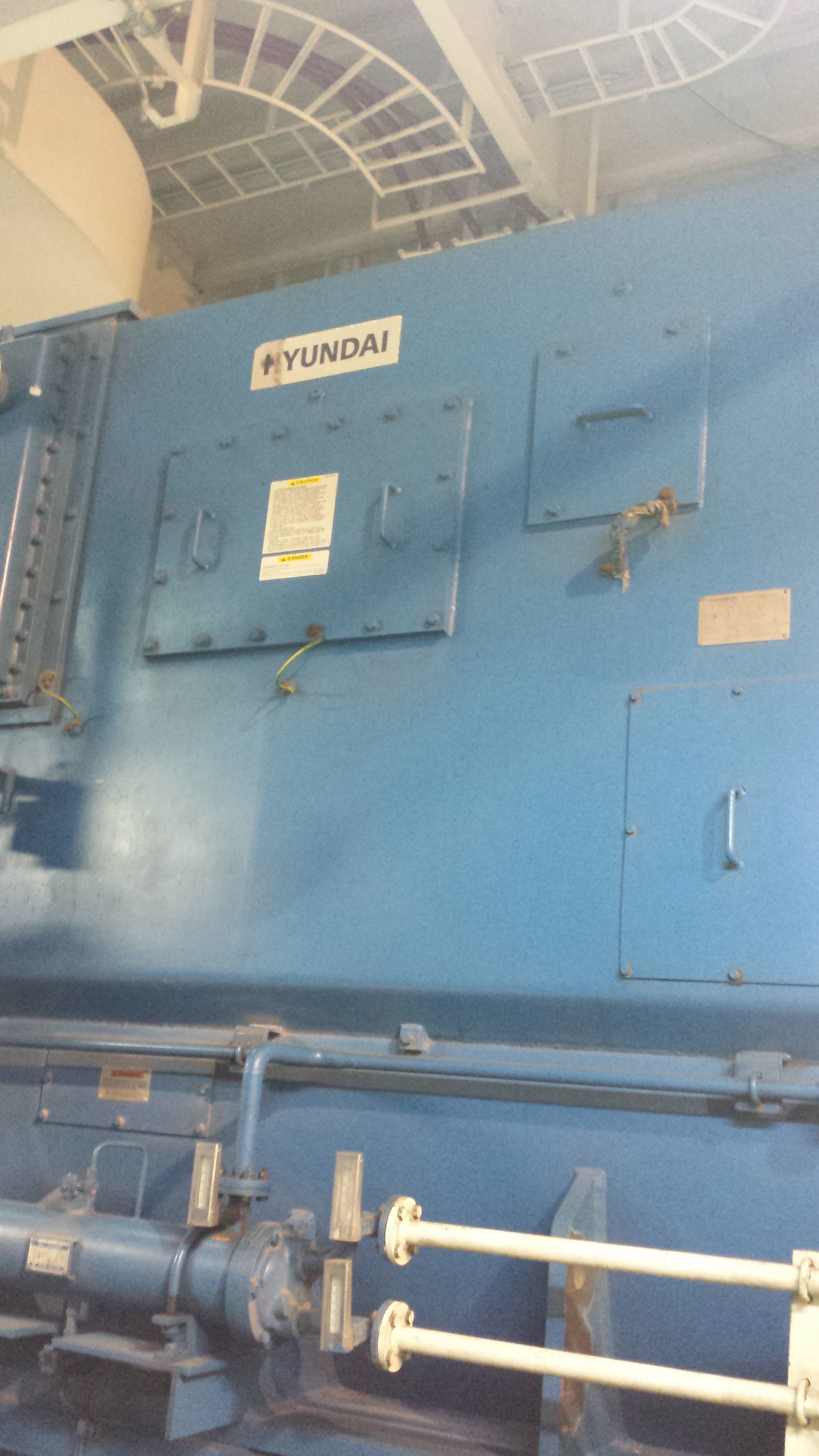
Hyundai generator (I think)

And in fact, the ship on which I am afloat, CMA CGM Corte Real, was itself manufactured in the Busan factories of Daewoo, and Hyundai has built the generators on this ship. And I wonder if there is some ancestral memory of river Clyde buried through the body of this ship passed from those Glaswegian shipwrights to their industrial progenitors.

Of course what else interests me about the above is the extent to which my trawl through Middle East Economic Digest back issues produced the impression that the ports; shipyards; pipelines; “military cities” and the like being built in the boom years after 1973 on the Arabian Peninsula were being built by Korean firms. A 1977 report, for example, says that “Last year, about 30 South Korean companies secured more than $2,000 million worth of construction contracts in the Middle East, which alone took more than 90 percent of Korean overseas construction activity.”  And this is only construction companies: what about engine-builders, and dockyards machinery manufacturers, and contractors of other sorts? What about the skilled labour that flowed for a time from Korea to the petroleum-producing countries (the way other Southeast Asian countries now export labour there today). Later, in 1980, when the economic boom had given way to crisis, MEED reported “reassessments” on the part of Korean companies, “as their labour costs rise and competition for fewer big contracts become tougher.”  Even in the tough conditions, the Korean share of the Saudi construction market was estimated at 23 percent!

Meanwhile, in the same 1977 issue of MEED, there is a small item about how Sharjah is hiring South Korean stevedores in order to make its ports “more attractive to shipping companies.” South Korea’s Sun Lee [presumably a recruiting company] was to provide “100 Koreans to augment the port labour force of 500 Indians and Pakistanis.”

I wonder in all the vast literatures of political economy written about the “miracle” of South Korean economic “take-off” and all the arid and politically dubious debates about authoritarian rule acting as a precondition of economic growth (all the stuff I had to read as a grad student 15 years ago and more), anyone has looked at the role these Middle Eastern contracts played in the growth of the chaebols. Something to pursue perhaps.


Posted in 2015 Trip, Allan Sekula, capital accumulation, labour, literature, Melville, Middle East, political economy, readings, seafaring, shipping conditions, transport, Travels | Leave a comment

Reading Capital 2 on a containership

8 February 2015

You begin to realise how much Marx actually crafted his writing when you compare Capital I to Capital II.  The former is beautifully edited, funny, extensively footnoted, erudite, and with a gorgeous narrative structure that inexorably push you forward as the book goes on.  Not so Capital II which was assembled from a series of notebooks by a reverent Engels who decided not to mess with scripture and left the lot unedited.  With the result that Capital II feels incredibly repetitive (at least in the first few chapters), and stilted, and rather devoid of the lush humour and beautiful sense of situatedness of the book in a vast corpus of reading which so characterise Volume I.

Nevertheless there are two passages of interest here, the first of which recalls the best stuff of Volume I: a global view which is historically grounded and which makes connections others do not.  It occurs, as with so much else that is great in Marx, in a footnote on hoarding:

The sudden increase in demand for cotton, jute, etc. as a result of the American Civil War led to a great limitation of rice cultivation in India, a rise in the price of rice, and the sale of old stocks of rice by the producers. On top of this, there was the unparalleled export of rice to Australia, Madagascar, etc. in 1864-6. Hence the acute character of the famine of 1866, which carried off a million people in Orissa alone.

The reference for this is House of Commons reports which Marx reads judiciously, and critically, connection and contextualising the famine within a broader context of war and trade.

His discussion of transport is not as interesting, as related as it is to the broader abstruse (“scientific” if using the language Engels used) discussion of value valorisation and different forms of capital.   For example:

But the use-value of things is realized only in their consumption, and their consumption may make a change of location necessary, and thus also the additional production process of the transport industry. The productive capital invested in this industry then adds value to the products transported, partly through the value carried over from the means of transport, partly through the value added by the work of transport.

So much so boring (for me anyway).  But then there is this glorious passage again where Marx’s humour and erudition rescues the dry text preceding it:

Transport requires, for example, greater or lesser measures of precaution, hence more of less expenditure of labour and means of labour, according to the relative fragility, perishability, and explosiveness of the article. The railway magnates have shown greater genius in inventing fantastic species than have botanists or zoologists. The classification of goods on the British railways, for example, fills volumes, and rests for its general principle on the tendency to transform the variegated natural properties of goods into an equal number of transportation ailments and pretexts for obligatory impositions.

‘Glass, which was formerly £11 per crate, is now worth only £2 since the improvements which have taken place in manufacture, and since the abolition of the duty; but the rate for carriage is the same as it was formerly, and higher than it was previously, when carried by canal. Formerly, manufacturers inform me that they had glass and glass ware for the plumbers’ trade carried at about 10s. per ton, within 50 miles of Birmingham. At the present time, the rate to cover risk of breakage, which we can very rarely get allowed, is three times that amount… The companies always resist any claim that is made for breakages.’ [Marx quoting the Royal Commission on Railways].

In all, his writing in Grundrisse, which I have quoted here before is more suggestive (and more beautifully crafted):

The more developed the capital, therefore, the more extensive the market over which it circulates, which forms the spatial orbit of its circulation, the more does it strive simultaneously for an even greater extension of the market and for greater annihilation of space by time. Only in so far as the direct product can be realized in distant markets in mass quantities in proportion to reductions in the transport costs, and only in so far as at the same time the means of communication and transport themselves can yield spheres of realization for labour, driven by capital; only in so far as commercial traffic takes place in massive volume — in which more than necessary labour is replaced — only to that extent is the production of cheap means of communication and transport a condition for production based on capital, and promoted by it for that reason.

As our long convoys of many millions of tonnes of goods snake through the militarised searoute that is Suez Canal I think of this “commercial traffic … in massive volume.”


A few hours later: I take back what I said.  The latter third of Volume II is full of all sorts of interesting things, including a reflection on time which although doesn’t directly answer my question about the management of time when “space is annihilated by time” – nevertheless it goes some ways towards laying out a thinking about it.  I still hold to my view that the volume is not as beautifully crafted as the first (and why should it be? It was a series of preliminary drafts) but….  I bow down to our Lord and Saviour Karl Marx who seems to have even foreseen the Keynesian solution to general economic crisis (where he talks about investment in infrastructure absorbing even the reserve army of unemployed; pp. 390-391 in the Penguin edition).

Posted in 2015 Trip, capital accumulation, empire, imperialism & colonialism, labour, political economy, readings, transport, Travels | Leave a comment

Shim El-Yasmine: Suez Canal

8 February 2015

“the great current of human inclination is to enjoyment.”  Karl Marx, Capital Vol. II

I want to be more jaded.  After all, my nautical venture is an all-expenses-paid research trip – the best of both worlds: doing what I love and a leisurely adventure unlike much else in the world.  I stare at the sea and do that thing which annoys me in other people’s writing: see the shiveringly romantic, the gorgeous transhistorical sea which gets at you somewhere in your viscera, evoking some sort of primordial memory even in a landlocked soul.  I see the seduction of large ships and of a kind of fragment of infinity.  Then, I read Ravi Ahuja’s “Capital at Sea, Shaitan Below Decks? and am horrified by the lives of those historical sailors.  I speak to the lovely smiley Croatian second engineer, the son of a professor of biology from the island of Korcula, who went to sea to adventure, and he tells me that when he retires, “I am never going to move. I will stay where I am and go nowhere!”  I ask him what he will do with the sea? How will he divorce himself from the sea?  He reluctantly acknowledges the lure, the seduction, but his response is “I will buy a 5 metre long boat and go fishing.” So, I don’t want to romance the sea.

Then there is Allan Sekula, whose every word resonates with me in ways no one else’s does: “Harbors are now less havens (as they were for the Dutch) than accelerated turning-basins for supertankers and container ships. The old harbour front, its links to a common culture shattered by unemployment, is now reclaimed for a bourgeois reverie on the mercantilist past.”  Is my seduction by the sea a kind of “bourgeois reverie”?  Surely it is a bit of that. And yet, how can I not?  I am not alone, surely.  Even the jaded Foucault (who, Sekula mentions approvingly, wrote about metaphorical containers as a means of discipline).  Even Melville who suffered at sea and whose novels are chronicles both of torment and of joy.  Sekula mentions a rhetorical device Engels uses in his Conditions of the Working Class:  to contrast life in the working class slums of the 19th century (“repulsive, disgraceful,… brutal indifference”) with the magnificence of maritime Thames with its bank of ships.  So, even Engels.

Even Sekula himself goes back to the sea, and even if he writes about “the maritime world as a space of class conflict,” there is a bit of machine love in his images of ships and of containers, of the sea itself.  He may not be into the sublime, but the technological sublime has brushed his camera lens. About Turner’s maritime sketches and paintings, Sekula writes: “This is not to reduce the Turneresque sublime to a simple technological determinist explanation, but rather to suggest that a painted sky that presumed the wind to be a motive force had a different referential status from one in which steam and smoke were introduced as evidence of new powers.”

You always have to see Sekula’s images in a series: because there are those epic images of the technological sublime which he manages to capture in modern panorama (not the sea or the sky, but the concrete harbour and the monstrosity of a ship’s hull) – all brought down to size by accompanying images of the labour that makes them. Sekula is fascinated, seduced even. How can you not be seduced by the maritime life (not just the sea; but the movement of humans and ships, ideas and dreams upon the surface of the water)?  How can you not retain something of a curiosity –even if critical and distant- about the epic technological transformations that so change the maritime spaces?

This is all of course intensified in me by the passage through Suez, which is as much about the technological sublime and the majesty of human labour –all those lives destroyed digging this canal; all those dead bodies; all the imperial accumulation by dispossession; all the corvée labour, all the malaria, yellow fever, and illness and exploitation– as it is about the gorgeousness of crossing through the desert on water. But what is really amazing is the ceremonial feel of the process as we –a convoy of 29 ships– magisterially move through the Suez Canal in this slow stately procession.  The fact that all the officers are dressed in their fineries and full uniform also intensifies the ceremonial feel of the passage.

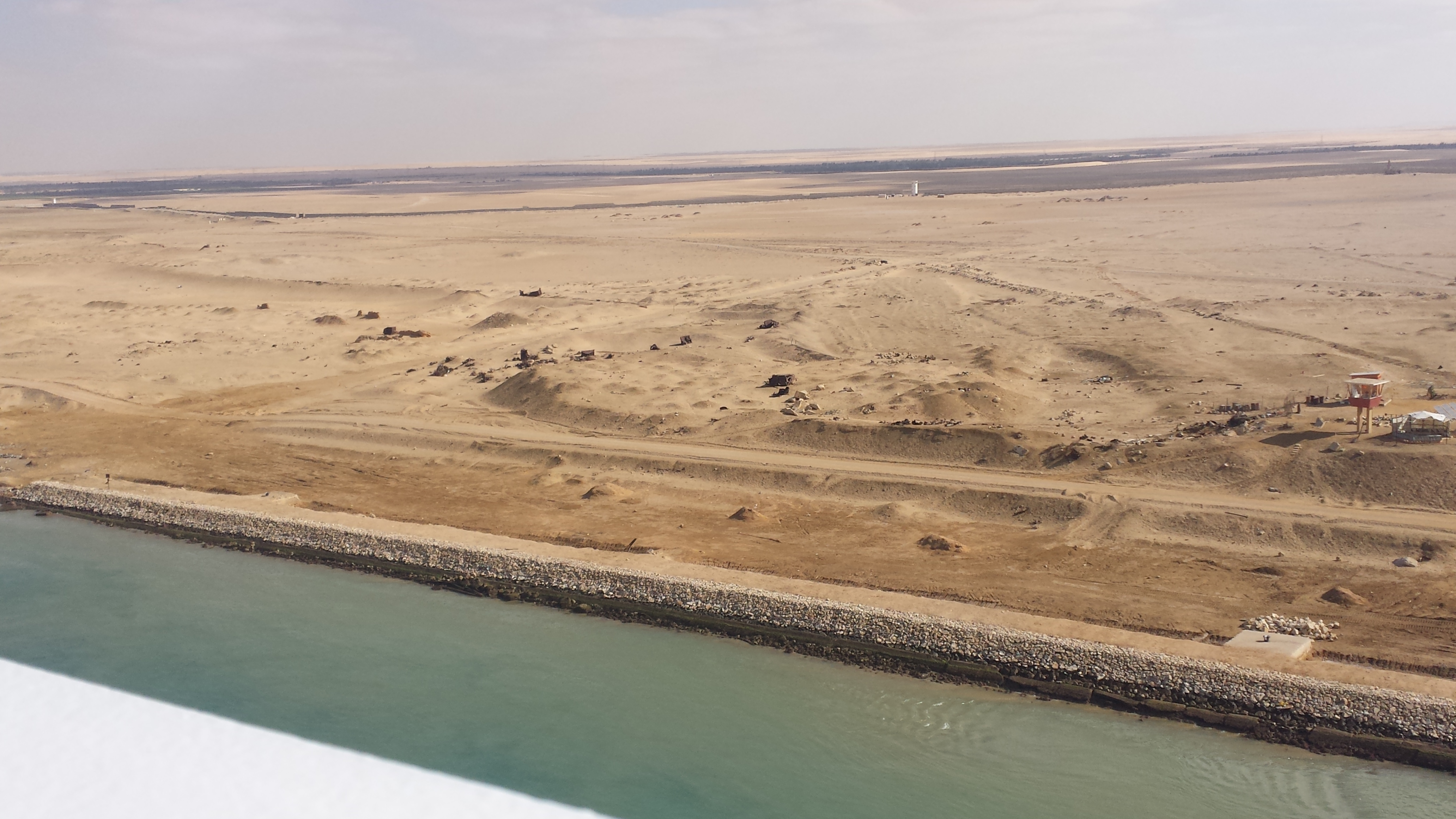
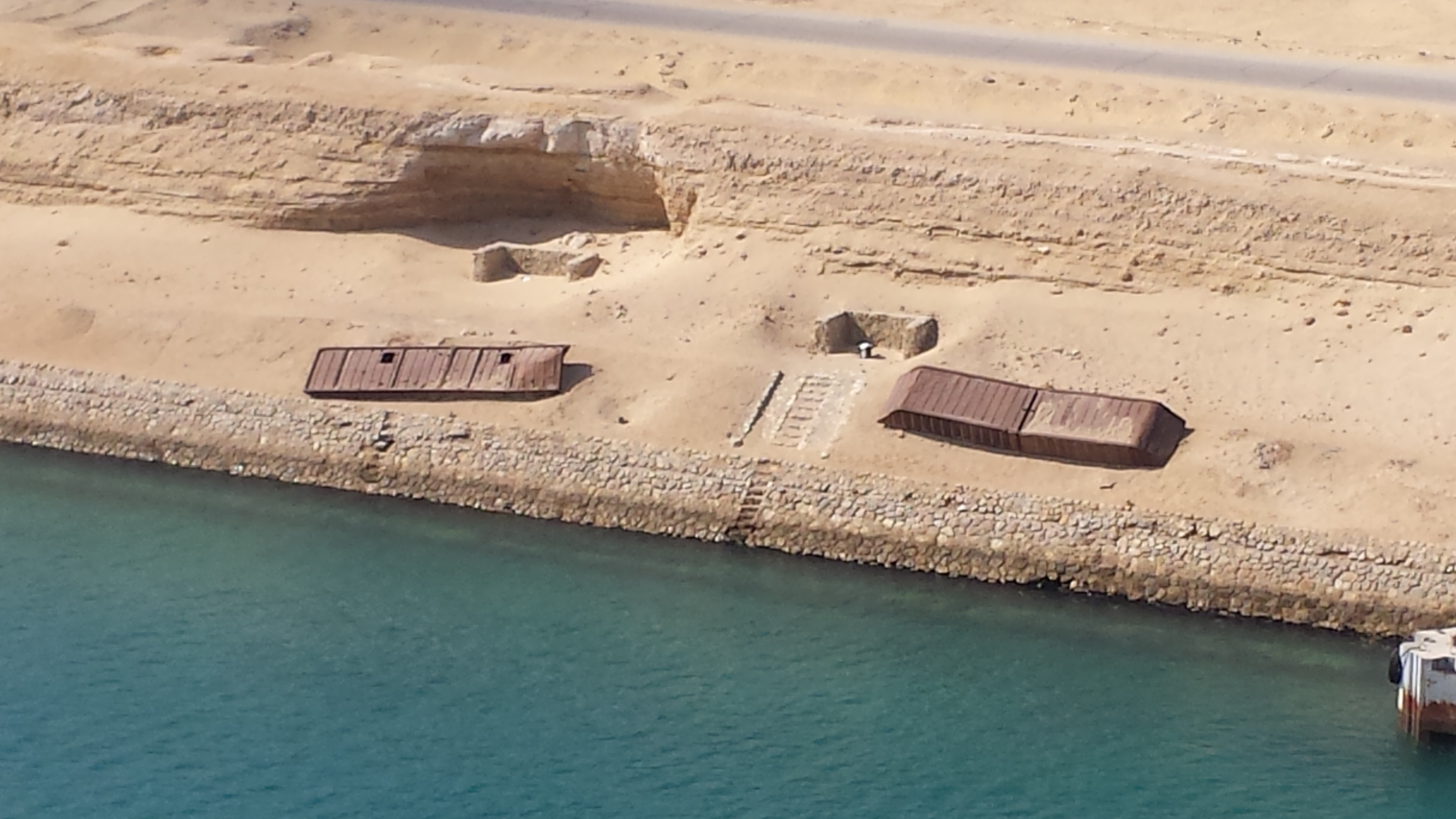
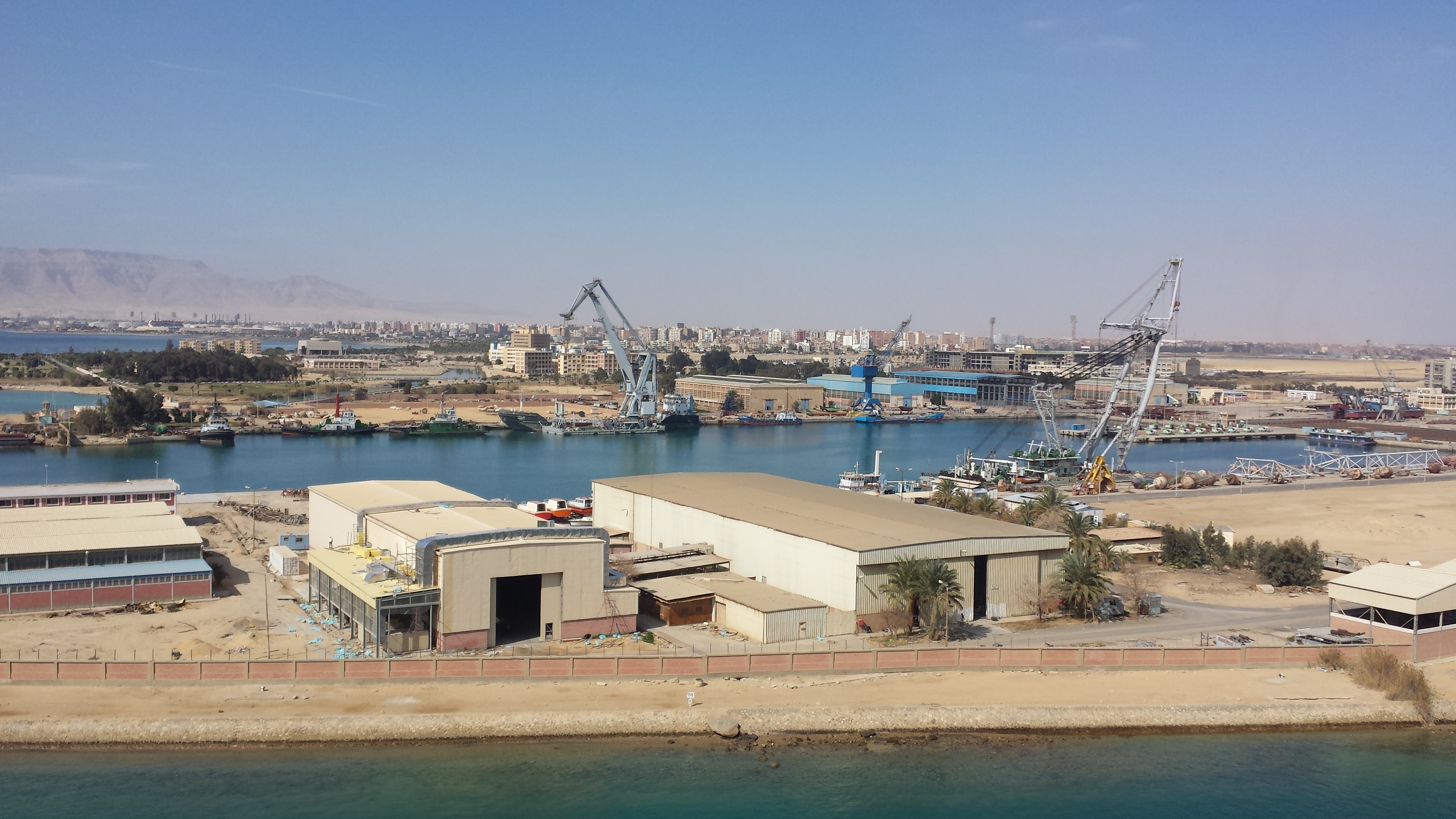
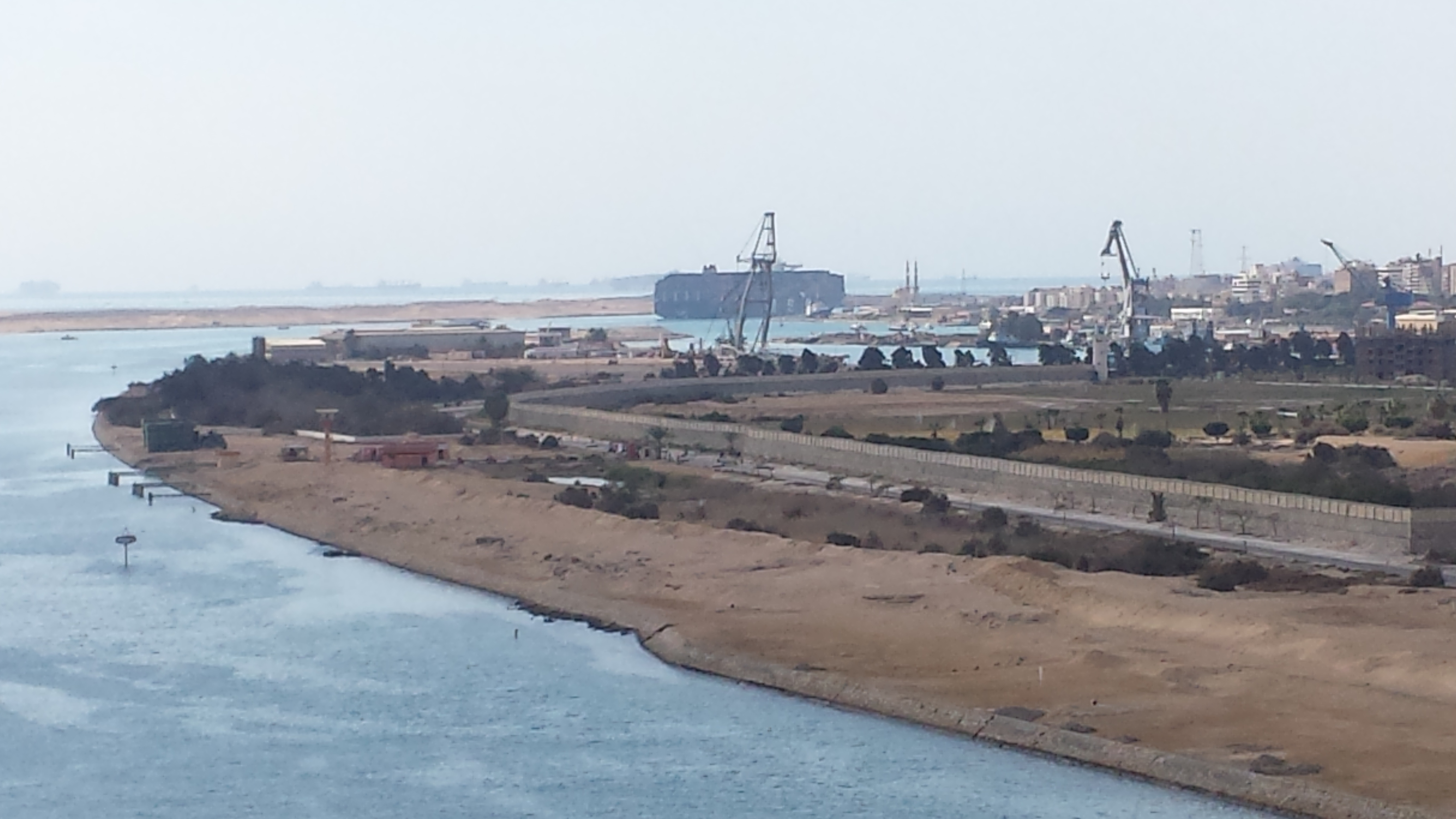
20150208_095437

In the Canal

Sadly, I couldn’t be there when we entered the channel just east of Port Said, one after another, our ship behind the MSC ship we had seen yesterday and ahead of a massive chemicals carrier.   The entry happened at 02.30 and I was then sleeping fitfully drugged with cold medicine for my terribly-timed illness. But I was up at 07.00 and on the bridge.  And discovered yet another ill-timed disaster: my camera’s memory card has been corrupted, and my camera does not have internal memory – which I didn’t know because the camera was new.  So I have had to-for the part of the journey I was most anticipating- use my crappy phone camera which in the sunshine does not focus very well and I have no way of adjusting for shutter speed and aperture and all the other fancy things I was just beginning to learn.  I am, of course, immensely annoyed at myself for not having bought an additional memory card when I bought the tripod in Heathrow.  And now, the tripod and the fancy camera are no use – unless the “slop chest” by some miracle includes memory cards. I can’t even play at imitating Allan Sekula now.

20150208_084936

Steaming in a narrow channel in convoy through the Great Bitter Lake

No matter.  By 08.00 we were in the Great Bitter Lake, traversing a narrow channel in the lake well marked by buoys.  The intensity of the passage is something to behold. The ceremonial feel of the whole process was only a tiny bit relieved by the loud cackle of the two very funny Egyptian pilots who didn’t realise there was someone on the bridge who spoke Arabic. In the last minute, I decided not to reveal myself, worrying that they may think I am some sort of spy (I mean how would they place me?  I am dark haired and a Khalili; they can presume that I am some sort of Israeli spy; or an Iranian one. But I have a British passport; so I can also be a nefarious British spy).  The lovely deck cadet told me that on one of the previous trips he had been on, a journalist whipped out his camera and starting photographing the banks of the canal; the pilots apparently stopped the boat and caused a huge amount of trouble.  It is rather terrifying the ease and comfort with which the citizenry assumes the role of spycatcher as part of its routine.

20150208_100938

Defensive measures: sand berm; high wall. I didn’t dare photograph the manned watchtowers.

What is most striking about the passage is how incredibly militarised the canal’s banks are.  I had visited the canal before at Port Said and didn’t remember how the entirety of the bank on the African side is one long defensive barrier: lofty sand berms; expansive no-man’s-lands; and a high stone wall with watchtowers at very frequent intervals.  And every kilometre or so a small military outpost.  And all these military edifices –appropriately in the yellow, beige, brown colours of desert camouflage– separate the rather preposterously verdant narrow band of settlement –with its sound of car-horns, dogs and donkeys– from the canal, the entirety of the route. There is one particular military pontoon bridge station that has EGYPT PEACE written on the sand berm with stones. Hmm.

20150208_095048

Burnt out military equipment buried in the sand. How old are these ruins?

20150208_104934

Rusty debris of containers (with sniper windows?)

On the Sinai side, things are a lot more forlorn. You still see desolate military outposts and bleak sentry boxes that look like white beehives every kilometre or so, and occasional sand-berms –this, of course, after the Great Bitter Lake. And you also see burnt out hulks of tanks; surely they can’t be the debris of war?  I recall that the canal had been blocked until 1975 by drowned tanks and other military hardware.  I wonder if some of these rusty hulks had been dredged from the canal on its reopening, now forty years ago.  One feels a lot of pathos looking at the skinny conscripts marching to and fro in the sun in the middle of nowhere, holding their weapons to their shoulders: from atop the ship, they look so young and fragile.  And the feeling is intensified when at one outpost, I can clearly see the young soldier not really paying attention to what goes on around him and instead checking something on what I can assume from the glint in the sun to be his phone’s screen.

What is as noteworthy is the Sinai side before the Great Bitter Lake (I love that name!).  The entirety of the Sinai side is one excavated hive of activity with dirt trucks climbing huge hills of earth that has been dug up. The Captain said that until only six months ago, the Sinai side had been a flat and barren plain, and now it is this vast movement of earthworks: the new Suez Canal for which the order of things in the Canal is being disturbed (ignore the laudatory tone of the link; everyone seems to be seduced by Sisi’s new project, including the BBC).  All the ship’s officers were astonished about the speed with which the digging seemed to be happening, and it certainly was an interesting sight to behold.  The flatlands now heaved upside down, the yellow dirt in masses, and the constant movement of trucks away from the hills.  I suppose if a ship our size pays $700,000 to go through the Canal, a two-way canal would facilitate higher earnings.  But then where do these earnings go?

20150208_110410

Port of Suez

20150208_105604

The convoy approaches port of Suez

The arrival at the port of Suez comes too quickly for my taste. I could have stood there watching our procession for so many more hours – this extraordinary circulation of goods through this narrow space in the sunshine.  As we approach Suez, the Suez crew and electrician let down their boat and after some vigorous waving at women they clearly had not expected, they were off.  The pilots, much more phlegmatic about women passengers, also said their goodbyes and went all the way down to the Upper Deck on the port side, where the gangway was let down for them – without a net!  And as the pilot boat came closer and closer to the ship and as the two pilots climbed down precariously, I was a bit worried for the chubby pilot who seemed to go down much more cautiously, precarious step after precarious step, and who needed a bit of help jumping from the gangway to the moving boat, where the skinny pilot had bounded down in a much more sprightly fashion, jumping on the pilot boat unaided.  But rather amazingly, the pilots, not even shod in lifeboats, managed to get off without incident and then we were off in the Bay of Suez – a little after 11.30.

20150208_115326

Navigating on a zigzag route through the ships and a very narrow channel away from the Canal

I would have imagined that was the end of it, but in fact the most breathtaking feat of steering of the ship was to only begin then. I hadn’t quite realised that the only channel deep enough to accommodate a ship with a draught as deep as ours (more than 16 metres) was actually a crooked searoute, a bit like the road through the woods in Hansel and Gretel, treacherously weaving around massive anchored containerships and oil tankers, zigzagging on an invisible road that made no sense, avoiding wrecks (marked on the map) and other hazards not marked on the map.  The officers had to run back and forth to check for the position of the now irregular buoys to ensure that as we turned hard right or hard left through invisible switchbacks we wouldn’t plough through the buoys.
It was only after we had put all the anchored ships behind us, and the road (according to the traces left by the convoy ships ahead of us) seemed a bit more direct that the Captain untucked his uniform shirt and went downstairs to get changed into more casual clothing.


Passing through the Bay of Suez

8 February 2015

20150208_160300

Wellheads on Egyptian coast

Now that we are past Suez, the ship has a Sabbath feel to it.  The ship’s office on the Upper Deck is empty; there is no one working on the decks; and there is some sound coming from the lower deck, but it could just as easily be the noise of goods rolling inside the containers or else the containers groaning.  The ship is going at extraordinary speed – at 100 rpm (what Allan Sekula calls “the speed of an amphetamine-driven human heart”) and 23.5 knots.  For the great majority of the way, we can see both coasts, the African coast of Egypt and the mountains in the cloud and haze of Sinai.  We are closer to the African coast, keeping to a narrow searoute, as we are flanked on both sides by well-heads, shallow waters, and oil fields.

20150208_163436

Ramadan oilfield in the Bay of Suez

I manage to capture the flared gas of the Ramadan oil fields.  There are others; right in the middle of the Bay, and also on the African coast.  Hadn’t quite realised that this was such a major oil production area.

20150208_172014

Looking to the African side of Bay of Suez (I think)

The Bay is very busy earlier in the afternoon with crude and chemical carriers and weighted containerships racing towards the Canal; although if the same schedule as last night is kept, they shall have to anchor and await tomorrow’s early afternoon convoy.  We are followed by loads of boats, but we leave them all behind as silently and determinedly we race towards the Red Sea.

Posted in 2015 Trip, Allan Sekula, Middle East, militaries, readings, transport, Travels | Leave a comment

Une Année Sans Lumiere: Encounters before Suez Canal

7 February 2015

15.00

Last night I was invited by the Filipino crew members to one of the crew members’ birthday party. He is an engine -fitter and he will be turning 40 tomorrow.  The crew recreation room unsurprisingly had a karaoke machine playing soft-rock versions of already soft rock songs. There were big bottles of wine (this isn’t a dry ship after all) and crisps and what looked like Filipino version of torshi.  Most of the people there were crew members, but the Filipino ship’s officer was there, and so was the boson with whom I had the longest chat.  Their karaoke-singing was quite sweet.  Slightly out of tune and with an unapologetically sentimental attachment to soulful saccharine soft rock.  But the accompanying laughter and the clapping and raised-arm waves were raucous, especially by the three younger crew members, all probably born in the late 1980s and possibly even in the 1990s; including the beautiful younger crew member whom I met while on my gander along the upper deck yesterday.

The birthday boy used to work on the QE2 (which was bought by the Dubai royal family and permanently docked in port Rashid) in the same capacity, but apparently working on containerships pays “a little bit” better than cruise-ships.  And he was apparently there when the QE2 was decommissioned and sold off to Dubai.

The boson has been a seafarer for 20 years; and he initially signed up because he wanted to see the world and couldn’t afford to do so otherwise.  Now, he says, he feels like he is “imprisoned” aboard the ship and only when he is home, he is free. He has a 17 year old, a 13 year old, and a 6 year old daughter (apparently he was trying for a son, unsuccessfully), and he is from northern Mindanao.  He said something about the Muslims in southern Mindanao that I thankfully didn’t hear over the sound of the karaoke and the raucous laughter of the youngsters. The boson mentioned that he takes 9 month contracts because thereafter he can take 6-7 months off at home.  He will be home in May and will stay there until January.  I suppose being higher in the hierarchy of the crew gives him privileges that the ordinary crew members do not have. He also mentioned that he Vibers with his young daughter daily.  The crew members have internet access that we passengers are not privy to.

Just as well. I am quite happy in my sense of disconnectedness, and the already shifting feeling of time, with its slower movement, and its markers set by our meals and my own anticipation of my frequent visits to the wheelroom to check the Admiralty charts and chat with whichever officers are on duty. Or to the upper deck with its proximity to the sea and to crew members who are happy to chat. Thus far, there is only the other second officer with his tall dark piratical good looks who has been somewhat reticent; all the other officers and crew members are happy to launch into conversations if you just ask a question – and I have so many questions about what appears on the map; and on the monitors; about the meaning of nautical miles; and the strange markings on the charts; and the day to day and hour by hour activities that go on in the wheelroom, in the engine room,  in the ship’s office, in the ship as a whole.


This morning one of the ship’s officers gave me my safety instructions, including showing me the ship’s citadel –in case of piracy.  It is in a metal cathedral in the ribcage of the ship under the bow, with enormous metal wells through which the ship’s anchors –on port and starboard sides- descend to the seabed.  The citadel is stocked with a kind of emergency toilet, and seats, and blankets and high-energy concentrated meal rations, and water and medicine, and playing cards even.  And a satellite phone connected to some British official entity.

While waiting for the ship’s officer to come down, I talked to the Montenegrin chief officer – he of the massive arms and beautiful sceptical smile.  He is the first to admit that he doesn’t understand why passengers would want to come aboard a containership.  Why not a cruise-ship he asked?  I told him all my reasons: it feels silly to say it is an adventure to someone whose job it is to work aboard this steel behemoth, but he seemed to understand – and he even understood better when I told him about my love of machines and the technological sublime. But not entirely persuaded.  In fact, everytime I mention my love of technology, they all say I must visit the engine room.  So, I will be asking the Captain and the chief engineer for permission to visit the engine room…

When I asked the first mate about different ports, he told me that on previous ships, when they arrive in Jeddah, if there were Muslim Indonesian crew members, they often organised a quick pilgrimage to Mecca whereas other crew members were required to remain shipboard.  He compared this with Israel and arriving in the ports of Ashdod or Haifa, where Muslim crew members can’t disembark, but the Christians often organise quick trips to Jerusalem or Bethlehem.  When I was in the wheelroom and heard over the radio the rather abrupt call from Haifa, I was a bit taken aback.  I suppose we are very close now.


In a few hours, we are going to likely arrive at the waiting area for Suez. I am not quite sure what the deal is at the moment with convoying south in the canal.  Can’t remember if one of the ship’s officers told me that we wait until morning or whether we go through at night.  But I am also beginning to see ships – now that we are hours away from Port Said, and the Admiralty charts warn of well-heads sticking 6 metres above the sea level and of all sorts of other dangers we are to watch for.  The surveys of the seabed were last completed in the 1980s.  I would say new surveys are due, given all the new gasfields discovered in this corner of the sea since then. But also it is fascinating to think of the sea not just as this corpus of water anymore, but as layer upon layer of congealed labour and potential capital.

I have finished Braudel –having cheated and not really read the more tedious histoire événtmentielle and am now skipping my merry way through Capital vol. II, about which I agree with Engels that it reads like a “scientific” (read: technical) manual.  Its beginning is dull and repetitive, having needed editing (but being preserved as prophetic scripture), and at least the earlier part has very little of Marx’s gorgeous, at time coruscating at times corrosive humour, and only occasionally displaying his erudition and vast readings.  But as it goes on, it has flashes of brilliance, and bits that remind one of an extended treatment of Chapter 10 of Grundrisse. I have to confess that I am looking forward to blowing through it so that I can then retire to a leisurely reading of Moby Dick, which promises to be the pleasure of all pleasures.  I have been a bit ill since yesterday, with my throat feeling scratchy and a bit rough.  Hilde has lent me a soft little scarf to wrap around my neck and I have been drinking endless warm teas and hot water with honey, and I have the grand and wonderful sachets of Lemsip in reserve for when the symptoms leave my throat and invade my head or sinuses, or the rest of my body.

I have only just seen my first well-head passing so close.  I can’t be bothered to run to my cabin to get my camera, but its proximity tells me that we are beginning to get closer to that congested heaving southeastern corner of the Mediterranean. I can’t be bothered to get the camera because at this moment, sitting here on the starboard deck, listening to Arcade Fire on my laptop, writing this in the sunshine, with the faint smell of diesel in the air, and the sea a deep blue, except for where the cloud-dappled sunshine makes the skin of the sea look like crumpled silver, I am again flooded by this cataclysm of happiness, of contentedness, of the sense that this, this moment, this ephemeral moment of feeling alive, is that thing I shall carry back with me for all the times that I shall be exhausted, frustrated, wounded, after. But I am also aware that my transcendent moment, secured in leisure, with music and the sea, is also when the 30 crew members are working below deck, above deck, in the various bits of the ship – in danger of burns, falling, fracture, exhaustion, tedium. And this is a “good” ship, flagged to Britain, with unionised seafarers and a captain who seems sympathetic and kind.

And there is me, with my moments of ecstasy, and there is the wellhead, its metal body protruding through the sea, bereft of my metaphysical joy, but instead layered again and again with residues of human labour, of the resources of the earth being drawn up through the crust, through the body of the sea, there in that silvery sea, so utterly lonesome, and yet such a clear marker to centuries, millennia, of humanity devouring itself.  Perhaps it is time for a walk on the upper deck.


7 February 2015

21.00

We are in a sea of ships at anchor in the darkness.  If ordinarily the merchant vessels travel at night only lit by a scant few lights to make them visible upon the “brooding darkness on the face of the deep” (in Melville’s words), tonight they are ablaze with lights along their lengths and with spotlights atop their bridge, more than a dozen of them, maybe even two dozen of them, awaiting the signal to go through Suez.  It is hard to tell if the string of lights to our starboard is the lights of Port Said or the lights of dozens of ships at anchor.  We are in the Northern Anchorage Zone for ships with draughts deeper than 12.8 metres.  There are still two other anchorage zones further south of us; and looking at those Admiralty charts (again!) it seems like the mouth of Suez Canal at Port Said is unbelievably shallow.  There are in fact dredged channels of about 20-something metres deep we have to go through. Otherwise, I can see us getting grounded on depths of less than 15 metres; some little expanses as low as 12 metres.

Already by 15.00 it was obvious that as we were rushing to the southeastern corner of the Mediterranean, that we were no longer alone in the sea. We passed a couple of bulk carriers, and a Maersk ship kept up with us on our portside until much later when it sped in front of us in our lane. And a massive MSC ship sped alongside us for a while until it fell back and got in our lane.  Rushing towards Suez seems to be a thing you have to do. The tradition of Suez (which has been disturbed, about which more below) requires that if you miss the convoy in the evening you will have to wait for the next day; and of course this can cost your ship a great deal of money, and so ships rush to arrive at the “qualification line” before 17.00.  We passed a warship of a sort that looked like it had been built from dark and light grey Lego.   It had no flag or other discernible markings and the officers mentioned that “military ships never give you any data.”  Certainly this one floated there slowly and anonymously and we soon overtook it.  Its only marking was L801 on its forward hull, which I shall have to look up when I have access to internet.

From about 16.00, the captain and a number of other officers all arrive in the wheelroom. It is the busiest I have seen it there.  There are two able seamen at watch; and a number of officers; including the second engineer who is off-duty and comes to watch the arrival at Suez. The activity is extraordinary. The radios are all going and the range of different accents calling “Port Said Port Control” – and asking for either passage or anchorage permission.  And the irate though efficient Arabic-accented English of Port Said port controllers (some of them women) directing the ships hither and tither.  There were a few of the ships that got quite a few pro forma questions from the Port Said Port Control: maximum and minimum speed; length; draught and cargo.  One particularly crystalline-voiced American captain had a cargo of wheat.  Another had a dangerous cargo of category 3.  Around 2.5 tonnes of it, whatever it was.  One was going to Aqaba; one had just come from Gibraltar.

By 18.30 the ship had dropped anchor – so silent and still that we didn’t feel it at dinner.  We are now gently swaying on the water, with our bow shifting slightly in the surprisingly strong cold wind.  We are there with a lot of very large containerships, the biggest “our sister ship” in size, a Hapag-Lloyd ship I think.  I don’t know when we will move again and although Hilde, my co-traveller, plans on waking up at mid-night to see if we have moved- I think I am a bit too ill to actually do the same.  I have just had my Lemsip and will soon crash and hope that when I wake in daylight that we will be crossing through Suez.

They tell me that before the works General Sisi’s government has undertaken at Suez in his fantasy of being a second Nasser, there used to be a clear schedule of passage: you arrived by 17.00; by 21.00 the convoy of ships would enter the canal southbound; would arrive at the Great Bitter Lake at some point in the middle of the night and anchor there, while the northbound convoy crossed and headed out to the Mediterranean. Then the southbound convoy would heave anchor and would be out of the canal by 13.00 the next day.  Not so now.  Now, they have to wait for vast northbound convoys to come out before they can go in and then 17 hours through the canal.  The officer on duty called up CMA CGM Magellan which is heading northbound at around 19.30 and they said that they still had another 30km to go in the canal.

When we are in convoy, we will be boarded by 2 or 3 Suez pilots who hand over to 2 other pilots just before the Great Bitter Lake, 3 or 4 crew members and an electrician.  The crew members are there should we need to be moored.  The electrician to plug in a spotlight.  The pilots to pilot us through the canal.  They all apparently bring onboard souvenirs and SIM cards and various other necessities: the informal economy working alongside, hand-in-hand with, the formal state-controlled economy. As much as I want to chat with them, I am also a bit apprehensive about the heightened “security” in Egypt and hesitate to reveal that I can actually understand Arabic while onboard a massive cargo ship going through the strategic Suez Canal.


Posted in 2015 Trip, labour, Middle East, militaries, the sea, Travels | Leave a comment

Peace Frog: Conquest by infrastructure

6 February 2015

I have to admit that I prefer Braudel’s longue durée over his histoire événtmentielle: Perhaps his influence runs through all the great historical accounts written since 1949, where explanations and theoretical framings are comfortably married to historiographic detail, but his eventful histories tend to be boring “one thing after another” accounts.  Not so his fabulous long-duration history which ends with this extraordinary reflection on war:

One war replaces another.  So when we say that war in the Mediterranean came to an end in 1574, we should make it clear which kind of war we mean.  Regular war, maintained at great expense by the authoritarian expansion of major states, yes, that certainly came to an end. But the living materials of that war, the men who could no longer be kept in the war fleets by what had become inadequate rewards and wages.  Sailors from the galleys, even sometimes the galleys themselves, deserting from the fleet, soldiers, or those who would normally have been soldiers, adventurers of large or small ambition were all absorbed into the undeclared war which now ranged on land and sea. One form of war was replacing another. Official war, sophisticated, modern and costly, now moved into northern Europe, and the Mediterranean was left with its secondary, minor forms. Its societies, economies and civilizations had to adapt as best they could to what was on land guerrilla warfare, on sea warfare by piracy.  And this war was to absorb much of their energy, regrets, bad consciences, vengeance and reprisals.  Brigandage subsumed as it were the energies of a social war which never surfaced. Piracy consumed the passions that would in other times have gone into a crusade or Jihad; no one apart from madmen and saints were now interested in either of these.

[…]

Having come this far, we are forced to a pessimistic conclusion. If the history of human aggression in the Mediterranean in the sixteenth century is neither fictitious nor illusory, war in its metamorphoses, revivals, Protean disguises and degenerate forms, reasserts is perennial nature: its red lines did not all break at once. Bellum omnium pater, the old adage was familiar to the men of the sixteenth century. War, the begetter of all things, the creature of all things, the river with a thousand sources, the sea without a shore: begetter of all things except peace, so ardently longed for, so rarely attained (pp. 890-1).

Earlier, Braudel tells of another form conquest can take:

Military victory was followed by another, more leisurely conquest: the construction of roads and fortified posts, the organization of camel trains, the setting in motion of all the supply and transport convoys … and finally, most important of all, that conquest which operated through these towns which the Turks had subdued, fortified or built. These now became major centres of diffusion of Turkish civilization: they calmed, domesticated and tamed at least the conquered regions, where it must not be imagined that an atmosphere of constant violence reigned (p. 665).

It is perhaps ironic to think of this as “conquest by infrastructure.”

Posted in 2015 Trip, infrastructure, logistics, militaries, readings, war | Leave a comment