Pop Containerization

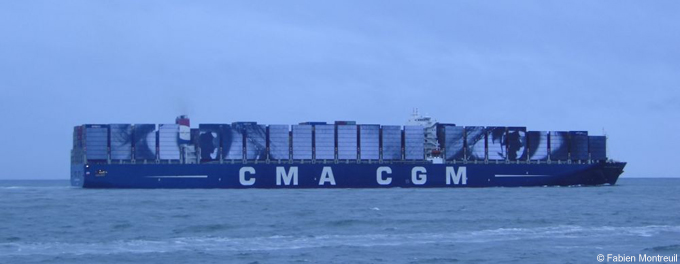
CMA CGM MagellanSo, not long ago, a graffiti artist, JR Artist, who flyposted a whole bunch of CMA CGM containers so that CMA CGM Magellan looked like this (at least until the next port where the containers had to be unloaded; I also wonder if they weren’t unloaded in the intermediate ports, what hell the crane operators must have gone through to make sure the ship remained upright):

Of  course CMA CGM was very happy to oblige this particular work of graffiti/flyposting.

Now, the fascination with containers and containerships shows up in this video.  I don’t know who Tinashe is (or I didn’t before reading her Wikipedia entry), but something about the regularity of the containers makes them very photogenic:

P.S. Title for the post and Tinashe video courtesy of Alberto!

Posted in capital accumulation, ships | Leave a comment

Comparing Experiences

Charmaine Chua and I both took containerships roughly at the same time.  She was much more involved: her trip took longer, on a different route, and she worked onboard.  We talk about our experiences over at the Disorder of Things blog.

Posted in Travels | 1 Comment

The unbearable deaths of thousands in the deep

And yet these unbearable deaths are borne by those who turn away.  As I am left mute with horror, I shall post these poems which I think speak to the deaths of so many in this watery graveyard:

from Salt
By Nayyirah Waheed

you broke the ocean in
half to be here.
only to meet nothing that wants you.

– immigrant

Look We Have Coming to Dover
By Daljit Nagra

‘So various, so beautiful, so new…’
– Matthew Arnold, ‘Dover Beach’

Stowed in the sea to invade
the lash alfresco of a diesel-breeze
ratcheting speed into the tide, with brunt
gobfuls of surf phlegmed by cushy come-and-go
tourists prow’d on the cruisers, lording the ministered waves.

Seagull and shoal life
Vexin their blarnies upon our huddled
camouflage past the vast crumble of scummed
cliffs, scramming on mulch as thunder unbladders
yobbish rain and wind on our escape, hutched in a Bedford van.

Seasons or years we reap
inland, unclocked by the national eye
or stab in the back, teemed for breathing
sweeps of grass through the whistling asthma of parks,
burdened, ennobled, poling sparks across pylon and pylon.

Swarms of us, grafting in
the black within shot of the moon’s
spotlight, banking on the miracle of sun –
span its rainbow, passport us to life. Only then
can it be human to hoick ourselves, bare-faced for the clear.

Imagine my love and I,
our sundry others, Blair’d in the cash
of our beeswax’d cars, our crash clothes, free,
we raise our charged glasses over unparasol’d tables
East, babbling our lingoes, flecked by the chalk of Britannia!

Posted in empire, literature, shipping conditions, the sea | Leave a comment

Silt

Silt
Stephen Burt

Things you know but can’t say,
the sort of things, or propositions
that build up week after week at the end of the day,

& have to be dredged
by the practical operators so that their grosser cargo
& barges & boxy schedules can stay.

The great shovels and beaks and the rolling gantries
of Long Beach, and of Elizabeth, New Jersey,
can keep their high and rigorous distinction
between on-time and late, between work and play.

“Since you excluded me, I will represent you,
not meanly but generously, with an attention
that is itself

a revenge, since it shows that I know you

better than you have ever known yourselves,

that if I could never have learned
how to be you, nor how to be
somebody you’d like to be very near, nevertheless

you could not do without me, or keep me away.”

Stephen Burt explains the poem like this:
“I was thinking about the commercial ports and harbors that have to be dredged so that they can stay commercially viable, and thinking that they resemble the mind, which fills up—as we grow up—both with practical information of no lasting resonance (timing for school closings, doctor’s appointments, when to get your car inspected) and with things you realize—about yourself and about other people—that you can’t say out loud; they’d offend, or make other people feel terrible, or make you look like a hypocrite, or require way more time to explain than other people ever have in an informal setting.

These two kinds of things—practical data and unsayable truths—might gradually fill up the minds of adults, making us like old ports that have to be dredged. Or like new ports, which also have to be dredged: like container ports—like the Port of Elizabeth, New Jersey, which we used to drive past, or the Port of Oakland, which if I recall correctly inspired the AT-AT walkers in The Empire Strikes Back.

These ports and their machines decide what comes into the country and what can’t be brought in; and what if the excluded, the never-unloaded, the dredged-away, had a better view of us than we have of ourselves? If you’ve already been excluded, you don’t have to worry about social proprieties, about not telling the truths that will get you kicked out (because you’ve already been kicked out): that’s not a new insight (it’s a variation on the idea I vaguely associate with Hegel—the slave knows the master; the master does not know the slave) but I hope I’ve made it at least a bit new in this poem, which (like most of what I’ve written lately) has one foot in gossip and youth (it’s a poem about mean girls) and another in the peculiar restrictions of adult lives.”

Hat tip to Charmaine Chua for sharing the poem!

Posted in environment, literature, ports, readings | Leave a comment

Somali Piracy

This really is the best journalism about Somali piracy I have read.  It is immensely sympathetic to the ordinary crewmen, many often belonging to the global South, who are the victims of the piracy.  But it also shows the extent to which piracy itself is today a form of enterprise; with wage workers who are starving former fishermen, investors, accountants, negotiators and the like.  Structures of exploitation and violence:

http://www.newyorker.com/magazine/2015/04/20/escape-or-die

Posted in capital accumulation, labour, Middle East, piracy, political economy, shipping conditions | Leave a comment

Container Spotting

Here is an account of an interesting obsession with containers…  I wonder what Allan Sekula would have made of this love of the technological sublime:

http://www.ediblegeography.com/container-spotting/

There are still many unanswered mysteries that the duo hopes to get to the bottom of in their research. Where are containers born? (Cannon pointed me to this video of a Chinese factory, which we both recommend watching on mute.) Can you tell the age of a container from its exterior? (Discontinued logos such as the MOL alligator provide one clue.) How many containers lie at the bottom of the ocean? Are there container hospitals, or do damaged ones just get scrapped?

Posted in Uncategorized | Leave a comment

Playing with trains in the sand: reflections on the MENA Cargo show

GUEST POST BY R.Z.

Having spent the last couple of years researching Private Military and Security Companies (PMSCs), attending their industry gatherings and military expos, I was very excited to shift gears to a new project and curious what differences I would find in the world of Middle East logistics.  On 17-18 March I attended the Middle East and North Africa Cargo show purported to be “the biggest logistics and transport infrastructure event in the Middle East and North Africa”. It was held in one of the massive halls in the Dubai World Trade Centre and organised in partnership with the United Arab Emirates National Transport Authority with a tag line of “improving efficiency and supply chain management for cargo owners and movers”.

The Cargo Show was co-located with the Middle East rail exhibition, thus a main focus was on the boom in rail and metro construction across the Gulf Cooperation Council (GCC).  Aside from passenger metro line construction across the GCC, a major railway project is underway meant to link 6 countries of the GCC running from Kuwait to Oman. At the moment GCC states are independently developing their sections of the rail line (at different stages), but roundtables with government spokespeople at the Cargo Show emphasized that negotiations at the GCC level about harmonizing borders and customs are finalized and will be managed to ensure “efficient” transport. The rail line does not stand alone of course, but is connected to both ports and airports ensuring “seamless logistics” flows throughout the region. There is much to be said for studying the state of GCC integration through the logistics sector.

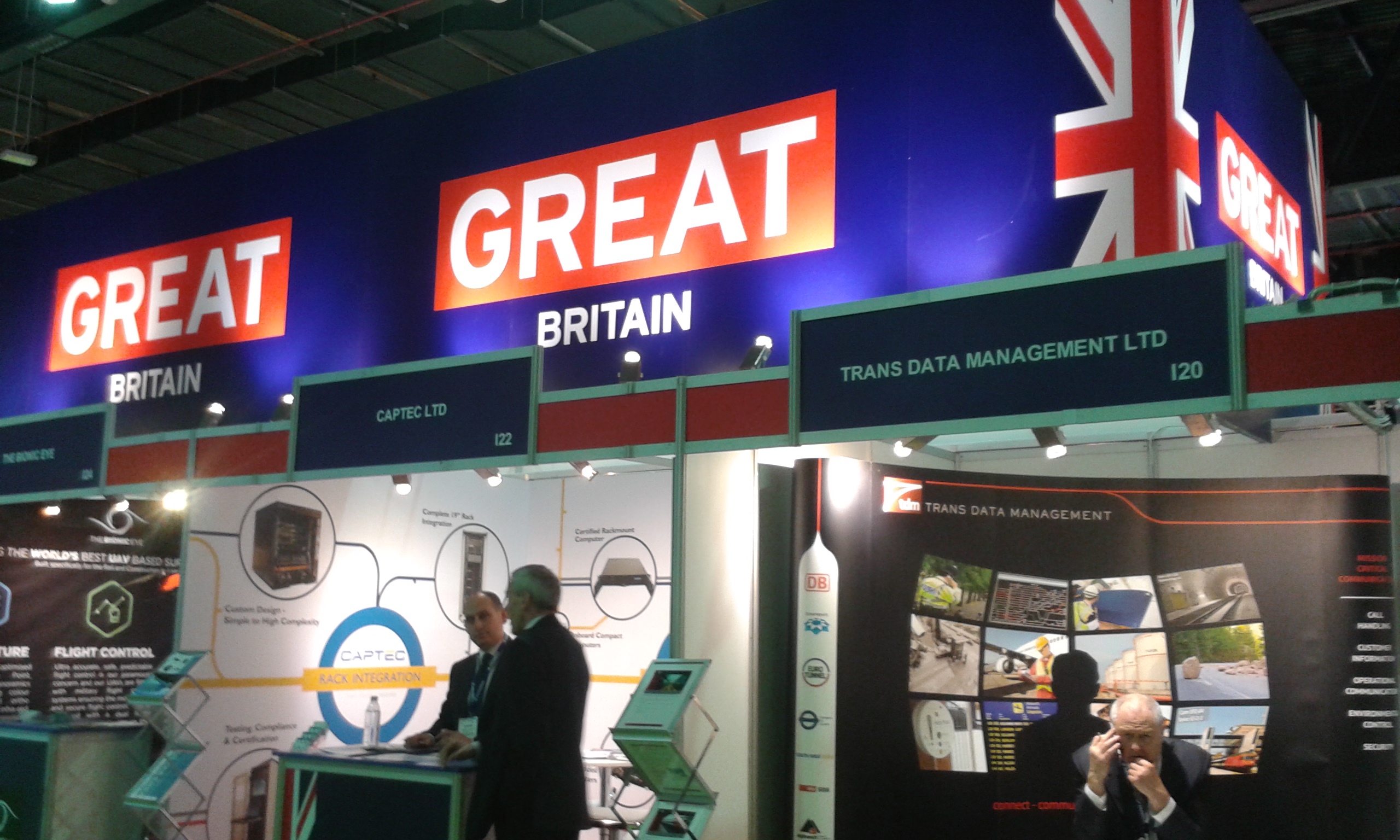
Like most corporate exhibits, the overpowering lights and studied smiles are difficult to adjust to. The first thing that struck me when entering the exhibition hall was how this could have easily been a military companies exhibition. 20150318_155238The familiar names were all there: Thales, Bombardier and Serco, but rather than model military equipment, the models were of trains.  Surveillance and tracking equipment featured heavily in a number of the stalls with an emphasis on keeping freight and passenger safety. One company explained how it had provided the Chicago Transit Authority with “IP video transmission, management, recording and storage system that allows operators to view and control cameras during daily operations”.

PMSC exhibitions always boast images glorifying the contractors themselves, in full military gear peering out in self –assured confidence ready to take aim. In contrast, this logistics conference featured very few human images, apart from those of masses of passengers. Portrayal of labour was entirely absent – despite the fact that thousands of workers will be involved in laying hundreds of kilometres of rail track in mainly desert areas. Not a single session of the 20 I attended mentioned who would build the tracks or who would maintain them. The two recruitment companies present were looking for high skill management positions “mainly from Europe” the young man at the stall told me. This was a world of machinery and navy blue executive suits.

20150318_155300But the machinery certainly had a nationality. The British stalls were the most emphatic about showing it off with big Union Jacks and Great Britain emblazed everywhere. Other European countries like Italy and Spain were more discrete in the imagery, but their talks emphasized the origin and repeatedly stressed “quality of our products” while casually pointing to the Chinese company stalls. While the larger US brands emphasized their efficiency, the European brands emphasized their legacy in “having rail for very long”. It truly felt like a microcosm of international political economy: all international corporations ready to cash in, Chinese companies solidly competing, Spain and Italy wanting a piece of the pie.20150318_155419

Aside from the corporate stalls, there was a series of talks in two major halls and five smaller stages sponsored by corporations. The stages were: technology, infrastructure, maintenance and Cargo 1 & 2 which focused on “integrated supply chain management” and included speakers from the Logistics Integrated WLL, Jumbo Electronics, APL Logistics UAE, Milaha Maritime, Aujan Coca Cola and Google among others.

In the non-rail sections of the exhibition floor, logistics companies and ports took up most of the space. Representatives from Oman’s Sohar port and free zone shared their vision to make “Sohar port the main gateway” to the GCC, noting that Sohar will be the starting point for the GCC rail line as well.  The presentation on Saudi rail was fascinating. The speaker from the operations unit of Saudi Rail described in detail the heavy industrial cargo transported from industrial cities on the new South / North tracks, also underscoring the connection to ports. Automation was a big topic of discussion in most sessions with long technical explanations about the virtues of driverless trains.

Most of the logistics companies present operated out of Dubai’s Jebel Ali port and stressed their ability to deal with the new challenges of e-commerce in the region. Their sessions, however, consisted mainly of company marketing speak highlighting the new boom in the logistics market in the region and why they want to lead it, rather than giving any detailed information.  It was interesting though to hear specific mantras repeated throughout: “this region is a growing logistics hub” and the “customer nowadays needs more of us and wants everything fast”.

The makeup of the space itself, much like PMSCs exhibitions, was hyper masculine. The only women present were serving food, ushering or modelling at the exhibits. When I asked any of them questions beyond the most obvious about the company, they referred me to a male engineer or marketing executive.  At 19 of the sessions I was the only woman in the room.

On a final note, it was very clear that Dubai city itself is regarded as the model to aspire to in the logistics sector, but also to go beyond. This could have been a factor of the exhibit being held in Dubai, but certainly most speakers idealized Jebel Ali container port and all wanted to draw lessons from Itihad rail. It is very fitting that my journey into the world of GCC logistics started in Dubai, but also very fitting that I enter it after two years of practice in PMSCs industry exhibitions – the two worlds certainly more than intersect.

Posted in capital accumulation, finance and insurance, infrastructure, logistics, Middle East, militaries, political economy | Leave a comment

Sinews of War and Trade

And here is my inaugural address on the Sinews of War and Trade (it might look like it is Gilbert Achcar, but it is actually my video!):

Posted in Uncategorized | Leave a comment

On how internet infrastructures follow marine transport

Leopold Lambert’s brilliant blog has a new entry about the submarine internet structure. It is well worth a careful peruse, especially because of its brilliant maps. It also contains loads of fascinating insight:

A particularity of this [submarine cable] network is that it tends to reproduce the existing territorial organization of maritime ports, rather than invent new ones, although we can notice some exceptions however, the Emirate of Fujairah, for instance, appears to be a major connection point between Europe, the Middle East and Asia, despite being a relatively small city/region (152,000 inhabitants). This leads us to the specific region of the Middle East and, in particular the Suez Canal that appears as being as important in its digital communication than it has been and continues to be for fret transportation. The same can be said (although to a lesser degree) about the Straight of Hormuz that remains a determining strategic corridor of water between Iran, Oman and the United Arab Emirates.

On January 27, 2011, Hosni Mubarak’s government ordered the five Egyptian Internet providers to shut down the totality of the network on the Egyptian territory, following three days of massive protests around the country that will eventually force him to step down two weeks later. This shutdown did not seem to affect the countries for which Suez is a relay — it seems that it did not even affect the Egyptian stock exchange’s network, even though the latter closed on the 27th, only to reopen two months later. However, these countries have been strongly affected twice in2008 and in 2011, when damages to the submarine cables (FLAG FEA, GO-1, SEA-ME-WE 3, and SEA-ME-WE 4) successively near Alexandria and in the Suez Canal itself significantly decreased the internet efficiency of about 100 million people in Middle Eastern and Asian countries. In a text entitled “Internet est maritime : les enjeux des câbles sous-marins,” (Internet Is Maritime: The Submarine Cables at Stake, in Revue internationale et stratégique 3/2014), Armand Colin describes how some countries rely on the fragility of their own network to ensure the ability to control it. Syria, for example, only has one point of entry, in Tartus, for the four submarine Internet cables that connect it to the world. In November 2012 and May 2013, the country experienced several days of shutdown, which was suspected to be of the Assad government’s doing in its handling of the civil war.


Posted in infrastructure, Middle East | Leave a comment

Arrival

15 February 2015

16.00

DSC00090

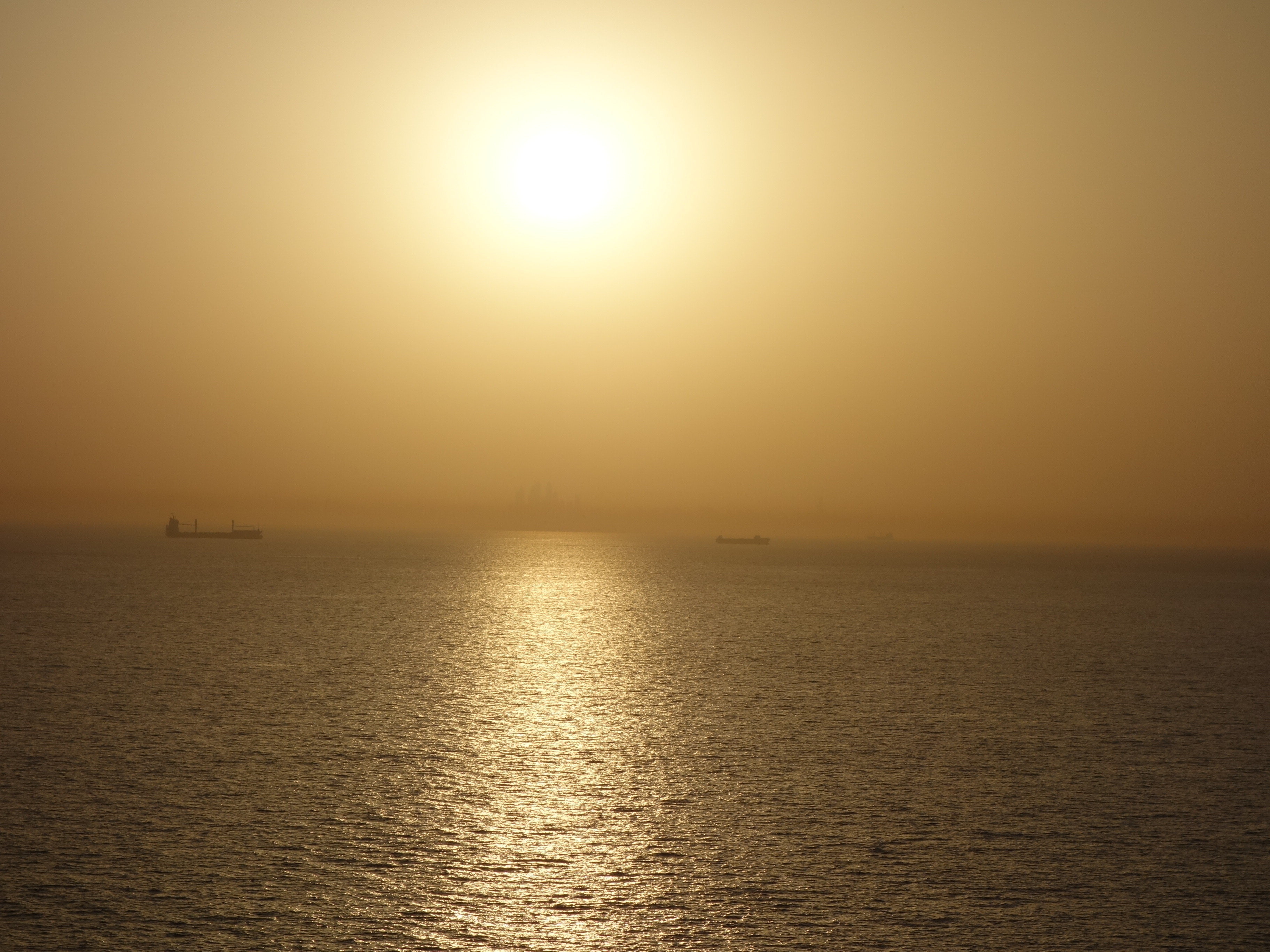
Sunrise over Dubai

We have arrived too soon, because of steaming at high speed through the Red Sea, the Gulf of Aden and the Arabian Sea, in order for the ship to make it to Ningbo for an earlier slot that has come free, but now the slot has been given up for Chinese New Year and the ship is no longer in a hurry. But I have nevertheless arrived a couple of days earlier than expected, to my regret. And yet, I may not be able to make landfall, as we are at anchor, have been at anchor since 07.17, some miles off the coast, awaiting a berth at Jabal Ali.  We are tantalisingly close, so close that you could see Dubai at dawn, but too far to be able to send messages.  When the sun rose and before the haze and humidity and pollution at the horizon became too impenetrable, we could actually see the towers of Dubai rising out of the mist. Now we sit at anchorage with a half dozen other containerships, some of them very large ones, and a few tankers and bulk carriers too.

What is astonishing about the Persian Gulf, and what I had not quite realised, and what is perhaps the response to my question about constraints is how unbelievably shallow it is.  Our ship’s draft is between 15 and 16 metres.  There are places not too far from where we are anchored where the depth of the sea is only 12 metres, and we would run aground if we happen upon them.  In fact, the entrance to Jabal Ali seems to be a dredged channel of around 18 or 20 metres of depth, the surrounds of which are shallow waters.  And the water seems treacherous in other ways too: there are shoals, sandbanks, that the Admiralty charts warn in their poetic admonishment, “could shift with the Shamals (northwestern winds).”  All entrances to all ports on this side are narrow channels. And the place seems to be a battleground between ships and marine oil and gas fields and oil and gas terminals.
DSC00061

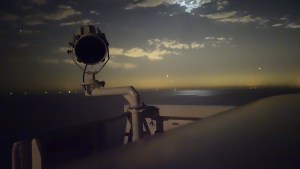
Waiting at anchor just before dawn

I woke up very early this morning –around 04.00- in anticipation of arrival.  The wheelroom was still dark at 05.00 when I finally made it up there, but not silent. The radio was constantly cackling, and people were having strange conversations and making strange sounds under the cover of darkness. One man said to the other on the radio “But you are not my brother?” Another complained in Farsi, “Nakhoda, canal bedeh sohbat konim digeh.” The strangest one was this partly ghostly partly hilarious deep-voiced man who was mooing like a cow.  As soon as the sun rose, though, the conversations became more business-like and the lonely madness of the dialogues in darkness subsided.


16 February 2015

In Jabal Ali port, Dubai

Having now arrived in Jabal Ali, I have to say I have now become jaded as I wished.  Now, what I see is no longer the glory (although I still get a thrill from the sheer epic size of the cranes), but the work that goes on here.  More below on this:

DSC00094

Ships at anchor at dawn

Again awake at 04.30 in anticipation of arrival in Jabal Ali, only to be told that there had been a delay; although the shipping agent mentioned that a berth had been secured for 09.00.  At 08.00, once the third officer called Jabal Ali Port Control again, he was told that all cargo operation had seized in the port because of localised dense fog and no visibility.  I went back to bed to take a short and restless nap, and when I came back up to the wheelroom at 9.30, they had received an all-clear, told that a pilot was on the way (who eventually arrived two hours later at 11.30) and had started the engine.  The captain had previously mentioned that it takes a minute or minute and a half per each revolution of the engine; and so getting the engine to whatever rpm needed (to slow down or speed up) takes a lot longer than it would with other kinds of combustion engine.

It seemed to me, as we floated along with 13 other ships in the hazy polluted warm sea with the lovely warm southern breeze blowing, that for such an enormous port, the biggest in the Middle East, the operations at Jabal Ali were a bit shambolic: change of ETA time at berth several times over, sometimes far too late to be implementable; far too little information given; far too much congestion; one captain registering a complaint on the radio about his pilot; and the story of having to wait 4 or 5 hours for a pilot at another time; and Jabal Ali perhaps far too confident of its own importance to have to worry about all of this.

As I stood there in the dark at anchor with the officer, we listened to the radio, and again, it was the madness of radio exchanges under the concealment of darkness.  One Iranian telling another one “Khorram, Khorram, bandari begzar.” And the conversations between another two Iranian ships surreal with their overabundance of ta’arof and polite niceties. Another man on watch in a lonely wheelroom howling into the radio. A third using the VHF channel to listen to terrible soft rock sentimental music. The officer said that sometimes these tankers remained at anchor for long periods and when they did, the people keeping watch at night went slightly mad with the tedium of waiting.

As we await the pilot to arrive, the anchors aweigh and then at home, the engine gently revving up and the ship drifting quietly, there is a companionable discussion between the Captain, the Chief, and the second mate about the price of property in Croatia, Montenegro and the Philippines.

DSC00126

Jabal Ali Port

DSC00120

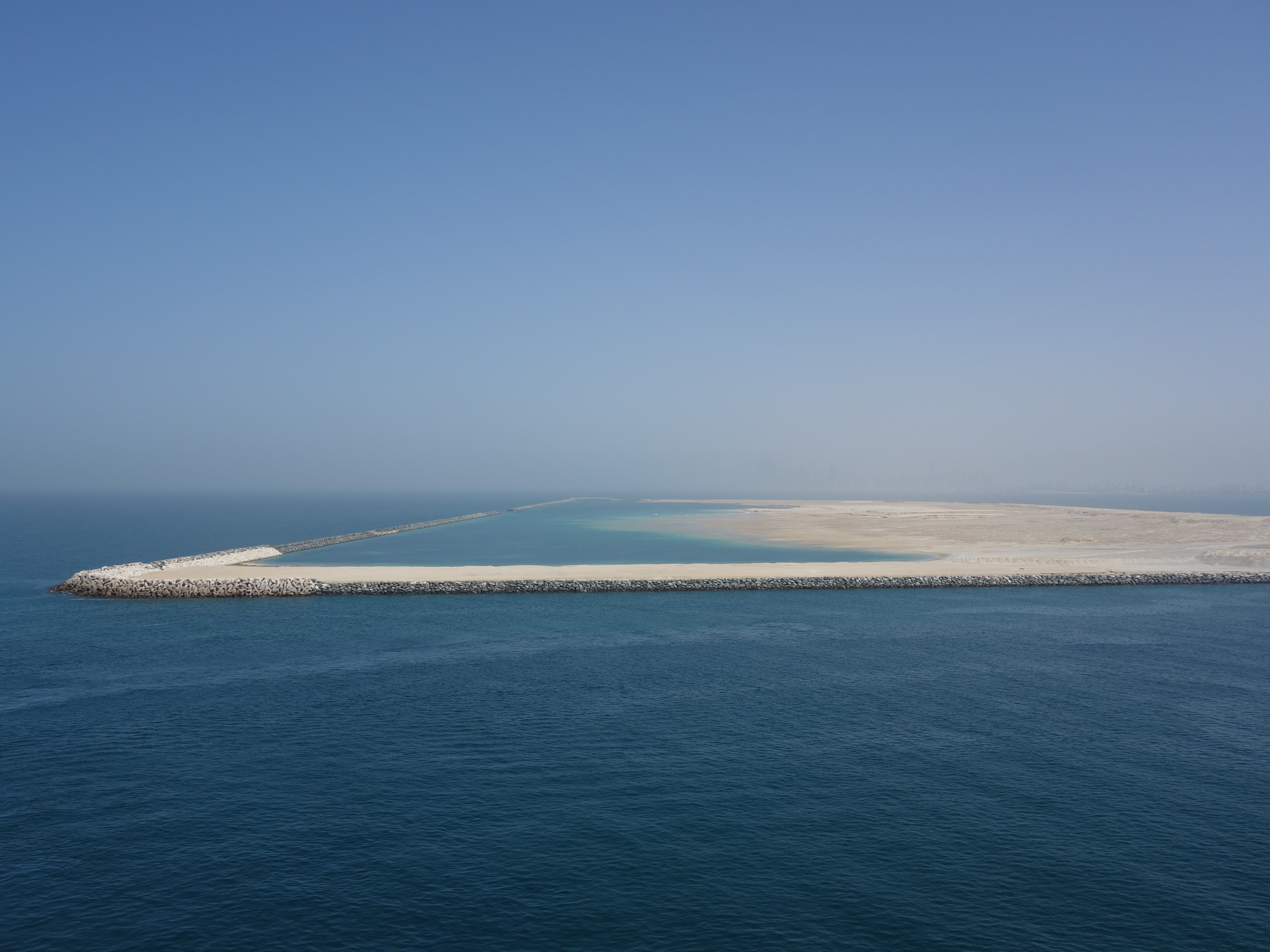
The Megamax project, Jabal Ali

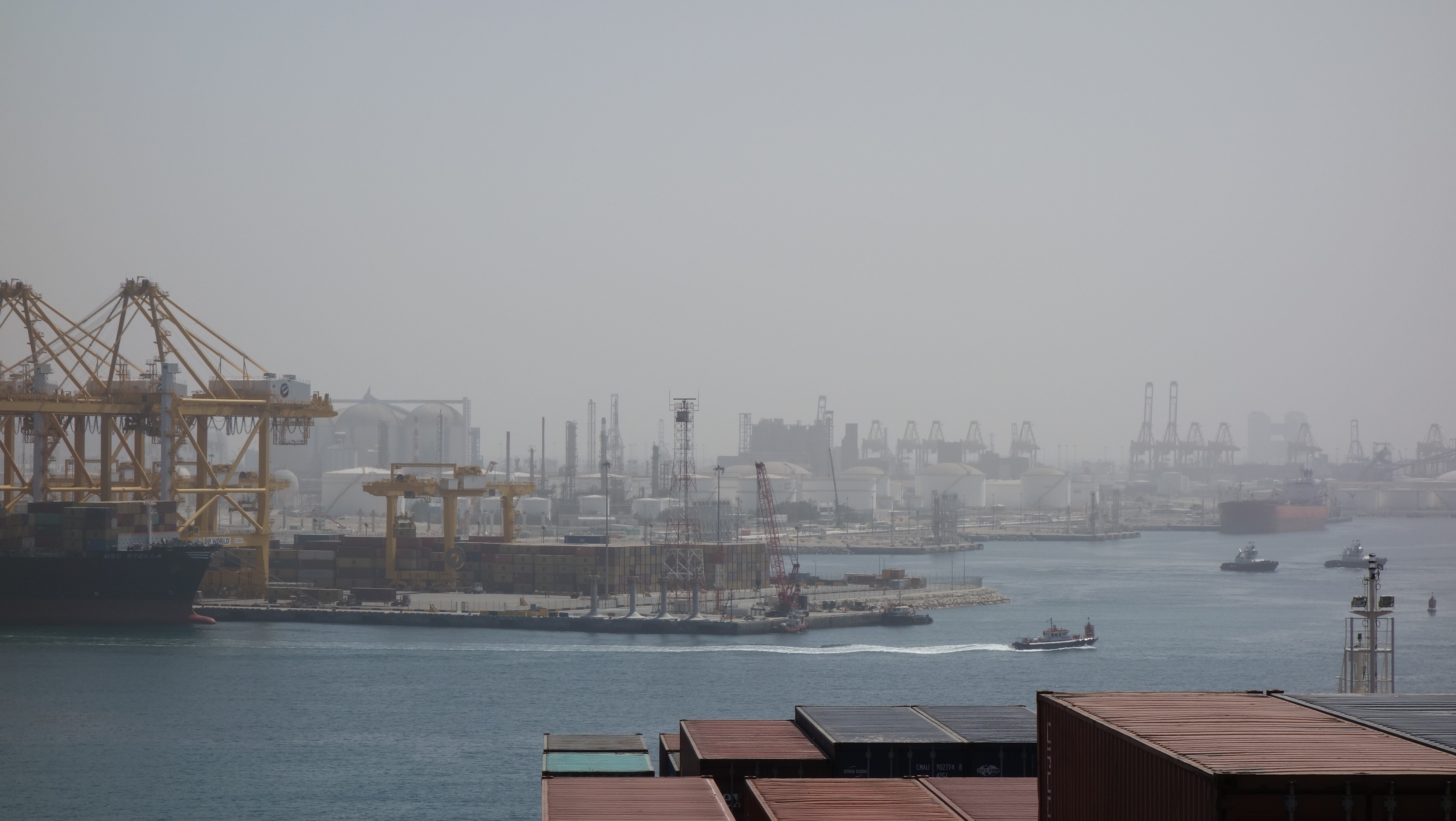
At last when the pilot boat Murshid approaches at 11.35, a moustachioed south Asian pilot comes aboard and promptly informs the captain that his shift ends at 12.00 and he will soon be replaced.  He leads us through into the channel, marked by buoys on both sides, and looking altogether too narrow.  Even at not too far a distance from the port, it is far too hazy to see the land.  The new pilot is a Yemeni captain, lean and wiry and gregarious, and his name is Mr Adly.   We are led through the latter part of the channel and when the haze at last subsides, there is the industrial dystopia that is Jabal Ali, with its refinery and aluminium smelter and power plant and bulk goods terminal and ro-ro terminal and grain silos, and multiple container terminals.   And the Megamax reclamation project on the outer edges of it, which the 2012 Admiralty chart speaks of being under construction and which is still in the same state of dishevelment today.  And on the way, you can also see the reclaimed Palm Jabal Ali, again with no construction activity visible on it, and the entirety of the feeling of movement and bustle coming from the port and the free zone beyond it.  And it is free: free of taxes, regulation, but perhaps most importantly of scrutiny.  The security sea and its cloak of invisibility cover the ports as well.

DSC00164

Security fence separating the ship’s berth from the port proper

This must be one of the most secure ports I have yet seen.  Even the ship berths are separated from the port by security fences, and in this gridded, demarcated, hot, hazy, dusty space, moving from one grid square to another requires all sorts of security checks.  Leaving the port to come back (for the crew or the passengers) is not really possible, as it takes an hour to drive to the customs and immigration point, and another hour to be processed there. But even more laboriously, the issuance of port passes is what takes a great deal of time and effort: you apparently need two photographs and to fill out a form and who knows what else.

DSC00118

Jabal Ali “Free Zone” in the haze

This is the function of the port away from the city.  Allan Sekula writes that “Harbors are now less havens (as they were for the Dutch) than accelerated turning-basins for supertankers and container ships.” But here, in these combined free-zone/ports which are now so de rigeur in every state and city-state that wants to become a Dubai or Singapore, they are more than that: they are factories. Literally.  There is –aside from the aluminium smelter and the refinery- a Timberland factory here.  And god knows what else.  This port is also where the US Navy ships come to rest and resuscitate and also there are warehouses somewhere in this vast land of tankers, cranes and metal girders that store the US logistics goods being deployed or drawn down from Afghanistan.  This vast area is part of the security sea, inaccessible, even invisible from the landside, lain out to see for everyone coming from the ships, but then the ships are part of this industrial landscape themselves.
DSC00143

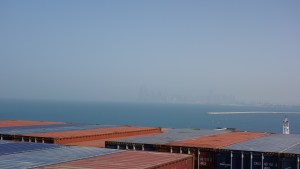
Dubai Marina in the haze

Not too far away from here are the vast towers of the Dubai Marina, clustered together in the haze.  I am sure that from those windows facing south people in those towers can see the port; but the port is far enough away that the humans are not seen; that the turning of the containerships and the movement of cranes becomes the beautiful ballet of growth and prosperity, and behind those windows people probably think more about the “wisdom and foresight” of the shuyukh that run these emirates and whose parastatal organisations found and manage and profit from and within these dystopias, and less about the constraints of capital, the abundance of labour, and the endless availability of seas to be reclaimed.


After arrival

It is a very odd thing taking the Metro going through the length of Dubai, and then arriving in Union Square where the middle class and clerical migrant workers pour out into the night in what is a festive beautiful twilight that can be happening anywhere in one of those “world cities” between the Tropics of Cancer and Capricorn (the latitude only mentioned because of the balminess of February) which consume fuel, goods, and labour from all over the world.

Getting out of the port itself was an experience.  We arrived in the immigration and customs building where two locals in no hurry at all were processing endless queues of sailors represented by their shipping agents or not.  Our shipping agent turned out to be a native of Mumbai who works for Rais Hassan Sa’adi in whose offices I had in September interviewed an old British colonial stalwart who had been a shipping agent in these parts for more than 50 years. And the other shipping agents all bore familiar names too: Kanoo for example or Khafji.  But of course others too, having to do with Maersk and Han Jin and Evergreen.  The Corte Real’s 4th engineer who needed to see a doctor and who had gotten off the ship an hour or so before me was still waiting in the queue.  I was the only woman in there, and naturally was called up to be helped ahead of everyone else waiting.  No one batted an eyelash, whether because of manly gallantry or me being a nuisance that needed getting rid of.  No one also knew what to do with me, including the shipping agent.  They had to struggle with the idea that I had a passport but not a seaman’s pass.  Or that I wanted to leave the premises of the port and not come back in. In the end I got the stamp and left (after a bit of banter with the immigration guy who turned out to be of Iranian descent from several generations back).  The exit from the port itself reminded me of Allan Sekula’s Forgotten Spaces, with the endless queues of trucks waiting to leave the port of Los Angeles or Long Beach (can’t remember which) and there being something about how no one really cared about the time these workers lost.  Much the same here: endless numbers of seamen in the immigration room being served at snail speed (where the airport immigration –and especially for European passengers- is a model of efficiency).  So, time is measured and priced differently according to the passport you carry and the social class you wear on your body.

Posted in 2015 Trip, capital accumulation, infrastructure, labour, logistics, Middle East, political economy, ports, transport, Travels | Leave a comment